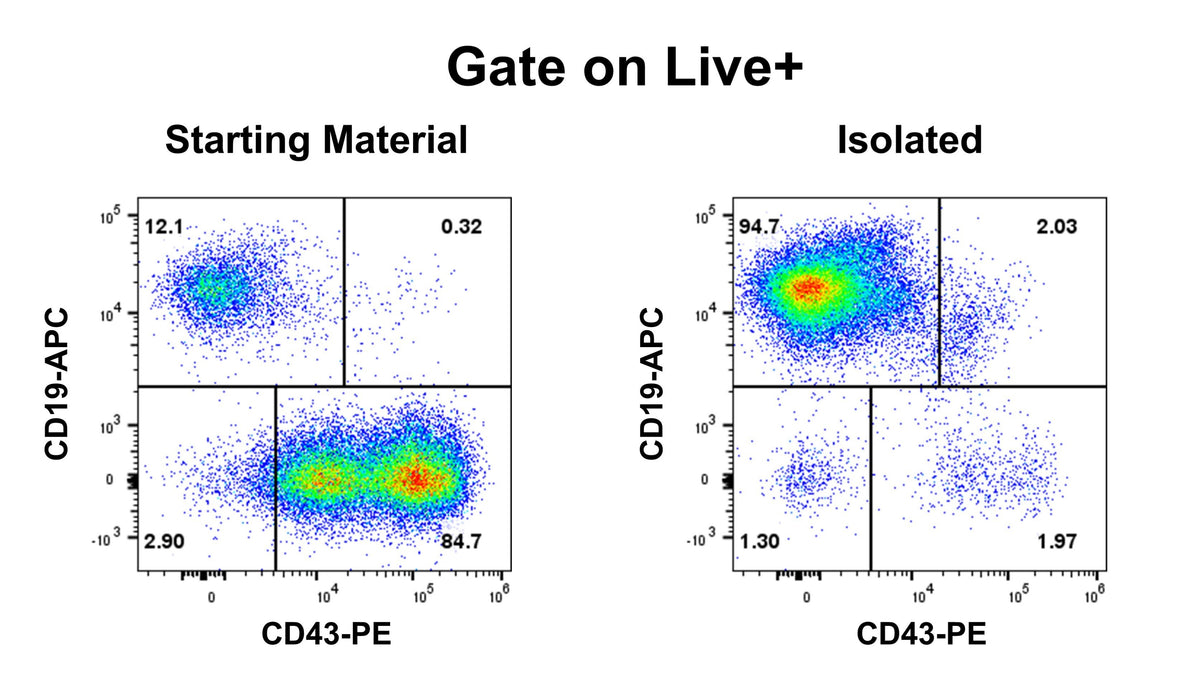
Human Pan B cells were enriched from peripheral blood mononuclear cells (PBMCs). After sorting, the cells were stained with CD19-APC (Clone: HIB19) and CD43-PE (Clone: CD43-10G7) fluorescent antibodies, and live cells (Live⁺) were gated for analysis to determine the proportion of Pan B cells in the sorted fraction. Flow cytometry results showed that the purity of CD19⁺ cells (including both CD43⁺ and CD43⁻) after sorting was 96.73%.
Human Pan B Cell Isolation Kit (Column-Based)
Human Pan B Cell Isolation Kit (Column-Based)
Price:
Regular price
$1,170 USD
Regular price
Sale price
$1,170 USD
Unit price
per
For shipping services or bulk orders, you may request a quotation.
Secure checkout with

View full details
Product Details
Product Details
Product Specification
| Format |
1 mL Human Pan B Cell Biotin Antibody Cocktail; 1.25 mL Streptavidin Beads; All components are stored in a buffer containing 0.05% sodium azide. |
| Capacity | Suitable for a total cell count of 1×10⁹, allowing up to 100 sorting runs. |
| Principle of Separation | This kit employs a column-based negative selection method to isolate Human Pan B cells from human peripheral blood mononuclear cells (PBMCs). In this negative selection process, non-Human Pan B cells are labeled with biotin-conjugated antibodies, and the cells are then incubated with streptavidin-nanomagnetic beads. As a result, the non-target cells become bound to the beads via the antibody complex, while the target Human Pan B cells remain unlabeled. The cell suspension is subsequently transferred to a separation column; under the influence of a magnetic field, the magnetically labeled non-target cells are retained in the column, whereas the unlabeled Human Pan B cells elute by gravity into a collection tube. The resulting supernatant represents the enriched fraction of Human Pan B cells after removal of the non-target cells. |
| Applications in cell sorting | Pan B cells in their native, unmanipulated state can be isolated from human PBMCs and used for a variety of downstream functional assays. |
| Reactivity | Human |
| Magnetic Bead Size | 20 nm |
| Separation Method | Column-Based |
| Selection Strategy | Negative Selection |
| Stability & Storage | Store protected from light at 2–8°C; do not freeze. |
Background
Human Pan B cells are a core cell population in the human humoral immune response. They can differentiate into specific antibodies and mediate the formation of immunological memory, serving as an important component of the body's adaptive immune system. They are extensively involved in immune defense, immune regulation, and the development of various immune-related diseases. The Human Pan B Cell Negative Selection Kit is developed based on negative selection technology using immunomagnetic beads, which avoids the antibody-binding labeling defects inherent in positive selection. It can specifically remove various non-target cells, including T cells, NK cells, monocytes, granulocytes, platelets, and red blood cells. The antibody components of this separation system do not contain CD43, effectively preventing the loss of CD43-positive B cell subsets and fully preserving diverse B cell lineages such as naïve B cells, memory B cells, and plasma cells. The resulting high-purity Pan B cells are free from exogenous labels and remain in their native state, maximizing the preservation of their biological potential for proliferation, differentiation, and antibody secretion. This makes them highly compatible with various in vitro functional assays and represents the current mainstream tool for isolating and purifying human Pan B cells in the research field.
Protocol
Note: This kit does not include the separation buffer; it must be provided separately. The corresponding Stater product number is S0D3018.
Taking the L Separation Column as an example
Steps |
Operating instructions |
Dosage and time |
|
Cell processing and labeling |
1 |
Isolate PBMCs from peripheral blood by density gradient centrifugation using lymphocyte separation medium, or directly thaw cryopreserved PBMCs, and perform cell counting; Note:It is recommended to count cells after staining with AO/PI; PBMCs can be centrifuged at 400 g for 7 minutes; |
Sample preparation |
2 |
Resuspend 1×10⁷cells in 100 μL of MagSep Separation Buffer; Note:Adjust reagent volumes proportionally based on sample volume; retain a pre-sorting sample to determine the proportion of Human Pan B cells; |
1×10⁷cells/100 μL |
|
3 |
Add 10 μL of Human Pan B Cell Biotin Antibody Cocktail to the sample and gently mix; Note:In this step, the mixture can be gently mixed by pipetting up and down 2–3 times. |
10 μL/100 μL |
|
4 |
Incubate the antibodies and cells in the cocktail at room temperature for 10 minutes. |
Incubate at room temperature for 10 minutes. |
|
5 |
After antibody incubation, add twice the volume of MagSep Separation Buffer, centrifuge at 400 g for 7 minutes, and then carefully discard the supernatant. Resuspend 1×10⁷ in 100 μL of MagSep Separation Buffer.Cells, proceed to the next step; |
Add a buffer volume twice the size to wash the antibody. |
|
6 |
Mix wellStreptavidin Beads, add 12.5 μLStreptavidin BeadsTo the sample; |
12.5 μL/100 μL |
|
7 |
Gently mix the magnetic beads and cells, and incubate at room temperature for 8 minutes. Note:In this step, the mixture can be gently mixed by pipetting up and down 2–3 times. During magnetic bead incubation, if cells settle, gently mix again at the 4-minute mark. |
Incubate at room temperature for 8 minutes. |
|
Cell sorting. |
8 |
In the column separation magnet,install the L Separation Column.Add 3 mL of MagSep Separation Buffer to rinse the separation column. |
Rinse the separation column. |
9 |
Add the cells to the separation column and collect the target cells using a collection tube. Note:The cell volume should be at least 500 μL; if insufficient, add MagSep Separation Buffer to make up the volume. The cells that drip down under gravity are the target cells. |
Collect the target cells. |
|
10 |
Add 3 mL of MagSep Separation Buffer and collect the target cells. Note:This step elutes the unlabeled target cells from the separation column, increasing the yield. |
Collect the target cells. |
|
|
Notes:1. Pay attention to the maximum capacity of the separation column.The S Separation Column can handle a maximum of1×10⁷cells;the L Separation Column can handle a maximum of1×10⁸cells. 2. If the viability of the sample is low, it is recommended to use a dead cell removal kit (Dead Cell Removal Set, (RUO)#S0K0009) to remove dead cells. | |||
Picture
Picture
Validation Data