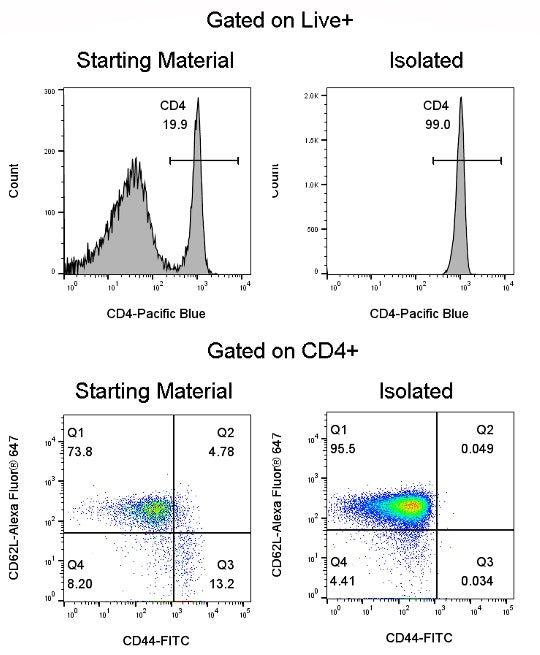
Naïve CD4 T cells were enriched from mouse splenocytes using a column-free Naïve CD4 T cell isolation kit. Cells were stained with CD4-Pacific Blue, CD44-FITC, and CD62L-Alexa Fluor® 647 fluorescent antibodies, and live cells (Live+) were gated for analysis to determine the proportion of Naïve CD4 T cells (CD4+CD44-CD62L+) in the sorted fraction. Flow cytometry results showed that the purity of the sorted Naïve CD4 T cells was 95.5%.
Mouse Naïve CD4 T Cell Isolation Kit (Column-Free)
Mouse Naïve CD4 T Cell Isolation Kit (Column-Free)
Price:
Regular price
$800 USD
Regular price
Sale price
$800 USD
Unit price
per
For shipping services or bulk orders, you may request a quotation.
Secure checkout with

View full details
Product Details
Product Details
Product Specification
| Format |
1 mL Mouse Naïve CD4 T Cell Biotin-Antibody Cocktail 1mL Streptavidin Beads |
| Capacity | Suitable for a total cell count of 1×10⁹, and can perform up to 100 sorting runs. |
| Principle of Separation | In this negative selection process, non-target cells are labeled with biotin-conjugated antibodies, and the cells are then incubated with streptavidin-nanomagnetic beads. The non-target cells are marked by the antibody‑bead complex, while the targetNaïve CD4 Tcells remain unlabeled. Subsequently, the cell suspension is transferred to a polystyrene tube and placed within the sorter's magnetic field. Under the influence of the magnetic field, the magnetically labeled non-target cells adhere to the tube wall, whereas the unlabeledNaïve CD4 Tcells remain in the supernatant. This supernatant constitutes theNaïve CD4 Tcell-enriched fraction after removal of the non-target cells.Naïve CD4 Tcell fraction. |
| Applications in cell sorting | Naïve CD4 T cells in their native, unmanipulated state are sorted from a single-cell suspension of fresh mouse spleen and can be used for a variety of downstream functional assays. |
| Reactivity | Mouse |
| Magnetic Bead Size | 150 nm |
| Separation Method | Column-Free |
| Selection Strategy | Negative Selection |
| Stability & Storage | Store protected from light at 2–8°C; do not freeze. |
Background
Mouse naive CD4⁺ T cells (initial CD4-positive T lymphocytes) are mature CD4⁺ T cells that have not yet encountered specific antigens and have not undergone activation, proliferation, or differentiation. By flow cytometry, their canonical phenotype is defined as CD4⁺CD44⁻CD62L⁺. CD62L (L-selectin) is a key receptor for lymph node homing, highly expressed on quiescent naive T cells; upon cell activation or exposure to mechanical or temperature stress, it is rapidly cleaved and shed by the ADAM17 metalloprotease. CD44 is an adhesion molecule characteristic of activated and memory T cells, and is barely expressed on resting naive CD4⁺ T cells. Based on these features, naive T cells (CD44⁻CD62L⁺), central memory T cells (CD44⁺CD62L⁺), and effector memory T cells (CD44⁺CD62L⁻) can be precisely distinguished. Cell purity is a critical prerequisite for functional assays involving naive CD4⁺ T cells. This kit employs immunomagnetic negative selection: biotinylated antibodies specifically label non-target cells, including B cells, CD8⁺ T cells, myeloid cells, and activated/memory T cells, which are then selectively removed using streptavidin-coated magnetic beads. Throughout the process, the target naive CD4⁺ T cells remain unlabeled and untouched, thereby maximizing preservation of their quiescent phenotype, viability, and differentiation potential. This approach efficiently yields high-purity, highly viable, unactivated "untouched" naive CD4⁺ T cells, suitable for various experimental applications such as in vitro polarization, cell activation assays, and studies of immune mechanisms.
Components
Protocol
NoteThis kit does not include sorting buffer; please provide it separately. The corresponding Stater product number is:S0D3018.
Steps |
Operating Instructions |
Dosage and timing |
1 |
The spleen was harvested from mice, passed through a 40-μm sterile filter to prepare a single-cell suspension, and subjected to red blood cell lysis using Red Blood Cell Lysis Buffer (without fixative, 1X) (Cat: S0D9002) prior to cell counting. Note:Throughout the grinding, filtration, and washing steps, use pre-cooled reagents and handle samples gently; avoid vigorous vortexing. It is recommended to count cells after staining with AO/PI. For splenic cells, centrifuge at 400 g for 7 minutes. |
Prepare the sample |
2 |
Using pre-cooled 100 μLMagSep Separation BufferResuspend to 1 × 10⁷cell; Note:Adjust the reagents proportionally based on the sample volume; retain a pre-sorting sample to test the Naïve CD4 ratio. |
1×10⁷cells/100 μL |
3 |
Add 10 μL of Mouse Naïve CD4 T cell Biotin Antibody Cocktail to the sample and gently mix. Note:For this step, gently pipette up and down 2–3 times to mix. |
10 μL /100 μL |
4 |
Incubate the antibodies in the cocktail with the cells at 2–8°C for 10 minutes. |
Incubate at 2–8°C for 10 minutes. |
5 |
Shake the Streptavidin beads for 5–30 seconds to mix thoroughly. |
Mix for 5–30 seconds. |
6 |
Add 10 μL of Streptavidin beads to the sample. |
10 μL/100 μL |
7 |
Gently mix the magnetic beads and cells, and incubate at 2–8°C for 5 minutes. Note:In this step, the mixture can be gently pipetted 2-3 times to mix thoroughly. In this step, the magnetic beads may settle at the bottom. You can gently tap the tube to mix them after 2.5 minutes. |
Incubate at 2-8℃ for 5 minutes. |
8 |
Add pre-cooledMagSep Separation Bufferto the sample and immediately place it on the magnetic stand to prevent the magnetic beads from settling heavily at the bottom. |
Adjust the total volume to 2.5 mL (for a 5 mL flow cytometry tube). Adjust the total volume to 7.5 mL (for a 15 mL centrifuge tube). |
9 |
Place the sample on the magnetic stand to allow the magnetic beads to adhere to the tube wall. |
Single-well magnetic rack adsorption (3 min). Multi-well magnetic rack adsorption (5 min). |
10 |
Tilt the magnetic rack and pour the sample into a new collection tube to collect the sample. Note: The sorted cells can be centrifuged at 400g for 7 minutes for subsequent culture and analysis. |
Cell sorting successful. |
|
Note:1. 0.1-1 × 10⁸Cells (0.1–1 mL) are recommended to be used with a 5 mL single-hole magnetic stirrer bar.Starter EasyIso Separator) The total adsorption volume is 2.5 mL; 2-5 ×10⁸For cells (2–5 mL), it is recommended to use a 15 mL multi-position magnetic stirrer.Starter EasyEights EasyIso Separator) The total adsorption volume is 7.5 mL; 2. Throughout the entire process, carefully control the temperature: keep the sorting buffer pre-cooled at all times, and proceed immediately with subsequent experiments after sorting. For flow cytometry, perform staining at 2–8°C in the dark, avoiding prolonged exposure to room temperature. | ||
Picture
Picture
Validation Data