2μg (R: reducing condition, N: non-reducing condition).
PCSK9 His Tag(D374Y) Protein, Human
PCSK9 His Tag(D374Y) Protein, Human
Price:
Regular price
$1,085 USD
Regular price
Sale price
$1,085 USD
Unit price
per
For shipping services or bulk orders, you may request a quotation.
Secure checkout with

View full details
Product Details
Product Details
Product Specification
| Species | Human |
| Synonyms | PCSK9, FH3, HCHOLA3, LDLCQ1, NARC1, PC9 |
| Accession | Q8NBP7 |
| Amino Acid Sequence | Gln 31 - Gln 692 with His Tag at the C-Terminus |
| Expression System | HEK293 |
| Molecular Weight | 15-25kDa&55-70kDa (Reducing) |
| Purity | >95% by SDS-PAGE&HPLC |
| Conjugation | Unconjugated |
| Physical Appearance | Lyophilized Powder |
| Storage Buffer | PBS, pH7.4, 5% trehalose |
| Reconstitution | Reconstitute at 0.1-1 mg/ml according to the size in ultrapure water after rapid centrifugation. |
| Stability & Storage |
· 12 months from date of receipt, lyophilized powder stored at -20 to -80℃. · 3 months, -20 to -80℃ under sterile conditions after reconstitution. · 1 week, 2 to 8℃ under sterile conditions after reconstitution. · Please avoid repeated freeze-thaw cycles. |
| Reference | 1. Zhao, M., et al. (2025). PCSK9 with a gain of function D374Y mutation aggravates atherosclerosis by inhibiting PPARα expression. Scientific Reports, 15, 6941. |
Background
The PCSK9 (Proprotein Convertase Subtilisin/Kexin type 9) D374Y mutation is one of the most potent gain-of-function (GOF) mutations known, strongly associated with severe familial hypercholesterolemia and premature cardiovascular disease.
This mutation replaces aspartic acid (D) with tyrosine (Y) at position 374 in the protein sequence. This subtle structural change dramatically increases the binding affinity of PCSK9 for the low-density lipoprotein receptor (LDLR). Biosensor studies show that at neutral pH, the D374Y mutant binds to the LDLR approximately 25 times more tightly than wild-type PCSK9. The mechanism involves Y374 forming a more optimized hydrogen bond network, greatly stabilizing the PCSK9-LDLR complex, with a dissociation constant (Kd) as low as 1 nM at neutral pH.
Functionally, PCSK9 primarily guides LDLRs to lysosomal degradation, reducing the number of LDLRs on the liver cell surface and impairing the clearance of LDL cholesterol from the blood. By binding more strongly to the LDLR, the D374Y mutant more effectively blocks receptor recycling, leading to enhanced LDLR degradation and abnormally high plasma LDL-C levels.
Picture
Picture
SDS-PAGE
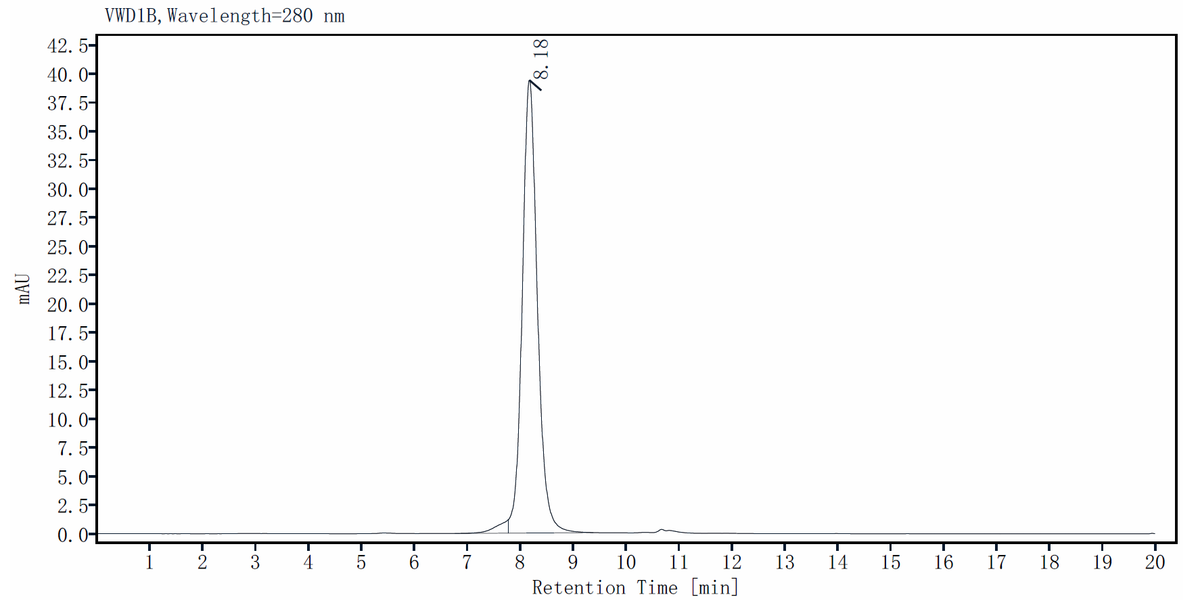
SEC-HPLC
The purity of PCSK9 His Tag(D374Y) Protein, Human is more than 95% determined by SEC-HPLC.
ELISA
Immobilized Human LDL R, Fc Tag at 2μg/mL (100 μL/well) can bind PCSK9 His Tag(D374Y) Protein, Human (Cat.No.UA016063) with a linear range of 38-76 ng/mL.