| Usage |
Required equipment and reagents:
1 、 Microplate reader ( wavelength 450nm Optical filter )
2 、 37°C Incubator ( Cell use is not recommended CO2 Incubator )
3 、 Automatic plate washer or multi-channel pipette /5ml Dropper ( For manual plate washing )
4 、 Precision single-pass (0.5-10μL, 5-50μL, 20-200μL, 200-1000μL) And multi-channel pipettes ( Pipette needs to be calibrated before use ) 。
5 、 Sterile EP Tubes and disposable tips
6 、 Absorbent paper and sample loading tank
7 、 Deionized or distilled water
Sample collection and storage:
1 Serum,
Whole Blood Samples Hold at Room Temperature 2 Hour or 2-8°C Overnight. 1000×g Centrifugation 20 Minutes, take the supernatant. Can be tested immediately, or frozen in packages according to one-time usage -20°C Or -80°C 。
2 Plasma,
Anticoagulants recommended EDTA-Na2/K2 , after sample collection 30 Within minutes 2-8°C , 1000×g Centrifugation 15 Minutes, take the supernatant. Can be tested immediately, or frozen in packages according to one-time usage -20°C Or -80°C 。 Please refer to the sample preparation guidelines for the use and selection of other anticoagulants.
3 Tissue samples,
Tissue samples are generally made into tissue homogenates, and the processing methods are as follows:
( 1 ) Place the target tissue on ice and use pre-cooled PBS Buffer (0.01M , pH=7.4) Wash to remove residual blood, weigh and use later.
( 2 ) The tissue homogenate was triturated with the lysate on ice. The volume of lysate added depends on the weight of the tissue. Generally, each 1g Use of tissue fragments 9ml Lysate. It is also recommended to add protease inhibitors to the lysate, such as 1mM PMSF 。
( 3 ) Can be reused for ultrasonic crushing or repeated freeze-thaw for further treatment ( In the process of ultrasonic crushing, ice bath is needed to cool down; Repeated freeze-thaw method can be repeated 2 Time ) 。
( 4 ) The prepared homogenate was mixed in 5000×g Centrifugation 5 Minutes, retain the supernatant for detection. Or frozen in packages according to one-time usage -20°C Or -80°C 。
( 5 ) According to the experimental needs, the total protein concentration of tissue homogenate samples can be measured first , To facilitate data analysis, recommended BCA Law. The total protein concentration is generally adjusted to 1-3mg/ml Used for ELISA Detection. Certain tissue samples, such as liver, kidney, and pancreas, contain higher concentrations of endogenous peroxygenase , When the sample concentration is high, it will react with the chromogenic substrate, resulting in false positives. Can try to use 1%H2O2 Inactivation 15min Re-test.
Note: Commonly used lysate PBS Buffer, or use moderate strength RIPA Lysate. Using RIPA When lysing solution, PH The value needs to be adjusted to PH7.3 , avoid using containing NP-40 , Triton X-100 And DTT The components will seriously inhibit the work of the kit. Recommended use 50mM Tris+0.9%NaCL+0.1% SDS,PH 7.3 , can be prepared by yourself or contact us to purchase.
4 Cell culture supernatant,
Collecting the supernatant, 2-8°C , 2500rpm Centrifugation 5min , the clarified cell culture supernatant was collected. Use immediately for testing, or dispense in a single-use amount -80°C Freeze for later use.
5 Cell lysate,
( 1 ) Collection and lysis of suspended cells: 2-8°C , 2500rpm Centrifugation 5min , collecting the cells. Add the pre-cooled PBS Gently mix and clean, 2-8°C , 2500rpm Centrifugation 5min , collecting the cells. join 0.5-1ml Cell lysate and appropriate amount of protease inhibitor ( Such as PMSF , working concentration 1mmol/L) , placed on ice, lysed 30min-1h , Or cooperate with ultrasonic crushing.
( 2 ) Collection and lysis of adherent cells: the supernatant was aspirated and pre-cooled PBS Wash three times. join 0.5-1ml Cell lysate and appropriate amount of protease inhibitor ( Such as PMSF , working concentration 1mmol/L) , gently scrape off the adherent cells with a cell scraper. The cell suspension was transferred into a centrifuge tube, placed on ice, and lysed 30min-1h , or cooperate with ultrasonic crushing.
( 3 ) During the cell lysis process, the centrifuge tube can be blown with the gun tip or intermittently shaken to fully lyse the protein , Appears slimy yes DNA , can be disrupted using ultrasonic DNA 。 ( Or with ultrasound 3-5mm Probe, Power 150-300W, Sonicated samples on ice, working 1-2 Seconds, stop 30 Seconds, 3~5 A cycle. )
( 4 ) Lysis or ultrasonic disruption is completed, 2-8°C , 10000rpm Centrifugation 10min , the supernatant is moved into EP In tubes, immediately used for testing, or dispensed into one-time usage -80°C Freeze for later use.
Note: The precautions are the same as for tissue samples.
6 Other biological samples
2-8°C , 1000×g Centrifuge samples 20 Minutes. Collect the supernatant for immediate detection, or press The primary usage amount is divided into -80°C Freeze for later use.
Other precautions for samples:
1 The test tube for collecting blood should be a disposable endotoxin-free test tube. Avoid the use of hemolyzed, hyperlipidemic samples.
2 Optimal storage conditions of samples: 2-8°C Storage should be less than 5 Day, -20°C Should not exceed 6 Months, -80°C Should not exceed 2 Years, it should be stored in liquid nitrogen beyond the above time. In order to reduce ice crystals when frozen specimens are thawed (0°C) Damage to the sample shall be adopted 15-25°C Quickly melt in water bath, centrifuge to remove the precipitate after melting, mix well and use for detection.
3 The detection range of the kit is not equivalent to the concentration range of the substance to be tested in the sample. If the concentration of the test substance in the sample is too high or too low, please dilute or concentrate the sample appropriately.
4 If the sample tested is special and there is no reference data, it is recommended to do pre-experiments to verify its effectiveness.
5 , the recombinant protein may not match the capture or detection antibody in the kit and cannot be detected.
Recommended sample dilution protocol:
Serum / Matrix components in plasma can affect test results and need to be diluted with sample diluent at least 2 Times (1/2) !
If your model group sample requires a different dilution ratio Please refer to the general dilution protocol below ( This protocol is a dilution protocol that does not set up double wells for testing. When you need to set up a double hole, please add the sample and diluent volume x Number of complex holes ) :
Dilution 2 Times (1/2) : One-step dilution. Take 60ul Sample addition 60ul In the sample dilution, mix gently.
Dilution 5 Times (1/5) : One-step dilution. Take 24ul Sample addition 96ul In the sample dilution, mix gently.
Dilution 10 Times (1/10) : One-step dilution. Take 12ul Sample addition 108ul In the sample dilution, mix gently.
Dilution 20 Times (1/20) : One-step dilution. Take 6ul Sample addition 114ul In the sample dilution, mix gently.
Dilution 50 Times (1/50) : One-step dilution. Take 3ul Samples and 47ul Normal saline ( I.e 0.9% Sodium chloride ) join 100ul In the sample dilution, mix gently.
Dilution 100 Times (1/100) : One-step dilution. Take 3ul Samples and 177ul Normal saline addition 120ul In the sample dilution, mix gently.
Dilution 1000 Times (1/1000) : Two-step dilution, you can dilute first 50 Times ( This step is entirely diluted with saline ) , re-dilution 20 Times. Gently mix well.
Dilution 10000 Times (1/10000) : Two-step dilution, you can dilute first 100 Times ( This step is entirely diluted with saline ) , re-dilution 100 Times. Gently mix well.
Dilution 100000 Times (1/100000) : Three-step dilution, you can dilute first 50 Times, re-dilute 20 Times ( The first two steps are all diluted with normal saline ) , final dilution 100 Times. Gently mix well.
Note: The amount of liquid taken during each dilution step is not less than 3ul , the dilution factor is not more than 100 Times. Each step of dilution should be mixed evenly to avoid foaming.
Pre-test reagent preparation:
ahead of schedule 20 Minutes remove the kit from the refrigerator and equilibrate to room temperature (18-25°C) 。 If the kit needs to be used multiple times, please take out only the enzyme-labeled slats and standards required for this experiment, and store the remaining enzyme-labeled slats and standards according to the specified conditions.
1 Lotion, :
With deionized water or distilled water ( The recommended resistivity is 18MΩ Ultrapure water ) Will 30ml Concentrated wash (48T For 15ml) Diluted to 750ml(48T For 375ml) And mix well. Or according to the requirements of the experiment, take an appropriate amount of concentrated washing liquid and dilute to 25 Double volume and mix well, return the unused solution 2-8°C 。
If crystals are formed in the concentrated washing liquid, they may be 40°C Heating in water bath ( The heating temperature should not exceed 50°C) , until the crystals are completely dissolved, mix well and use.
The prepared lotion is best used on the same day. If you can't use it up, you can keep it in 2-8°C , not more than 48 Hours.
2 Standard, :
( 1 ) Lyophilized standards were managed in 10000×g Centrifugation 1 Minutes. Marked as Zero tube.
( 2 ) take 1ml Add the sample diluent to the lyophilized standard tube, screw the tube cap tightly, and let it stand at room temperature 2 Minutes, upside down several times and gently mix well ( Or join 1mL Sample dilution, stand 1-2 After minutes, mix well with a low speed vortex instrument 3-5 second ) 。 1000×g Low speed centrifugation 1 Minutes, collect the liquid to the bottom of the tube.
( 3 ) Gradient dilution: separately 7 1 EP Tubes, respectively labeled as 1/2 、 1/4 、 1/8 、 1/16 、 1/32 、 1/64 And blank 。 First in each EP Add separately into the tube 0.3ml Sample dilution of. Take again 0.3ml Zero tube Standard solution is added to 1/2 Tube, mix thoroughly. Take again 0.3ml 1/2 Tube standard solution to 1/4 Tube, mix thoroughly. Take again 0.3ml 1/4 Tube standard solution to 1/8 Tube, mix thoroughly, and so on. attention Blank EP Only the sample dilution is in the tube. At this point, from Zero tube Tube to blank Take care of this 8 1 EP The concentration of the standard in the tube is 1000pg/ml, 500pg/ml, 250pg/ml, 125pg/ml, 62.5pg/ml, 31.25pg/ml, 15.625pg/ml, 0pg/ml 。
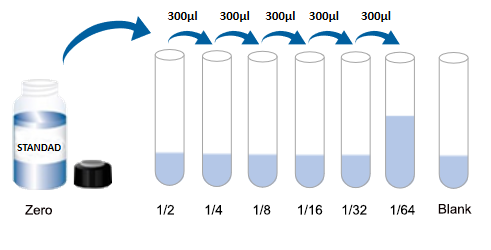
Note : Dissolved tube zero standard, please store in 2-8°C , and in 12 Use within hours. For other diluted gradient standard working solution, please refer to 2 Use within hours.
3 Biotin, - Antibody working solution:
Pre-experiment 30 Ready within minutes, ready-to-use, not suitable for long-term storage.
( 1 ) Calculate the total volume of working fluid required: 100ul/ Hole × Number of holes. ( It is best to prepare more than the total volume 100ul-200ul Amount of )
( 2 ) 1000×g Low speed centrifugation 1 Minutes, the biotin will be concentrated - The antibody was collected to the bottom of the tube.
( 3 ) Press with antibody dilution 1/100 Dilute concentrated biotin in proportion of - Antibody, mix well. ( If will 10ul Concentrated biotin - Antibody addition 990ul In antibody dilution )
4 、 HRP- Streptavidin (SABC) Working fluid:
Pre-experiment 30 Ready within minutes, ready-to-use, not suitable for long-term storage.
( 1 ) Calculate the total volume of working fluid required: 极速赛车168开奖网
|

