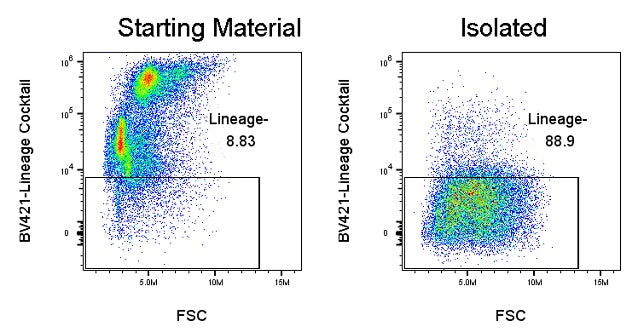
Lineage-negative (Lin⁻) stem/progenitor cells were enriched from mouse bone marrow cells. Cells were stained with the Lineage Cocktail-BV421 fluorescent antibodies (anti-mouse CD3, clone 17A2; anti-mouse Ly-6G/Ly-6C, clone RB6-8C5; anti-mouse CD11b, clone M1/70; anti-mouse CD45R/B220, clone RA3-6B2; anti-mouse TER-119/erythroid cells, clone Ter-119), and live cells (Live⁺) were gated for analysis to determine the proportion of Lin⁻ stem/progenitor cells in the sorted fraction. Flow cytometry results indicated that the purity of this sorting was 88.9%.
Mouse Lineage Cell Depletion Kit (Column-Based)
Mouse Lineage Cell Depletion Kit (Column-Based)
Price:
Regular price
$920 USD
Regular price
Sale price
$920 USD
Unit price
per
For shipping services or bulk orders, you may request a quotation.
Secure checkout with

View full details
Product Details
Product Details
Product Specification
| Format |
1 mL Mouse Lineage Cell Depletion Biotin-Antibody Cocktail 1 mL Streptavidin NanoBeads |
| Capacity | Suitable for a total cell count of 1×10⁹, allowing up to 100 sorting runs. |
| Principle of Separation | This kit employs a column-based negative selection method to isolate lineage-negative (Lin⁻) stem cells/progenitor cells from mouse bone marrow. In this negative selection process, mature lineage cells are labeled with biotin-conjugated antibodies, and the cells are then incubated with streptavidin-nanomagnetic beads. Non-target cells are labeled via antibody-bead complexes, while the target lineage-negative (Lin⁻) stem cell/progenitor cell population remains unlabeled. Subsequently, the cell suspension is loaded onto a separation column; under the influence of a magnetic field, the magnetically labeled non-target cells are retained in the column, whereas the unlabeled lineage-negative (Lin⁻) stem cells/progenitor cells elute into the collection tube under gravity. The resulting supernatant consists of untouched cells that remain unmarked by magnetic beads and retain their native cellular activity. |
| Applications in cell sorting | Label-free, native lineage-negative (Lin⁻) stem/progenitor cells are sorted from fresh mouse bone marrow single-cell suspensions and can be used for a variety of downstream functional assays. |
| Reactivity | Mouse |
| Magnetic Bead Size | 20 nm |
| Separation Method | Column-Based |
| Selection Strategy | Negative Selection |
| Stability & Storage | Store protected from light at 2–8°C; do not freeze. |
Background
Lin⁻ cells are a population of primitive cells in mice that do not express any surface lineage markers characteristic of mature, terminally differentiated cells. They are predominantly found in bone marrow tissue, with smaller numbers present in hematopoietic tissues such as the spleen. This cell population primarily comprises hematopoietic stem cells (HSCs) and hematopoietic progenitor cells (HSPCs), representing undifferentiated cells within the hematopoietic system that possess self-renewal capacity and multipotential differentiation potential, distinct from fully committed, functionally specialized mature hematopoietic cells. The purified primitive cell population obtained by excluding all mature hematopoietic lineages—such as T cells, B cells, monocytes/macrophages, granulocytes, and erythroid cells—serves as a foundational enriched group for isolating and studying hematopoietic stem and progenitor cells. Using immunomagnetic negative selection, a mixture of biotinylated lineage antibodies specifically labels all Lin⁺ mature hematopoietic cells, which are then selectively bound by streptavidin-coated magnetic beads. These labeled cells are retained via magnetic field adsorption, while the unlabeled Lin⁻ primitive stem and progenitor cells, unaffected by the magnetic field, pass through and are collected. A key advantage of this negative sorting technique is contact-free separation: the target cells remain unexposed to antibodies and magnetic beads, thereby avoiding surface antigen cross-linking, cell activation, or damage, thus preserving the stem cells' intrinsic stemness, viability, and differentiation potential to the greatest extent—superior to positive selection—and making it well-suited for demanding stem cell functional assays.
Protocol
Note: This kit does not include the separation buffer; it must be provided separately. The corresponding Stater product number is S0D3018.
Taking theL Separation Columnas an example,
the steps |
and operating instructions |
for dosage and timing are as follows: |
|
Cell processing and labeling |
1 |
Collect mouse bone marrow, prepare a single-cell suspension, and perform cell counting; Note:Mouse bone marrow must undergo red blood cell lysis using Red Blood Cell Lysis Buffer (without fixative, 1X) (Cat: S0D9002); it is recommended to count cells after staining with AO/PI; |
Sample preparation |
2 |
Resuspend 1 × 10⁷live cells in 100 μL of pre-cooledMagSep Separation Buffer(Cat: S0D3018); Note:Adjust reagent volumes proportionally according to sample volume; retain a pre-sorting sample to determine the Lin- cell percentage; |
1 × 10⁷cells/100 μL |
|
3 |
Add 10 μL of the Mouse Lineage Cell Depletion Biotin-Antibody Cocktail to the sample and gently mix. Note:In this step, the mixture can be gently mixed by pipetting up and down 2–3 times. |
10 μL/100 μL |
|
4 |
Incubate the antibodies and cells in the cocktail at 2–8°C for 10 minutes. |
Incubate at 2–8°C for 10 min. |
|
5 |
Add 10 times the cell volume of pre-cooledMagSep Separation BufferWash the cells, centrifuge at 400g for 7 minutes, discard the supernatant, and resuspend to the original volume. |
Centrifuge at 400g for 7 minutes. |
|
6 |
Mix the Streptavidin NanoBeads thoroughly, then add 10 μL of Streptavidin NanoBeads to the sample. |
10 μL/100 μL |
|
7 |
Gently mix the magnetic beads and cells, and incubate at 2–8°C for 5 minutes. Note:In this step, gently pipette up and down 2-3 times to mix thoroughly; |
Incubate at 2-8℃ for 5 min |
|
Cell sorting |
8 |
In the column-based magnetic separator, install the L Separation Column and add 3 mLMagSep Separation Bufferto rinse the separation column; |
Rinse the separation column |
9 |
Add the cells to the separation column and collect the target cells using a collection tube; Note:The cell volume should be at least 1 mL; if insufficient, useMagSep Separation Bufferto make up the volume; the cells that drip down under gravity are the target cells; |
Collect the target cells |
|
10 |
Add 3 mL ofMagSep Separation Bufferthree times, collecting the target cells each time; Note:This step elutes the unlabeled target cells from the separation column, increasing the yield. |
Collect the target cells |
|
|
Notes: 1. Pay attention to the maximum capacity of the separation column; the S Separation Column can handle up to 1×10⁷ labeled cells; the L Separation Column can handle up to 1×10⁸ labeled cells; 2. Throughout the entire process, pay close attention to temperature control; keep the sorting buffer pre-cooled at all times and avoid leaving it at room temperature for extended periods. | |||
Picture
Picture
Validation Data