WB result of Uteroglobin Recombinant Rabbit mAb
Primary antibody: Uteroglobin Recombinant Rabbit mAb at 1/1000 dilution
Lane 1: mouse lung lysate 20 µg
Secondary antibody: Goat Anti-rabbit IgG (H+L), HRP conjugated at 1/10000 dilution
Predicted MW: 11 kDa
Observed MW: 11 kDa
Uteroglobin Recombinant Rabbit mAb (S-6021)
Uteroglobin Recombinant Rabbit mAb (S-6021)
Price:
Regular price
$100 USD
Regular price
Sale price
$100 USD
Unit price
per
For shipping services or bulk orders, you may request a quotation.
Secure checkout with

View full details
Product Details
Product Details
Product Specification
| Host | Rabbit |
| Antigen | Uteroglobin |
| Synonyms | Club cell 17 kDa protein; Club cell phospholipid-binding protein (CCPBP); Club cells 10 kDa secretory protein (CC10); PCB-binding protein; Secretoglobin family 1A member 1; Cc10; Ugb; Utg; Scgb1a1 |
| Location | Secreted |
| Accession | Q06318 |
| Clone Number | S-6021 |
| Antibody Type | Recombinant mAb |
| Isotype | IgG |
| Application | WB, IHC-P |
| Reactivity | Ms, Rt |
| Purification | Protein A |
| Concentration | mg/ml |
| Conjugation | Unconjugated |
| Physical Appearance | Liquid |
| Storage Buffer | PBS, 40% Glycerol, 0.05% BSA, 0.02% sodium azide |
| Stability & Storage | 12 months from date of receipt / reconstitution, -20 °C as supplied |
Dilution
| application | dilution | species |
| WB | 1:1000 | Ms |
| IHC-P | 1:500-1:4000 | Ms, Rt |
Background
Uteroglobin, also known as Clara cell secretory protein (CC16) or secretoglobin family 1A member 1 (SCGB1A1), is a steroid hormone-inducible, evolutionarily highly conserved homodimeric secretory protein first discovered in the uterine fluid of pregnant rabbits during early gestation, and has since been confirmed to be widely expressed in the mucosal epithelium of nearly all organs that communicate with the external environment. This protein possesses multiple biological functions, with its core role manifested in potent anti-inflammatory and immunomodulatory properties: it inhibits the activity of secretory phospholipase A2 (sPLA2), binds and sequesters various hydrophobic ligands such as progesterone, retinol, and phospholipids, and exhibits anti-chemotactic, anti-allergic, and anti-tumor activities. In the respiratory system, it is abundantly secreted by non-ciliated bronchial Clara cells and is essential for protecting the respiratory tract from oxidative stress and inflammatory damage; in addition, studies have revealed that it plays a key role in maintaining normal renal function by binding fibronectin with high affinity in the glomerulus to inhibit abnormal extracellular matrix deposition. Based on its pleiotropic effects, polymorphisms in the SCGB1A1 gene are associated with the risk of inflammatory diseases such as asthma, while gene knockout mouse models have confirmed that deficiency of this protein exacerbates lung infections and glomerular lesions, highlighting its important value in maintaining homeostasis.
Picture
Picture
Western Blot
Immunohistochemistry
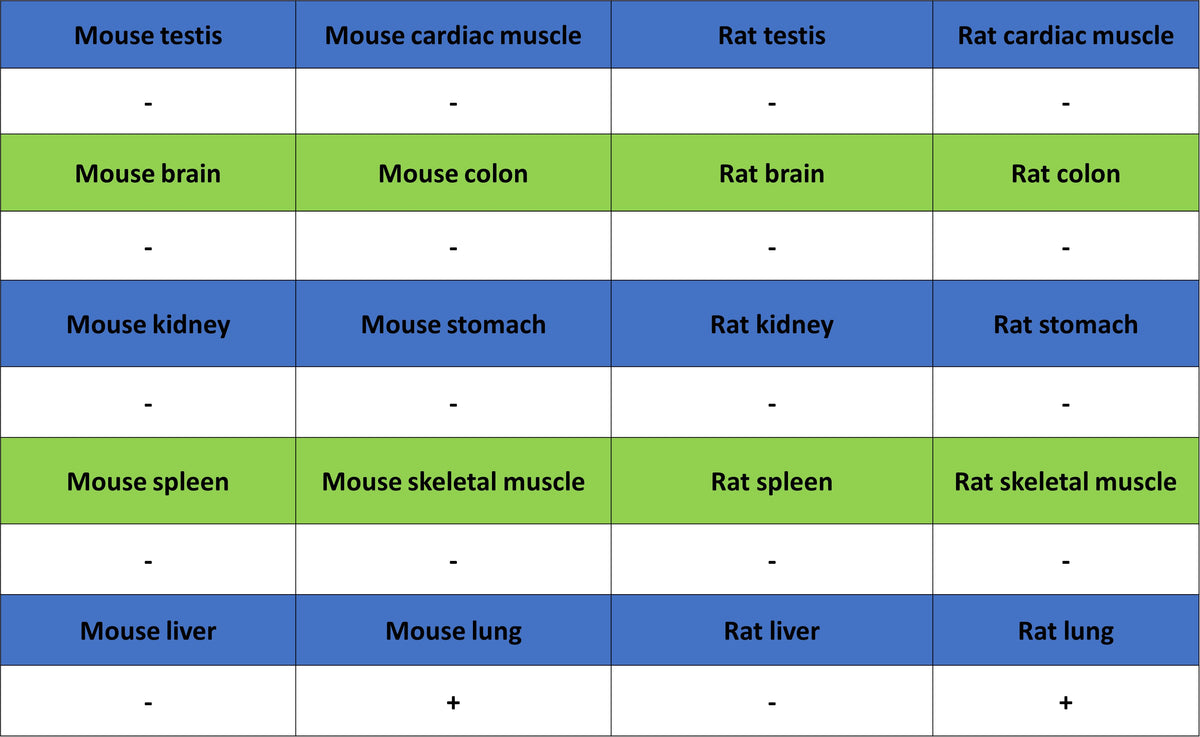
IHC shows positive staining in paraffin-embedded mouse lung. Anti-Uteroglobin antibody was used at 1/4000 dilution, followed by a HRP Polymer for Rabbit IgG (ready to use). Counterstained with hematoxylin. Heat mediated antigen retrieval with Tris/EDTA buffer pH9.0 was performed before commencing with IHC staining protocol.
IHC shows positive staining in paraffin-embedded rat lung. Anti-Uteroglobin antibody was used at 1/500 dilution, followed by a HRP Polymer for Rabbit IgG (ready to use). Counterstained with hematoxylin. Heat mediated antigen retrieval with Tris/EDTA buffer pH9.0 was performed before commencing with IHC staining protocol.