WB result of Tartrate Resistant Acid Phosphatase Recombinant Rabbit mAb
Primary antibody: Tartrate Resistant Acid Phosphatase Recombinant Rabbit mAb at 1/1000 dilution
Lane 1: MCF7 whole cell lysate 20 µg
Lane 2: SK-MEL-28 whole cell lysate 20 µg
Negative control: MCF-7 whole cell lysate
Secondary antibody: Goat Anti-rabbit IgG (H+L), HRP conjugated at 1/10000 dilution
Predicted MW: 37 kDa
Observed MW: 38 kDa
Tartrate Resistant Acid Phosphatase Recombinant Rabbit mAb (S-5960)
Tartrate Resistant Acid Phosphatase Recombinant Rabbit mAb (S-5960)
Price:
Regular price
$100 USD
Regular price
Sale price
$100 USD
Unit price
per
For shipping services or bulk orders, you may request a quotation.
Secure checkout with

View full details
Product Details
Product Details
Product Specification
| Host | Rabbit |
| Antigen | Tartrate resistant acid phosphatase |
| Synonyms | Tartrate-resistant acid phosphatase type 5; Tartrate-resistant acid ATPase (TrATPase); Type 5 acid phosphatase; ACP5 |
| Location | Lysosome |
| Accession | P13686 |
| Clone Number | S-5960 |
| Antibody Type | Recombinant mAb |
| Isotype | IgG |
| Application | WB, IHC-P |
| Reactivity | Hu, Ms, Rt |
| Positive Sample | SK-MEL-28 |
| Purification | Protein A |
| Concentration | 0.5 mg/ml |
| Conjugation | Unconjugated |
| Physical Appearance | Liquid |
| Storage Buffer | PBS, 40% Glycerol, 0.05% BSA, 0.02% sodium azide |
| Stability & Storage | 12 months from date of receipt / reconstitution, -20 °C as supplied |
Dilution
| application | dilution | species |
| WB | 1:1000 | Hu |
| IHC-P | 1:500 | Hu |
Background
Tartrate-resistant acid phosphatase (TRAP) is a binuclear iron-containing acid phosphatase encoded by the ACP5 gene, belonging to the purple acid phosphatase family, and is named for its resistance to inhibition by tartrate. This enzyme is primarily localized in the lysosomal compartments of osteoclasts, macrophages, and dendritic cells, and exists in two isoforms in vivo: TRAP5b is mainly found in osteoclasts in bone tissue, while TRAP5a is predominantly present in immune cells. In bone metabolism, TRAP is an important marker of osteoclast activity, with its core function being the dephosphorylation of osteopontin, thereby regulating the attachment and detachment of osteoclasts to bone and participating in bone resorption and remodeling processes; consequently, serum TRAP levels are positively correlated with bone resorption rates and are significantly elevated in diseases characterized by increased bone resorption, such as osteoporosis, hyperparathyroidism, and metastatic bone tumors. In the immune system, TRAP regulates inflammatory responses and immune cell activity by inactivating osteopontin. In addition, TRAP is well-known as a cytochemical marker for hairy cell leukemia, and its expression is elevated in Gaucher disease, Hodgkin's disease, and certain leukemias. Loss-of-function mutations in its encoding gene ACP5 can lead to spondyloenchondrodysplasia with immune dysregulation (SPENCDI), a disease characterized by skeletal dysplasia, spastic cerebral calcification, and increased susceptibility to autoimmune diseases, with the mechanism involving sustained phosphorylation of osteopontin due to TRAP inactivation, leading to prolonged bone resorption and excessive immune system activation.
Picture
Picture
Western Blot
Immunohistochemistry
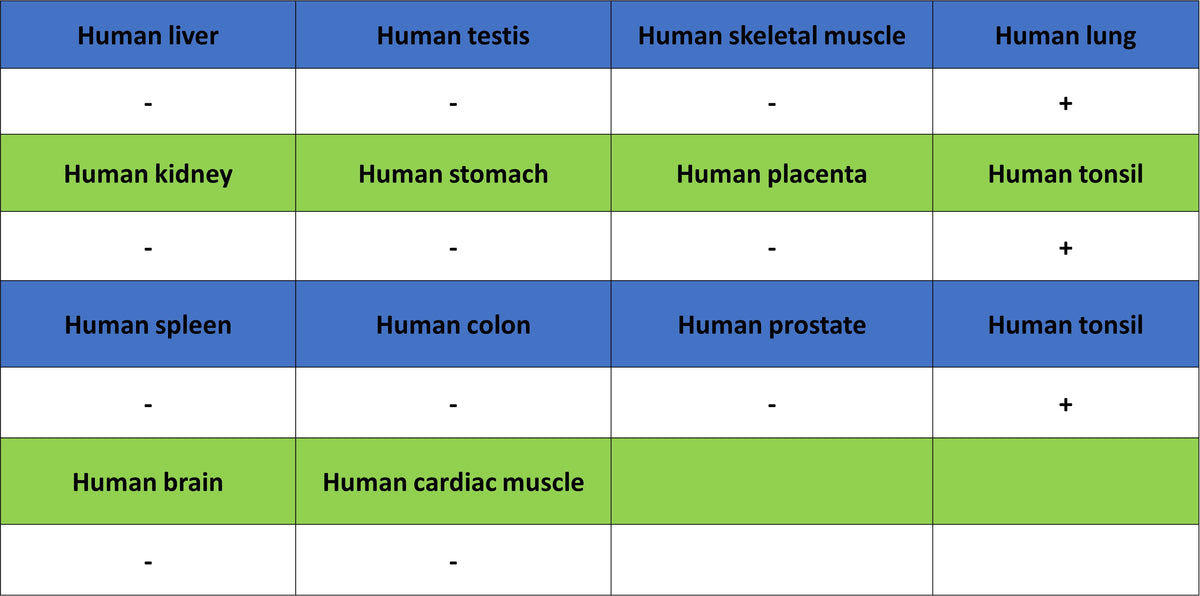
IHC shows positive staining in paraffin-embedded human lung. Anti-Tartrate resistant acid phosphatase antibody was used at 1/500 dilution, followed by a HRP Polymer for Rabbit IgG (ready to use). Counterstained with hematoxylin. Heat mediated antigen retrieval with Tris/EDTA buffer pH9.0 was performed before commencing with IHC staining protocol.
IHC shows positive staining in paraffin-embedded human tonsil. Anti-Tartrate resistant acid phosphatase antibody was used at 1/500 dilution, followed by a HRP Polymer for Rabbit IgG (ready to use). Counterstained with hematoxylin. Heat mediated antigen retrieval with Tris/EDTA buffer pH9.0 was performed before commencing with IHC staining protocol.