WB result of SUCLA2 Rabbit Polyclonal Antibody
Primary antibody: SUCLA2 Rabbit Polyclonal Antibody at 1/1000 dilution
Lane 1: Caco-2 whole cell lysate 20 µg
Lane 2: HeLa whole cell lysate 20 µg
Lane 3: HEK-293 whole cell lysate 20 µg
Lane 4: Hep G2 whole cell lysate 20 µg
Lane 5: MOLT-4 whole cell lysate 20 µg
Secondary antibody: Goat Anti-rabbit IgG (H+L), HRP conjugated at 1/10000 dilution
Predicted MW: 50 kDa
Observed MW: 40 kDa
SUCLA2 Rabbit Polyclonal Antibody
SUCLA2 Rabbit Polyclonal Antibody
Price:
Regular price
$100 USD
Regular price
Sale price
$100 USD
Unit price
per
For shipping services or bulk orders, you may request a quotation.
Secure checkout with

View full details
Product Details
Product Details
Product Specification
| Host | Rabbit |
| Antigen | SUCLA2 |
| Synonyms | Succinate--CoA ligase [ADP-forming] subunit beta, mitochondrial; ATP-specific succinyl-CoA synthetase subunit beta (A-SCS); Itaconyl--CoA ligase [ADP-forming] subunit beta (;); Malyl--CoA ligase [ADP-forming] subunit beta (;); Succinyl-CoA synthetase beta-A chain (SCS-betaA) |
| Immunogen | Synthetic Peptide |
| Location | Mitochondrion |
| Accession | Q9P2R7 |
| Antibody Type | Polyclonal antibody |
| Isotype | IgG |
| Application | WB, IP |
| Reactivity | Hu, Ms, Rt, Mk |
| Positive Sample | Caco-2, HeLa, HEK-293, MOLT-4, RAW264.7, PC-12, COS7 |
| Predicted Reactivity | Bv |
| Purification | Immunogen Affinity |
| Concentration | 0.5 mg/ml |
| Conjugation | Unconjugated |
| Physical Appearance | Liquid |
| Storage Buffer | PBS, 40% Glycerol, 0.05% BSA, 0.02% sodium azide |
| Stability & Storage | 12 months from date of receipt / reconstitution, -20 °C as supplied |
Dilution
| application | dilution | species |
| WB | 1:1000 | Hu, Ms, Rt, Mk |
| IP | 1:50 | Hu, Ms, Rt, Mk |
Background
The SUCLA2 (succinyl-CoA ligase ADP-forming subunit beta) gene encodes the beta subunit of succinyl-CoA ligase, a key enzyme in the mitochondrial tricarboxylic acid (TCA) cycle that catalyzes the conversion of succinyl-CoA to succinate coupled with the phosphorylation of ADP to ATP. This enzyme functions as a heterodimer composed of an invariant alpha subunit (SUCLG1) and a substrate-specific beta subunit (SUCLA2 or SUCLG2), with the ADP-specific beta subunit encoded by SUCLA2 being predominantly expressed in high-energy-demanding tissues such as the brain and skeletal muscle. In addition to its direct involvement in energy metabolism, SUCLA2 also interacts with nucleoside diphosphate kinase and participates in maintaining mitochondrial DNA synthesis and stability. Pathogenic variants in this gene cause autosomal recessive SUCLA2-related mitochondrial DNA depletion syndrome, also known as mitochondrial DNA depletion syndrome type 5, characterized by early-onset encephalopathy, hypotonia, developmental delay, myopathy, movement disorders, sensorineural hearing loss, and elevated lactate and methylmalonic acid levels.
Picture
Picture
Western Blot
WB result of SUCLA2 Rabbit Polyclonal Antibody
Primary antibody: SUCLA2 Rabbit Polyclonal Antibody at 1/1000 dilution
Lane 1: RAW 264.7 whole cell lysate 20 µg
Secondary antibody: Goat Anti-rabbit IgG (H+L), HRP conjugated at 1/10000 dilution
Predicted MW: 50 kDa
Observed MW: 40 kDa
WB result of SUCLA2 Rabbit Polyclonal Antibody
Primary antibody: SUCLA2 Rabbit Polyclonal Antibody at 1/1000 dilution
Lane 1: PC-12 whole cell lysate 20 µg
Secondary antibody: Goat Anti-rabbit IgG (H+L), HRP conjugated at 1/10000 dilution
Predicted MW: 50 kDa
Observed MW: 40 kDa
WB result of SUCLA2 Rabbit Polyclonal Antibody
Primary antibody: SUCLA2 Rabbit Polyclonal Antibody at 1/1000 dilution
Lane 1: COS7 whole cell lysate 20 µg
Secondary antibody: Goat Anti-rabbit IgG (H+L), HRP conjugated at 1/10000 dilution
Predicted MW: 50 kDa
Observed MW: 40 kDa
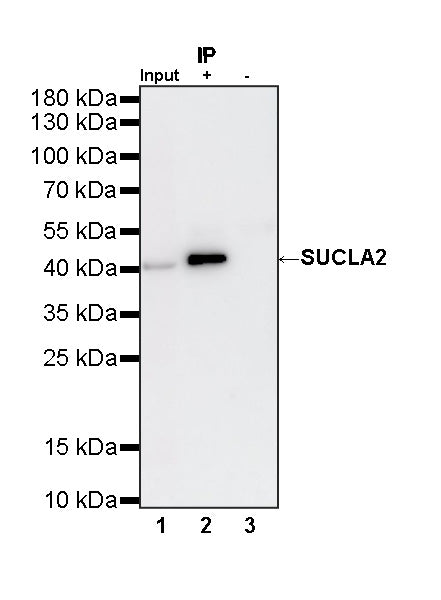
IP
SUCLA2 Rabbit mAb at 1/50 dilution (1 µg) immunoprecipitating SUCLA2 in 0.4 mg HeLa whole cell lysate.
Western blot was performed on the immunoprecipitate using SUCLA2 Rabbit mAb at 1/1000 dilution.
Secondary antibody (HRP) for IP was used at 1/2000 dilution.
Lane 1: HeLa whole cell lysate 20 µg (Input)
Lane 2: SUCLA2 Rabbit mAb IP in HeLa whole cell lysate
Lane 3: Rabbit monoclonal IgG IP in HeLa whole cell lysate
Predicted MW: 50 kDa
Observed MW: 43 kDa