WB result of SPTLC1 Recombinant Rabbit mAb
Primary antibody: SPTLC1 Recombinant Rabbit mAb at 1/1000 dilution
Lane 1: 293T whole cell lysate 20 µg
Lane 2: Hela whole cell lysate 20 µg
Lane 3: HepG2 whole cell lysate 20 µg
Lane 4: Jurkat whole cell lysate 20 µg
Lane 5: MCF7 whole cell lysate 20 µg
Lane 6: BxPC-3 whole cell lysate 20 µg
Lane 7: A549 whole cell lysate 20 µg
Lane 8: HT-29 whole cell lysate 20 µg
Lane 9: K-562 whole cell lysate 20 µg
Secondary antibody: Goat Anti-rabbit IgG (H+L), HRP conjugated at 1/10000 dilution
Predicted MW: 53 kDa
Observed MW: 53 kDa
SPTLC1 Recombinant Rabbit mAb (S-6028)
SPTLC1 Recombinant Rabbit mAb (S-6028)
Price:
Regular price
$100 USD
Regular price
Sale price
$100 USD
Unit price
per
For shipping services or bulk orders, you may request a quotation.
Secure checkout with

View full details
Product Details
Product Details
Product Specification
| Host | Rabbit |
| Antigen | SPTLC1 |
| Synonyms | Serine palmitoyltransferase 1; Long chain base biosynthesis protein 1 (LCB 1); Serine-palmitoyl-CoA transferase 1 (SPT 1; SPT1); LCB1 |
| Location | Endoplasmic reticulum |
| Accession | O15269 |
| Clone Number | S-6028 |
| Antibody Type | Recombinant mAb |
| Isotype | IgG |
| Application | WB, IHC-P |
| Reactivity | Hu |
| Positive Sample | 293T, HeLa, HepG2, Jurkat, MCF7, BxPC-3, A549, HT-29, K-562 |
| Purification | Protein A |
| Concentration | 0.5 mg/ml |
| Conjugation | Unconjugated |
| Physical Appearance | Liquid |
| Storage Buffer | PBS, 40% Glycerol, 0.05% BSA, 0.02% sodium azide |
| Stability & Storage | 12 months from date of receipt / reconstitution, -20 °C as supplied |
Dilution
| application | dilution | species |
| WB | 1:1000-1:5000 | Hu |
| IHC-P | 1:2000 | Hu |
Background
SPTLC1 (serine palmitoyltransferase long chain base subunit 1) is one of the catalytic core subunits of serine palmitoyltransferase (SPT) encoded by the SPTLC1 gene. This enzyme is the key rate-limiting enzyme in the de novo sphingolipid biosynthesis pathway, catalyzing the condensation of L-serine and palmitoyl-CoA to generate 3-ketodihydrosphingosine on the endoplasmic reticulum membrane, providing essential precursors for the synthesis of all sphingolipids (such as ceramides and sphingomyelins). This protein belongs to the type II pyridoxal phosphate-dependent aminotransferase family, possessing an N-terminal transmembrane domain that anchors it to the endoplasmic reticulum membrane, while the majority of its C-terminal domain resides in the cytoplasm to perform catalytic functions. SPTLC1 must form heterodimers with SPTLC2 or SPTLC3, and then assemble with auxiliary subunits SPTSSA or SPTSSB to form the complete SPT complex, with its substrate preference varying depending on the complex composition; meanwhile, its activity is tightly regulated by negative feedback from the ORMDL protein family to maintain sphingolipid homeostasis. Dysfunction of SPTLC1 is closely associated with various diseases: specific mutations in SPTLC1 alter the enzyme's substrate selectivity, leading to the abnormal synthesis of neurotoxic deoxysphingolipids, which causes autosomal dominant hereditary sensory and autonomic neuropathy type 1A (HSAN1A); while another class of mutations located in the N-terminal transmembrane domain (such as A20T) disrupts ORMDL-mediated inhibition, resulting in excessive SPT activity and accumulation of canonical sphingolipids, which is associated with juvenile amyotrophic lateral sclerosis (ALS27); additionally, SPTLC1 expression is significantly reduced in clear cell renal cell carcinoma, and its overexpression can exert tumor-suppressive effects by inhibiting the EGFR/VEGFR signaling pathway and epithelial-mesenchymal transition, with low expression predicting poor patient prognosis.
Picture
Picture
Western Blot
Immunohistochemistry
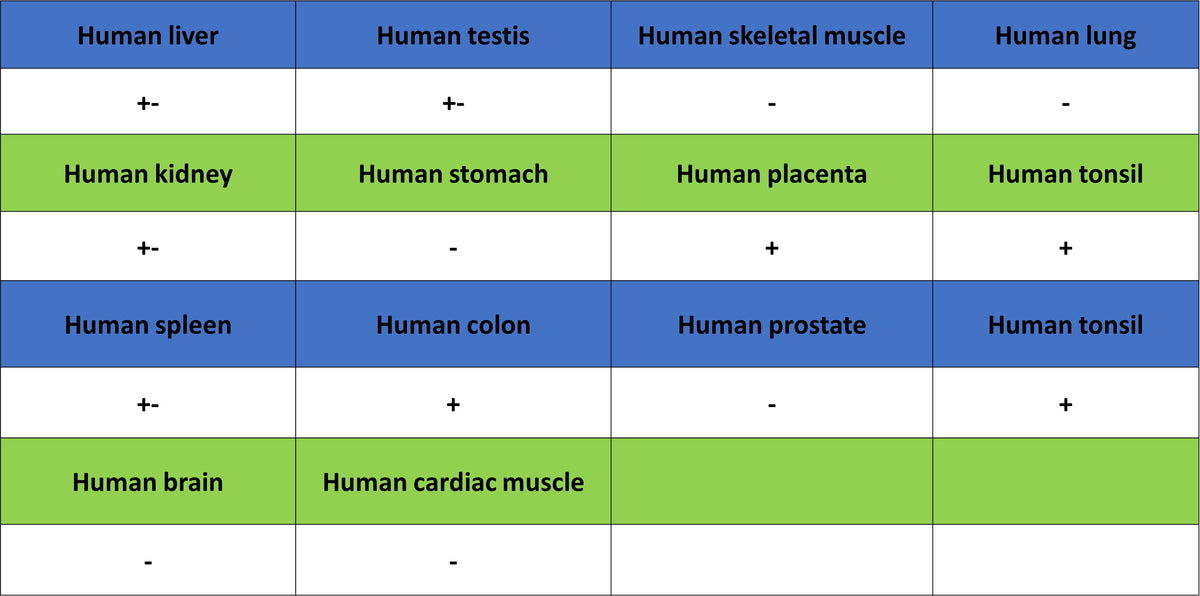
IHC shows positive staining in paraffin-embedded human placenta. Anti-SPTLC1 antibody was used at 1/2000 dilution, followed by a HRP Polymer for Rabbit IgG (ready to use). Counterstained with hematoxylin. Heat mediated antigen retrieval with Tris/EDTA buffer pH9.0 was performed before commencing with IHC staining protocol.
Negative control: IHC shows negative staining in paraffin-embedded human skeletal muscle. Anti-SPTLC1 antibody was used at 1/2000 dilution, followed by a HRP Polymer for Rabbit IgG (ready to use). Counterstained with hematoxylin. Heat mediated antigen retrieval with Tris/EDTA buffer pH9.0 was performed before commencing with IHC staining protocol.
IHC shows positive staining in paraffin-embedded human breast cancer. Anti-SPTLC1 antibody was used at 1/2000 dilution, followed by a HRP Polymer for Rabbit IgG (ready to use). Counterstained with hematoxylin. Heat mediated antigen retrieval with Tris/EDTA buffer pH9.0 was performed before commencing with IHC staining protocol.
IHC shows positive staining in paraffin-embedded human lung cancer. Anti-SPTLC1 antibody was used at 1/2000 dilution, followed by a HRP Polymer for Rabbit IgG (ready to use). Counterstained with hematoxylin. Heat mediated antigen retrieval with Tris/EDTA buffer pH9.0 was performed before commencing with IHC staining protocol.