WB result of PGAM5 Recombinant Rabbit mAb
Primary antibody: PGAM5 Recombinant Rabbit mAb at 1/1000 dilution
Lane 1: A549 whole cell lysate 20 µg
Lane 2: HepG2 whole cell lysate 20 µg
Lane 3: MCF7 whole cell lysate 20 µg
Lane 4: untreated HeLa whole cell lysate 20 µg
Lane 5: HeLa treated with 100 µM CCCP for 2 hours whole cell lysate 20 µg
Secondary antibody: Goat Anti- rabbit IgG, (H+L), HRP conjugated at 1/10000 dilution
Predicted MW: 32 kDa
Observed MW: 30, 32 kDa
This blot was developed with high sensitivity substrate
PGAM5 Recombinant Rabbit mAb (S-3980-76)
PGAM5 Recombinant Rabbit mAb (S-3980-76)
Price:
Regular price
$100 USD
Regular price
Sale price
$100 USD
Unit price
per
For shipping services or bulk orders, you may request a quotation.
Secure checkout with

View full details
Product Details
Product Details
Product Specification
| Host | Rabbit |
| Antigen | PGAM5 |
| Synonyms | Serine/threonine-protein phosphatase PGAM5, mitochondrial; Bcl-XL-binding protein v68; Phosphoglycerate mutase family member 5 |
| Immunogen | Synthetic Peptide |
| Location | Mitochondrion |
| Accession | Q96HS1 |
| Clone Number | S-3980-76 |
| Antibody Type | Recombinant mAb |
| Isotype | IgG |
| Application | WB |
| Reactivity | Hu, Rt |
| Positive Sample | A549, HepG2, MCF7, rat kidney, rat colon |
| Purification | Protein A |
| Concentration | 2 mg/ml |
| Conjugation | Unconjugated |
| Physical Appearance | Liquid |
| Storage Buffer | PBS, 40% Glycerol, 0.05% BSA, 0.02% sodium azide |
| Stability & Storage | 12 months from date of receipt / reconstitution, -20 °C as supplied |
Dilution
| application | dilution | species |
| WB | 1:500-1:1000 | Hu, Rt |
Background
PGAM5 is a mitochondrial-localized atypical serine/threonine phosphatase that plays a central regulatory role in cellular stress, programmed cell death, and mitochondrial quality control. Its most notable structural feature is the formation of dodecameric ring-shaped oligomers through the N-terminal WDXNWD motif, and this higher-order assembly is essential for activating its phosphatase activity. Functionally, PGAM5 serves as a hub in a complex signaling network: on one hand, it promotes mitochondrial fission by dephosphorylating and activating the MAP kinase ASK1, as well as mediating DRP1 dephosphorylation, thereby participating in the regulation of necroptosis and oxidative stress responses; on the other hand, it initiates the selective clearance of damaged mitochondria by dephosphorylating the mitophagy receptor FUNDC1, or maintains the PINK1/Parkin-mediated mitophagy pathway by stabilizing PINK1 protein, thus exerting protective effects in neurodegenerative disease models. Due to its critical position in inflammatory and cell death pathways, PGAM5 exhibits a "double-edged sword" characteristic with both pro-inflammatory and anti-inflammatory functions. Its dysfunction is closely associated with various diseases, including heart failure, Parkinson's disease, ischemic brain injury, and hepatocellular carcinoma, making it a highly promising drug target.
Picture
Picture
Western Blot
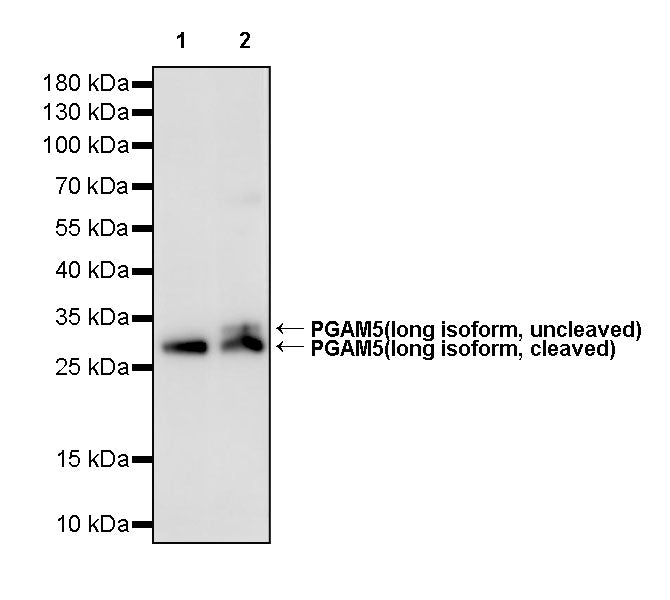
WB result of PGAM5 Recombinant Rabbit mAb
Primary antibody: PGAM5 Recombinant Rabbit mAb at 1/1000 dilution
Lane 1: rat kidney lysate 20 µg
Lane 2: rat colon lysate 20 µg
Secondary antibody: Goat Anti- rabbit IgG, (H+L), HRP conjugated at 1/10000 dilution
Predicted MW: 32 kDa
Observed MW: 30, 32 kDa
This blot was developed with high sensitivity substrate