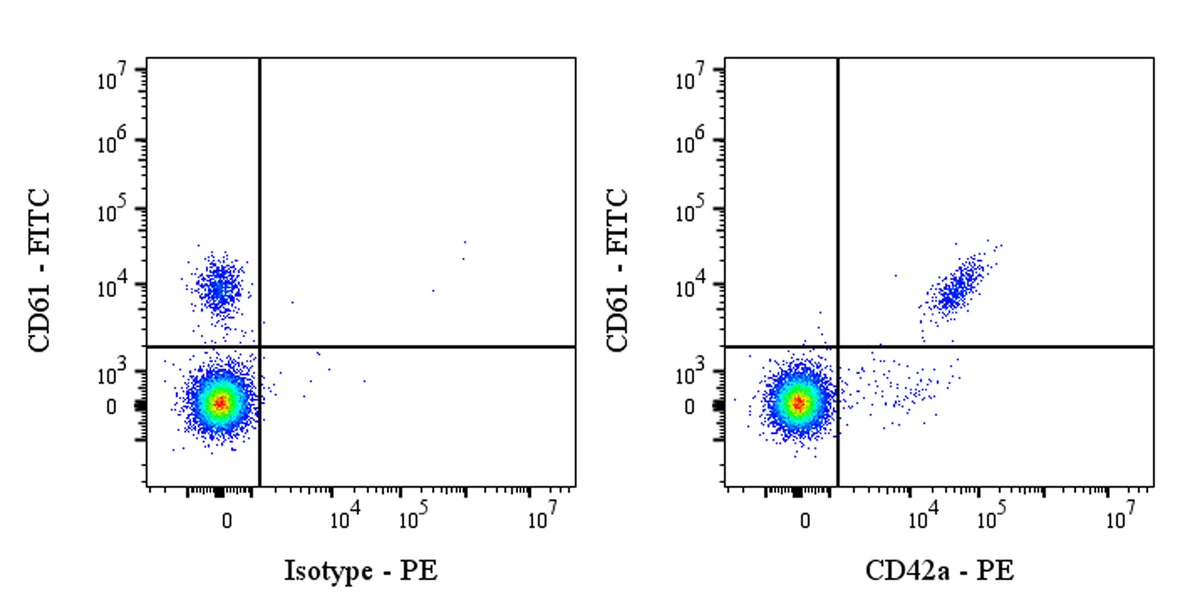
Flow cytometric analysis of human CD42a expression on fresh human peripheral blood platelets. Fresh human peripheral blood platelets were stained with FITC Mouse Anti-Human CD61 Antibody and either PE Mouse IgG1, κ Isotype Control (left panel) or SDT PE Mouse Anti-Human CD42a Antibody (right panel) at 2 μl/test. Flow cytometry and data analysis were performed using Agilent NovoCyte Quanteon and FlowJo™ software.
PE Mouse Anti-Human CD42a Antibody (S-4391)
PE Mouse Anti-Human CD42a Antibody (S-4391)
Price:
Regular price
$135 USD
Regular price
Sale price
$135 USD
Unit price
per
For shipping services or bulk orders, you may request a quotation.
Secure checkout with

View full details
Product Details
Product Details
Product Specification
| Host | Mouse |
| Antigen | CD42a |
| Synonyms | Platelet glycoprotein IX; GP-IX; GPIX; Glycoprotein 9; GP9 |
| Location | Membrane |
| Accession | P14770 |
| Clone Number | S-4391 |
| Antibody Type | Mouse mAb |
| Isotype | IgG1,k |
| Isotype Control | S0B5756 |
| Application | FCM |
| Reactivity | Hu |
| Positive Sample | Fresh human peripheral blood platelets |
| Purification | Protein G |
| Concentration | 0.1 mg/ml |
| Conjugation | PE |
| Physical Appearance | Liquid |
| Storage Buffer | PBS, 1% BSA, 0.09% sodium azide |
| Stability & Storage | 12 months from date of receipt / reconstitution, 2 to 8 °C as supplied |
Dilution
| application | dilution | species |
| FCM | 2μl per million cells in 100μl volume | Hu |
Background
CD42a, also known as glycoprotein IX (GPIX), is a small, single-pass transmembrane glycoprotein expressed on platelets and megakaryocytes that non-covalently associates with glycoproteins Ibα, Ibβ, and V to form the GPIb-V-IX complex, which acts as the platelet receptor for von Willebrand factor (vWF), enabling vWF-dependent platelet adhesion to injured vessel walls and initiating arterial hemostasis; CD42a contains leucine-rich repeats, is encoded by GP9 on chromosome 3q21.3, and mutations in this gene cause Bernard–Soulier syndrome, a bleeding disorder characterized by giant platelets and impaired aggregation.
Picture
Picture
FC