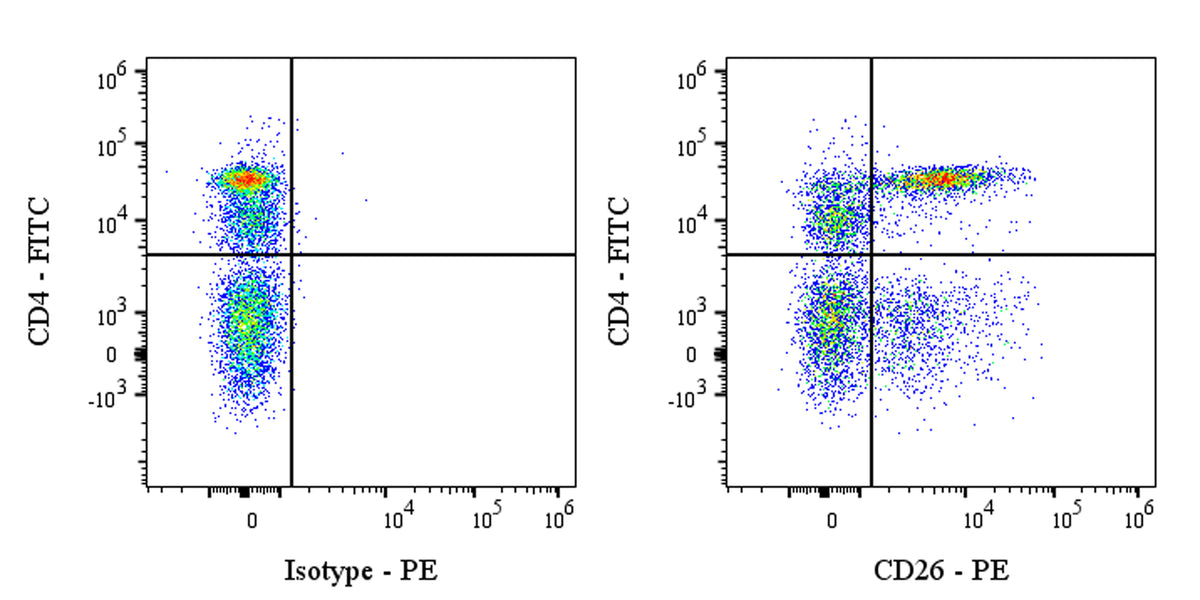
Flow cytometric analysis of human CD26 expression on human peripheral blood cells. Human peripheral blood cells were stained with either PE Mouse IgG1, κ Isotype Control (left panel) or SDT PE Mouse Anti-Human CD26 Antibody (right panel) at 5 μl/test. Flow cytometry and data analysis were performed using Agilent NovoCyte Quanteon and FlowJo™ software.
PE Mouse Anti-Human CD26 Antibody (M-A261)
PE Mouse Anti-Human CD26 Antibody (M-A261)
Price:
Regular price
$145 USD
Regular price
Sale price
$145 USD
Unit price
per
For shipping services or bulk orders, you may request a quotation.
Secure checkout with

View full details
Product Details
Product Details
Product Specification
| Host | Mouse |
| Antigen | CD26 |
| Synonyms | Dipeptidyl peptidase 4; ADABP; Adenosine deaminase complexing protein 2 (ADCP-2); Dipeptidyl peptidase IV (DPP IV); T-cell activation antigen CD26; TP103; ADCP2; DPP4 |
| Location | Cell membrane |
| Accession | P27487 |
| Clone Number | M-A261 |
| Antibody Type | Mouse mAb |
| Isotype | IgG1,k |
| Isotype Control | S0B5756 |
| Application | FCM |
| Reactivity | Hu |
| Positive Sample | Human peripheral blood cells |
| Purification | Protein G |
| Concentration | 0.2 mg/ml |
| Conjugation | PE |
| Physical Appearance | Liquid |
| Storage Buffer | PBS, 1% BSA, 0.09% sodium azide |
| Stability & Storage | 12 months from date of receipt / reconstitution, 2 to 8 °C as supplied |
Dilution
| application | dilution | species |
| FCM | 5μl per million cells in 100μl volume | Hu |
Background
CD26, also known as dipeptidyl peptidase-4 (DPP-4), is a multifunctional type II transmembrane glycoprotein widely expressed on the surface of various cell types, including T lymphocytes, endothelial cells, and epithelial cells, where it serves dual roles as an enzymatic regulator and a signaling molecule. Functionally, it acts as a serine exopeptidase that specifically cleaves X-proline or X-alanine dipeptides from the N-terminus of polypeptides, thereby modulating the biological activity of numerous substrates such as incretin hormones (GLP-1 and GIP), chemokines, and neuropeptides, which makes it a pivotal therapeutic target for type 2 diabetes management through DPP-4 inhibitors. Beyond its enzymatic activity, CD26 functions as a costimulatory molecule in T-cell activation and immune regulation, interacts with extracellular matrix proteins like collagen and fibronectin to influence cell adhesion and migration, and has been implicated in cancer progression and viral entry (notably as a functional receptor for MERS-CoV), highlighting its complex significance in immunology, metabolism, and infectious disease pathophysiology.
Picture
Picture
FC