1μg (R: reducing condition, N:non-reducing condition).
PARG His tag Protein, Mouse
PARG His tag Protein, Mouse
Price:
Regular price
$730 USD
Regular price
Sale price
$730 USD
Unit price
per
For shipping services or bulk orders, you may request a quotation.
Secure checkout with

View full details
Product Details
Product Details
Product Specification
| Species | Human |
| Synonyms | Poly(ADP-ribose) glycohydrolase, PARG |
| Accession | O88622-1 |
| Amino Acid Sequence | Met1-Thr969 with His Tag at the C-Terminus |
| Expression System | E.coli |
| Molecular Weight | 20-25kDa (Reducing) |
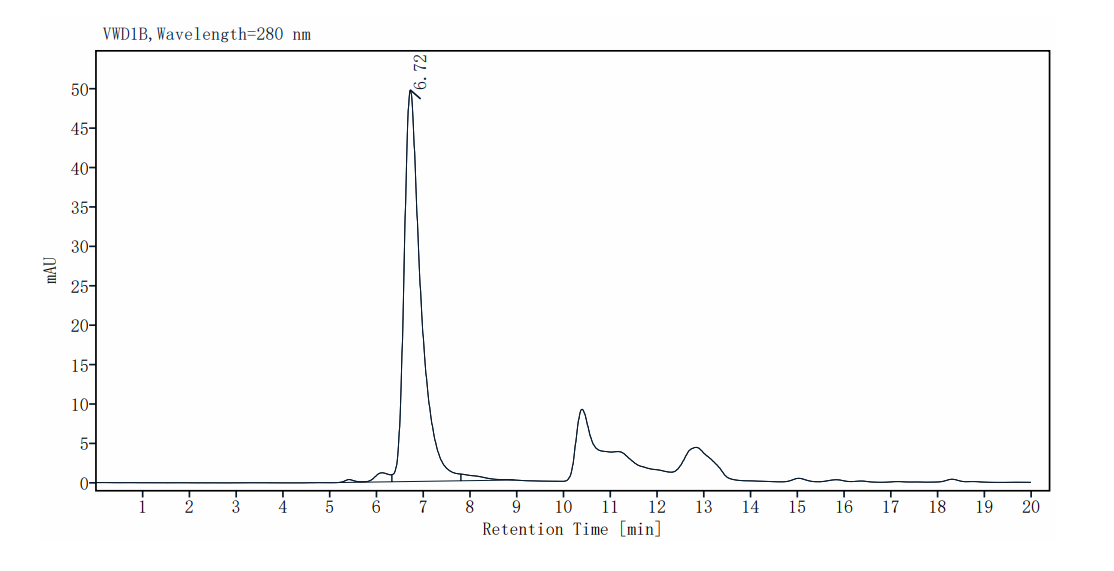
| Purity | >90% by SDS-PAGE,> 95% by HPLC |
| Conjugation | Unconjugated |
| Tag | His Tag |
| Physical Appearance | Liquid |
| Storage Buffer | 50mM Tris, 200mM NaCl, 20% Glycerol, 1mM DTT, pH7.5 |
| Stability & Storage | Stable for 12 months upon stored at -80℃ from the date of receipt. And avoid repeated freeze-thaws cycles. |
| Reference | Sun Y, Chen J, Huang SN, Su YP, Wang W, Agama K, Saha S, Jenkins LM, Pascal JM, Pommier Y. PARylation prevents the proteasomal degradation of topoisomerase I DNA-protein crosslinks and induces their deubiquitylation. Nat Commun. 2021 Aug 18;12(1):5010. |
Background
PARG (Poly(ADP-ribose) Glycohydrolase) serves as the key negative regulator of PAR metabolism, belonging to the glycoside hydrolase family that modulates protein PARylation levels through hydrolysis of glycosidic bonds within PAR chains. Structurally, PARG comprises an N-terminal regulatory domain and a C-terminal catalytic domain; the catalytic domain forms an α/β-barrel fold with an active site constituted by a catalytic triad of Glu755/Glu756/Asp737, executing exoglycosidase activity by binding to terminal ADP-ribose units of PAR chains, with His-tags commonly employed for recombinant protein purification. Functionally, PARG maintains dynamic equilibrium with PARPs (particularly PARP1/2) to rapidly degrade PAR chains and preserve cellular PARylation homeostasis, thereby regulating DNA damage repair, replication fork restart, transcriptional control, and cell death; PARG deficiency leads to PAR chain accumulation, triggering replication stress and genomic instability. Clinically, PARG inhibitors (such as COH34 and PDD00017273) exhibit synthetic lethality with PARP inhibitors, demonstrating therapeutic potential for BRCA-mutant tumors and PARP inhibitor-resistant patients, currently positioned at preclinical/early clinical development stages as an emerging target for synthetic lethal strategies.
Picture
Picture
SDS-PAGE
SEC-HPLC
The purity of PARG His tag Protein, Mouse is more than 95% determined by SEC-HPLC.