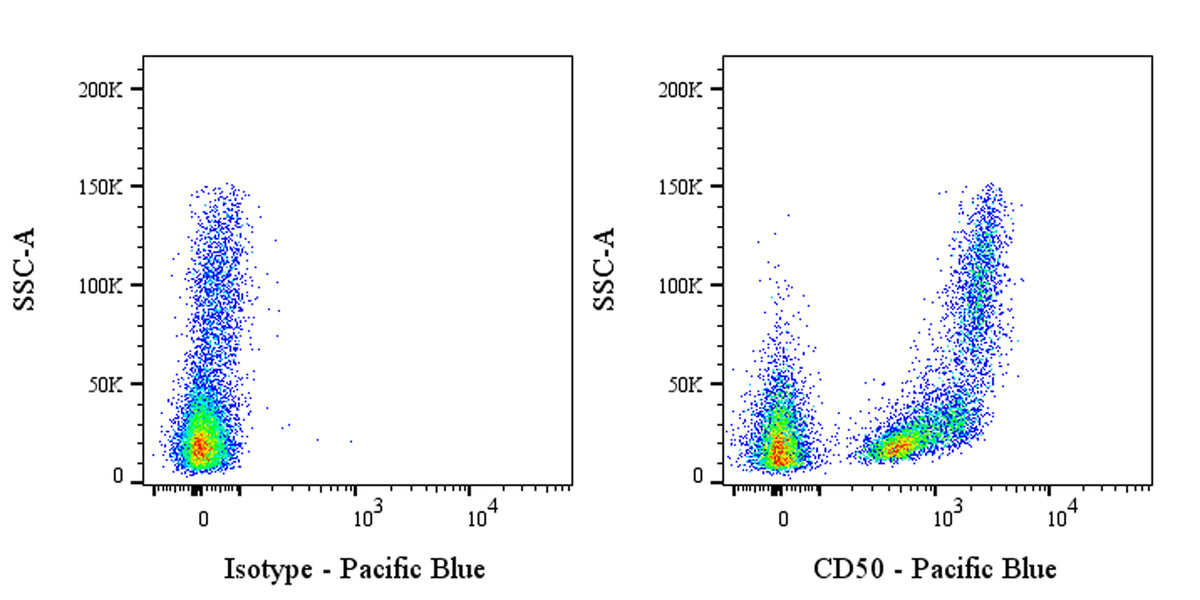
Flow cytometric analysis of CD50 expression on human peripheral blood leukocytes. Human peripheral blood leukocytes were stained with Pacific Blue Mouse IgG2b, k Isotype Control (left panel) or SDT Pacific Blue Mouse Anti- Human CD50 Antibody (right panel) at 5 μl/test. Flow cytometry and data analysis were performed using BD FACSymphony™ A1 and FlowJo™ software.
Pacific Blue Mouse Anti-Human CD50 Antibody (S-4993)
Pacific Blue Mouse Anti-Human CD50 Antibody (S-4993)
Price:
Regular price
$230 USD
Regular price
Sale price
$230 USD
Unit price
per
For shipping services or bulk orders, you may request a quotation.
Secure checkout with

View full details
Product Details
Product Details
Product Specification
| Host | Mouse |
| Antigen | CD50 |
| Synonyms | Intercellular adhesion molecule 3; CDw50; ICAM-R; ICAM3 |
| Location | Cell membrane |
| Accession | P32942 |
| Clone Number | S-4993 |
| Antibody Type | Mouse mAb |
| Isotype | IgG2b,k |
| Isotype Control | S0B1581 |
| Application | FCM |
| Reactivity | Hu |
| Positive Sample | Human peripheral blood leukocytes |
| Purification | Protein A |
| Concentration | 0.2 mg/ml |
| Conjugation | Pacific Blue |
| Physical Appearance | Liquid |
| Storage Buffer | PBS, 1% BSA, 0.09% sodium azide |
| Stability & Storage | 12 months from date of receipt / reconstitution, 2 to 8 °C as supplied |
Dilution
| application | dilution | species |
| FCM | 5μl per million cells in 100μl volume | Hu |
Background
CD50, also known as intercellular adhesion molecule-3 (ICAM-3), is a member of the immunoglobulin superfamily and the ICAM family, serving as an important ligand for the integrin LFA-1 (CD11a/CD18). It is constitutively and highly expressed on all leukocytes, playing a critical role in the early stages of adaptive immune responses by facilitating the initial contact between naïve T cells and antigen-presenting cells. Beyond mediating cell-cell adhesion, CD50 itself functions as a potent signaling molecule; its cross-linking triggers intracellular signaling events such as elevated calcium flux in T cells, and it can act as a costimulatory molecule to promote T-cell activation and proliferation. Furthermore, CD50 expression levels are closely associated with T-cell differentiation and maturation status, being expressed at higher levels on memory T cells than on naïve T cells, and it is also involved in the clearance of apoptotic neutrophils.
Picture
Picture
FC