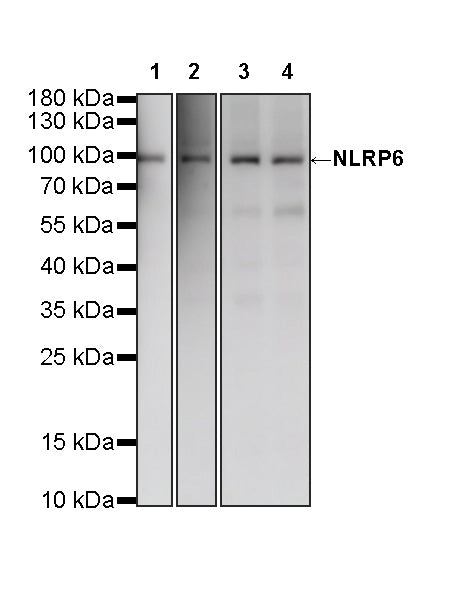
WB result of NLRP6 Rabbit mAb
Primary antibody: NLRP6 Rabbit mAb at 1/1000 dilution
Lane 1: K-562 whole cell lysate 20 μg
Lane 2: MCF7 whole cell lysate 20 μg
Lane 3: HeLa whole cell lysate 20 μg
Lane 4: 293T whole cell lysate 20 μg
Secondary antibody: Goat Anti-Rabbit IgG (H+L), HRP conjugated at 1/10000 dilution
Predicted MW: 99 kDa
Observed MW: 99 kDa
This blot was developed with high sensitivity substrate
NLRP6 Rabbit mAb
NLRP6 Rabbit mAb
Price:
Regular price
$100 USD
Regular price
Sale price
$100 USD
Unit price
per
For shipping services or bulk orders, you may request a quotation.
Secure checkout with

View full details
Product Details
Product Details
Product Specification
| Host | Rabbit |
| Antigen | NLRP6 |
| Synonyms | NACHT, LRR and PYD domains-containing protein 6; Angiotensin II/vasopressin receptor; PYRIN-containing APAF1-like protein 5; NALP6; PYPAF5 |
| Location | Cytoplasm |
| Accession | P59044 |
| Antibody Type | Recombinant mAb |
| Isotype | IgG |
| Application | WB |
| Reactivity | Hu |
| Positive Sample | K-562, A549, MCF7, THP-1 |
| Purification | Protein A |
| Concentration | 1 mg/ml |
| Conjugation | Unconjugated |
| Physical Appearance | Liquid |
| Storage Buffer | PBS, 40% Glycerol, 0.05% BSA, 0.02% sodium azide |
| Stability & Storage | 12 months from date of receipt / reconstitution, -20 °C as supplied |
Dilution
| application | dilution | species |
| WB | 1:1000 | Hu |
Background
NLRP6 (NACHT, LRR, and PYD domains-containing protein 6) is a functionally diverse and important member of the NOD-like receptor (NLR) family, originally known as PYPAF5. Its protein structure consists of three core domains: an N-terminal pyrin domain (PYD), a central nucleotide-binding domain (NACHT), and a C-terminal leucine-rich repeat (LRR) domain responsible for recognizing pathogen signals. NLRP6 primarily functions as a sensor of innate immunity, with high expression in intestinal epithelial cells, and plays a critical role in host defense, maintenance of intestinal microecology, and epithelial integrity. Upon recognizing microbial or metabolic signals, it recruits the adaptor protein ASC through its PYD domain, thereby activating caspase-1 and assembling into the NLRP6 inflammasome. This complex promotes the maturation and secretion of pro-inflammatory cytokines such as IL-1β and IL-18, and can induce pyroptosis. In addition, NLRP6 functions also involve regulating the NF-κB and MAPK signaling pathways, responding to viral RNA to induce interferon production, and even participating in the regulation of renal water-salt balance. Studies have shown that NLRP6 dysfunction is closely associated with various pathological processes, including inflammatory bowel disease, colorectal cancer, and metabolic diseases.
Picture
Picture
Western Blot