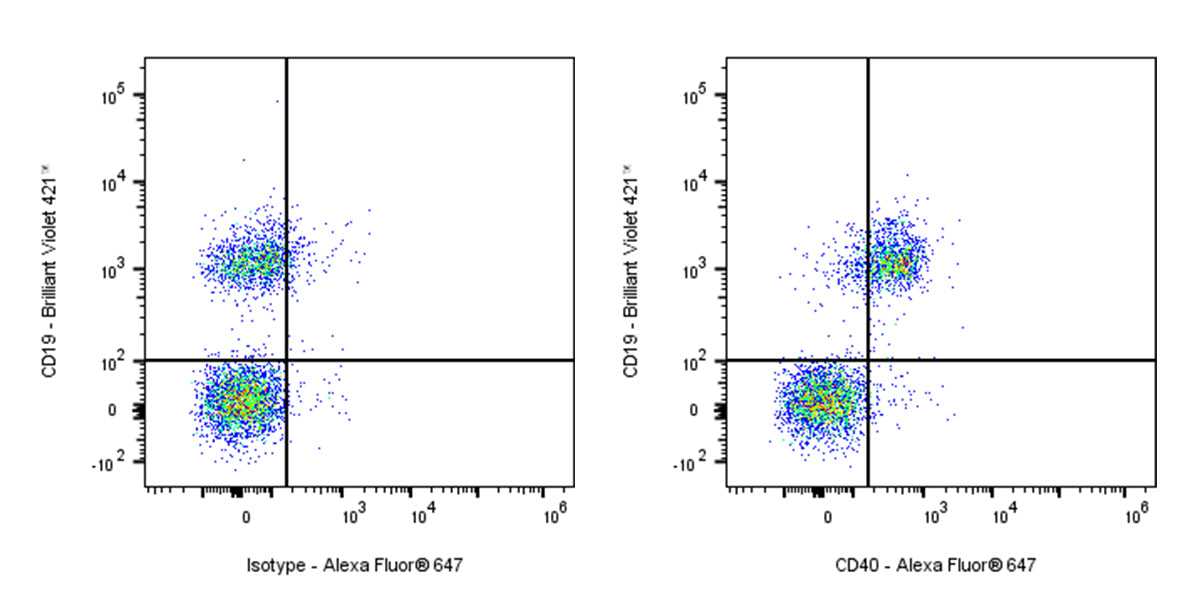
Flow cytometric analysis of BALB/c mouse splenocytes labelling Mouse CD40body at 1/200 (0.1 μg) dilution (Right) compared with a Mouse IgG2a isotype control (Left). Goat Anti - Mouse IgG Alexa Fluor® 647 was used as the secondary antibody. Then cells were stained with CD19 - Brilliant Violet 421™ separately. Events were gated on viable lymphocytes.
Mouse Anti-Mouse CD40 Antibody (S-3723)
Mouse Anti-Mouse CD40 Antibody (S-3723)
Price:
Regular price
$100 USD
Regular price
Sale price
$100 USD
Unit price
per
For shipping services or bulk orders, you may request a quotation.
Secure checkout with

View full details
Product Details
Product Details
Product Specification
| Host | Mouse |
| Antigen | CD40 |
| Synonyms | Tumor necrosis factor receptor superfamily member 5; B-cell surface antigen CD40; Bp50; CD40L receptor; Tnfrsf5; Cd40 |
| Location | Cell membrane |
| Accession | P27512 |
| Clone Number | S-3723 |
| Antibody Type | Mouse mAb |
| Isotype | IgG2a |
| Application | FCM |
| Reactivity | Ms |
| Positive Sample | BALB/c mouse splenocytes |
| Purification | Protein A |
| Concentration | 2 mg/ml |
| Conjugation | Unconjugated |
| Physical Appearance | Liquid |
| Storage Buffer | PBS pH7.4 |
| Stability & Storage | 12 months from date of receipt / reconstitution, 2 to 8 °C as supplied |
Background
CD40, also known as TNFRSF5, is a type I transmembrane protein and a member of the tumor necrosis factor receptor superfamily, primarily expressed on antigen-presenting cells such as dendritic cells, macrophages, and B cells. Its ligand, CD40L (CD154), is mainly found on activated T cells and is also expressed on platelets, endothelial cells, and smooth muscle cells. The interaction between CD40 and CD40L plays a crucial role in immune regulation, mediating a wide range of immune responses, including B cell proliferation, differentiation, and immunoglobulin class switching, as well as enhancing T cell activation and dendritic cell maturation. This interaction initiates intracellular signaling pathways involving TRAF proteins and leads to the activation of transcription factors such as NF-κB, which in turn regulate cytokine production and immune cell function. CD40 signaling is also implicated in metabolic processes, influencing glucose metabolism and lipid homeostasis, particularly in macrophages and endothelial cells. Dysregulation of the CD40-CD40L pathway is associated with various diseases, including immunodeficiency syndromes and autoimmune disorders.
Picture
Picture
FC