


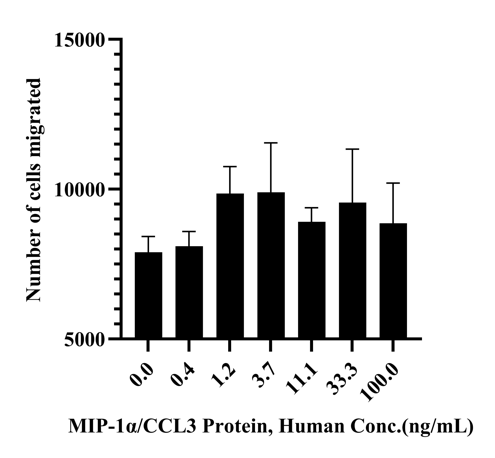
Determined by its ability to chemoattract human monocytes using a concentration range of 1.0-30.0 ng/ml.
MIP-1α/CCL3 Protein, Human
MIP-1α/CCL3 Protein, Human
Price:
Regular price
$159 USD
Regular price
Sale price
$159 USD
Unit price
per
For shipping services or bulk orders, you may request a quotation.
Secure checkout with

View full details
Product Details
Product Details
Product Specification
| Species | Human |
| Synonyms | C-C motif chemokine 3, MIP-1-alpha, Macrophage inflammatory protein 1-alpha, LD78-alpha |
| Accession | P10147 |
| Amino Acid Sequence | Ser24-Ala92 |
| Expression System | E.coli |
| Molecular Weight | 10kDa (Reducing) |
| Purity | >95% by SDS-PAGE & RP-HPLC |
| Endotoxin | <0.1EU/μg |
| Conjugation | Unconjugated |
| Tag | No Tag |
| Physical Appearance | Lyophilized Powder |
| Storage Buffer | PBS, pH7.4. |
| Reconstitution | Reconstitute at 0.1-1 mg/ml according to the size in ultrapure water after rapid centrifugation. |
| Stability & Storage |
· 12 months from date of receipt, lyophilized powder stored at -20 to -80℃. · 3 months, -20 to -80℃ under sterile conditions after reconstitution. · 1 week, 2 to 8℃ under sterile conditions after reconstitution. · Please avoid repeated freeze-thaw cycles. |
| Reference | 1.Rheumatol Ther. 2023 Aug;10(4):793-808.Epub 2023 May 25. |
Background
Chemokines are a class of cytokines that can cause cells to undergochemotactic movement, and their main role in the body is in chemotactic cellmigration. They are widely expressed in various tissues and cells of the body,and their receptors are mainly expressed in white blood cells, mediating thedirectional migration of white blood cells to play a biological role. CCL3, oneof the components of the chemokinep CC ligand family was also termed as MIP(macrophage inflammatory protein). It can be expressed on the surface ofmacrophages, lymphocytes, epithelial cells, and other cells. It mediates thesecretion of cytokines by immune cells and promotes the aggregation andmigration of a variety of cells. C-C motif chemokine receptor 1 (CCR1) and CCR5are the receptors of CCL3.C-C motif chemokine ligand 3 (CCL3) belongs toinflammatory cell chemokine. CCL3 or macrophageinflammatory protein-1α (MIP-1α), an important chemokine implicated in bothimmune surveillance and tolerance, has emerged as a prognostic biomarker inboth solid and hematological malignancies.
Picture
Picture
Bioactivity
SDS-PAGE

1μg
(R: reducing condition, N: non-reducing condition).

