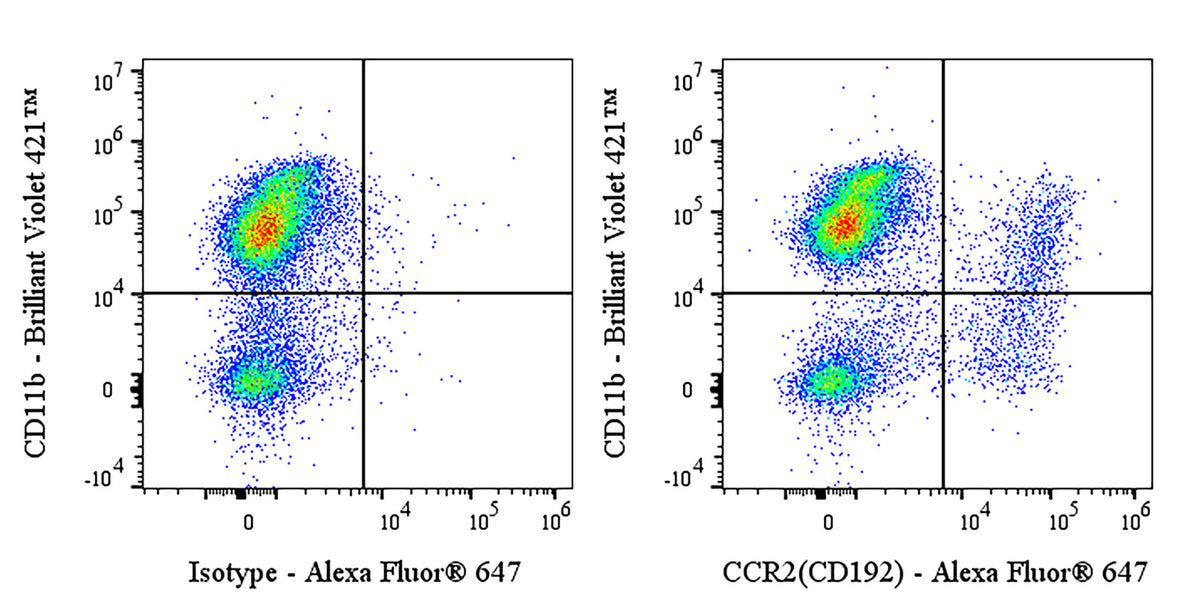
Flow cytometric analysis of BALB/c mouse bone marrow labeled with Anti-Mouse CCR2 antibody at 1/500 dilution (1 μg) / (right panel) compared with a Rat IgG1, κ Isotype Control / (left panel). Goat Anti-Rat IgG Alexa Fluor® 647 was used as the secondary antibody. Then cells were stained with CD11b - Brilliant Violet 421™ antibody separately. Flow cytometry and data analysis were performed using Agilent NovoCyte Quanteon and FlowJo™ software.
Invivo Anti-Mouse CCR2 (CD192) Recombinant mAb
Invivo Anti-Mouse CCR2 (CD192) Recombinant mAb
Price:
Regular price
$175 USD
Regular price
Sale price
$175 USD
Unit price
per
For shipping services or bulk orders, you may request a quotation.
Secure checkout with

View full details
Product Details
Product Details
Product Specification
| Host | Rat |
| Antigen | CCR2 (CD192) |
| Synonyms | C-C chemokine receptor type 2; C-C CKR-2; CC-CKR-2; CCR-2; JE/FIC receptor; MCP-1 receptor; Cmkbr2 |
| Location | Cell membrane |
| Accession | P51683 |
| Clone Number | S-4898 |
| Antibody Type | Rat mAb |
| Isotype Control | S0B7122 |
| Application | ELISA, FCM |
| Reactivity | Ms |
| Positive Sample | BALB/c mouse bone marrow |
| Purification | Protein G |
| Concentration | 5 mg/ml |
| Purity | >95% (Determined by SDS-PAGE) |
| Endotoxin | <1EU/mg |
| Conjugation | Unconjugated |
| Physical Appearance | Liquid |
| Storage Buffer | PBS pH7.4, containing no preservative |
| Stability & Storage | 2 to 8 °C for 2 weeks under sterile conditions; |
Dilution
| application | dilution | species |
| FCM | 1:500 | Ms |
Background
CD192, also known as CCR2, is a seven-transmembrane, G-protein-coupled receptor that belongs to the beta chemokine receptor family. It is primarily expressed on monocytes, macrophages, basophils, dendritic cells, and some T cells. CD192 acts as a receptor for several chemokines, including monocyte chemoattractant protein-1 (MCP-1/CCL2), MCP-2/CCL8, MCP-3/CCL7, and MCP-4/CCL13. This receptor plays a crucial role in mediating monocyte chemotaxis and is involved in various inflammatory responses, such as the recruitment of monocytes into tissues during atherosclerosis, rheumatoid arthritis, and tumor formation. Additionally, CD192 has been implicated in the pathogenesis of certain cancers, where it controls the recruitment of activated macrophages that can either promote tumor cytotoxicity or inhibit tumor growth.
Picture
Picture
FC