Human & Monkey DKK3 OneStep ELISA Kit
Human & Monkey DKK3 OneStep ELISA Kit

Product Details
Product Details
Product Specification
| Immunogen | Recombinant Protein |
| Antibody Type | Recombinant mAb |
| Reactivity | Hu, Mk |
| Purification | Protein A |
| Stability & Storage | 12 months from date of receipt / reconstitution, 2 to 8°C as supplied. |
Kit
| Precision | Intra-assay: 2.9%; Inter-assay: 4.2% |
| Sample type | Serum; EDTA Plasma, Heparin Plasma, Citrate Plasma; Cell Culture Supernatant |
| Assay type | Sandwich (quantitative) |
| Sensitivity | 14.2 pg/mL |
| Range | 39.1 pg/mL – 2500 pg/mL |
| Recovery | Serum: 101% EDTA Plasma: 99% Citrate plasma: 98% Heparin Plasma: 103% Cell Culture Supernatant: 106% |
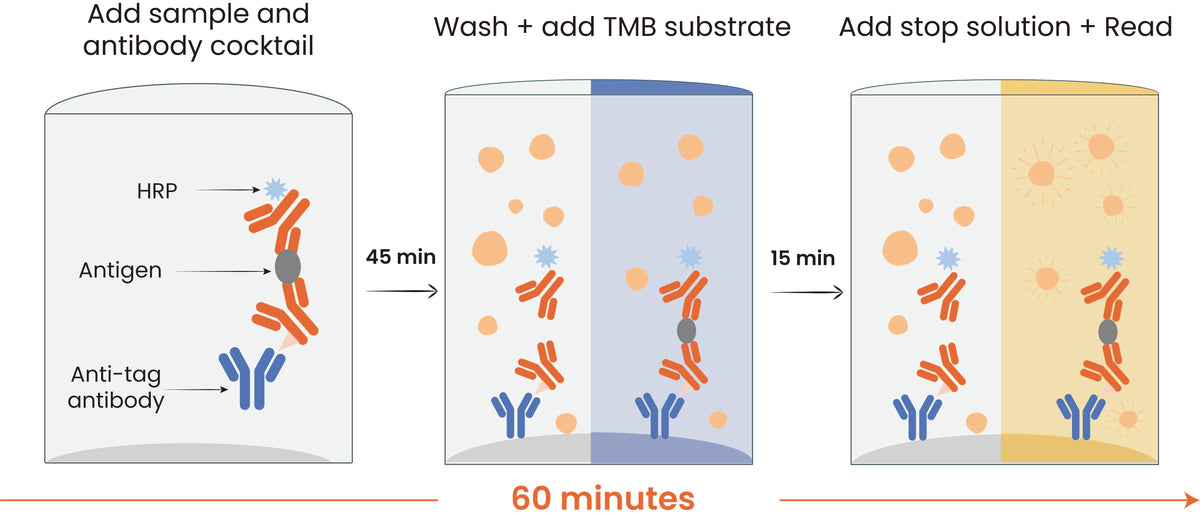
| Assay time | 60 minutes |
| Species reactivity | Hu, Mk |
Background
Human and monkey DKK3 proteins are highly conserved secreted glycoproteins belonging to the Dickkopf family, yet they exhibit distinct structural and functional features that set them apart from DKK1/2. Human DKK3 consists of 350 amino acids and contains a unique 7-amino-acid insertion (L249–E255) and a proline residue at position 258 within its C-terminal C2 domain, which collectively prevent effective binding to LRP5/6 co-receptors, thereby lacking canonical Wnt-antagonistic activity. Monkey DKK3 (e.g., from rhesus macaque) shares 91%–100% sequence identity with its human ortholog, with particularly high conservation in key functional domains. Functionally, DKK3 is involved in Wnt signaling modulation, tumor suppression, renal fibrosis, blood pressure regulation, and other pathophysiological processes, and its altered expression in chronic kidney diseases makes it a promising diagnostic biomarker. In terms of applications, recombinant human DKK3 is widely used in basic research, and the high cross-species homology positions non-human primates as valuable preclinical models for evaluating DKK3-targeted therapeutics, providing reliable tools for translational studies in cancer, kidney disease, and regenerative medicine.