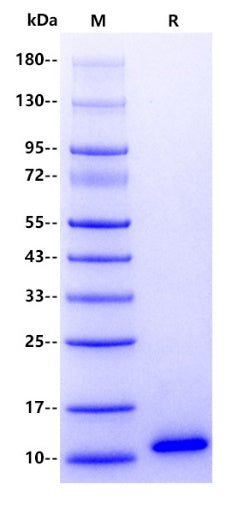
2μg(R: reducing conditions)
Human CCL8 Protein, His Tag
Human CCL8 Protein, His Tag
Price:
Regular price
$100 USD
Regular price
Sale price
$100 USD
Unit price
per
For shipping services or bulk orders, you may request a quotation.
Secure checkout with

View full details
Product Details
Product Details
Product Specification
| Species | Human |
| Synonyms | C-C motif chemokine 8, HC14, Monocyte chemoattractant protein 2, Monocyte chemotactic protein 2 (MCP-2), Small-inducible cytokine A8, MCP2, SCYA10, SCYA8 |
| Accession | P80075 |
| Amino Acid Sequence | Protein sequence (P80075, Met1-Pro99, with C-His Tag) MKVSAALLCLLLMAATFSPQGLAQPDSVSIPITCCFNVINRKIPIQRLESYTRITNIQCPKEAVIFKTKRGKEVCADPKERWVRDSMKHLDQIFQNLKP |
| Expression System | HEK293 |
| Molecular Weight | Predicted MW: 10.6 kDaObserved MW: 11 kDa |
| Purity | >95% by SDS-PAGE |
| Endotoxin | <1EU/μg |
| Conjugation | Unconjugated |
| Tag | with C-His Tag |
| Physical Appearance | Lyophilized powder |
| Storage Buffer | Lyophilized from a 0.2 μm filtered solution of PBS, pH7.4 with 3% trehalose. |
| Reconstitution | Reconstitute no more than 1 mg/mL according to the size in deionized water after rapid centrifugation. |
| Stability & Storage | 12 months from date of receipt, -20 to -70 °C as supplied. |
Background
CCL8, also known as Monocyte Chemoattractant Protein-2 (MCP-2), is a small cytokine belonging to the CC chemokine family. It is produced by various cells, including monocytes, fibroblasts, and endothelial cells, often in response to inflammatory stimuli. Its primary function is to recruit immune cells to sites of inflammation or infection by binding to several receptors, most notably CCR1, CCR2, CCR5, and CCR8. Through these interactions, CCL8 directs the migration of monocytes, lymphocytes, eosinophils, and dendritic cells. CCL8 plays a significant role in both antimicrobial defense and the pathogenesis of various diseases. It is implicated in chronic inflammatory conditions, allergic responses, and cancer, where it can influence tumor progression and the tumor microenvironment.
Picture
Picture
SDS-PAGE