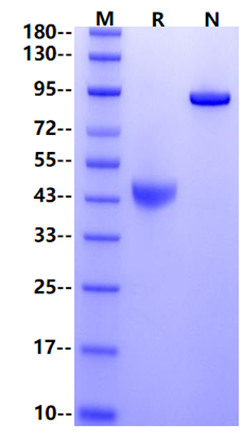
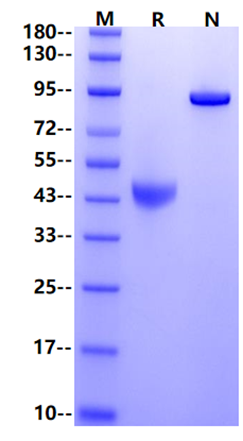
2μg (R: reducing conditions, N: non-reducing conditions).
GITR/TNFRSF18 Fc Chimera Protein, Human
GITR/TNFRSF18 Fc Chimera Protein, Human
Price:
Regular price
$557 USD
Regular price
Sale price
$557 USD
Unit price
per
For shipping services or bulk orders, you may request a quotation.
Secure checkout with

View full details
Product Details
Product Details
Product Specification
| Species | Human |
| Synonyms | CD357 antigen, CD357, GITR, GITR-D, GITRtumor necrosis factor receptor superfamily member 18, Glucocorticoid-induced TNFR-related protein, TNFRSF18, tumor necrosis factor receptor superfamily, member 18 |
| Accession | Q9Y5U5-1 |
| Amino Acid Sequence | Gln26-Glu161, with C-terminal Human IgG Fc |
| Expression System | HEK293 |
| Molecular Weight | 40-50kDa |
| Purity | >95% by SDS-PAGE |
| Endotoxin | <0.1EU/μg |
| Conjugation | Unconjugated |
| Tag | Human Fc |
| Physical Appearance | Lyophilized Powder |
| Storage Buffer | PBS, pH7.4 |
| Reconstitution | Reconstitute at 0.1-1 mg/ml according to the size in ultrapure water after rapid centrifugation. |
| Stability & Storage | · 12 months from date of receipt, lyophilized powder stored at -20 to -80℃. · 3 months, -20 to -80℃ under sterile conditions after reconstitution. · 1 week, 2 to 8℃ under sterile conditions after reconstitution. · Please avoid repeated freeze-thaw cycles. |
| Reference | 1,NatureCommunications volume 12, Article number: 1378 (2021) Cite this article 5809 Accesses 9 Citations 1 Altmetric Metrics. |
Background
GITR(Glucocorticoid-induced Tumor necrosis factor Receptor), also known as AITR and TNFRSF18, is a 40 kDa transmembrane glycoprotein belonging to the tumor necrosis factor receptor (TNF-R) superfamily. Mature human GITR consists of a 137 amino acid (aa) extracellular domain (ECD) with three tandem TNFR cysteine-rich repeats, a 21 aa transmembrane segment, and a 58 aa cytoplasmic domain. GITR is expressed on CD4+CD25+ regulatory T cells (Treg) as well as on subsets of thymocytes, lymph node cells, and splenocytes. GITR plays a key role in dominant immunological self-tolerance maintained by CD25(+)CD4(+) regulatory T cells.
Picture
Picture
SDS-PAGE