WB result of FLI-1 Rabbit Polyclonal Antibody
Primary antibody: FLI-1 Rabbit Polyclonal Antibody at 1/1000 dilution
Lane 1: SH-SY5Y whole cell lysate 20 μg
Lane 2: Ramos whole cell lysate 20 μg
Lane 3: MOLT4 whole cell lysate 20 μg
Lane 4: U-937 whole cell lysate 20 μg
Lane 5: A20 whole cell lysate 20 μg
Negative control: SH-SY5Y whole cell lysate
Secondary antibody: Goat Anti-Rabbit IgG (H+L), HRP conjugated at 1/10000 dilution
Predicted MW: 51 kDa
Observed MW: 51 kDa
FLI-1 Rabbit Polyclonal Antibody
FLI-1 Rabbit Polyclonal Antibody
Price:
Regular price
$100 USD
Regular price
Sale price
$100 USD
Unit price
per
For shipping services or bulk orders, you may request a quotation.
Secure checkout with

View full details
Product Details
Product Details
Product Specification
| Host | Rabbit |
| Antigen | FLI-1 |
| Synonyms | Friend leukemia integration 1 transcription factor; Proto-oncogene Fli-1; Transcription factor ERGB; FLI1 |
| Immunogen | Synthetic Peptide |
| Location | Nucleus |
| Accession | Q01543 |
| Antibody Type | Polyclonal antibody |
| Isotype | IgG |
| Application | WB |
| Reactivity | Hu, Ms |
| Positive Sample | Ramos, MOLT4, U-937, A20, mouse thymus |
| Purification | Protein A |
| Concentration | 2 mg/ml |
| Conjugation | Unconjugated |
| Physical Appearance | Liquid |
| Storage Buffer | PBS, 40% Glycerol, 0.05% BSA, 0.02% sodium azide |
| Stability & Storage | 12 months from date of receipt / reconstitution, -20 °C as supplied |
Dilution
| application | dilution | species |
| WB | 1:1000 | Hu, Ms |
Background
FLI-1 (Friend Leukemia Virus Integration Site 1) protein is a prominent member of the ETS transcription factor family, originally discovered as a proto-oncogene due to its activation in Friend virus-induced erythroleukemia. It specifically recognizes and binds to DNA sequences through its highly conserved ETS domain, thereby regulating the expression of various target genes. Under normal physiological conditions, FLI-1 is essential for embryonic vascular formation and megakaryopoiesis, and it promotes megakaryocyte differentiation. However, its dysregulation is closely associated with multiple diseases: it can fuse with the EWSR1 gene (found in approximately 85% of Ewing sarcoma cases) or undergo other translocations that drive tumorigenesis; in erythroleukemia, its overexpression inhibits erythroid differentiation while promoting cell proliferation and survival; additionally, FLI-1 abnormalities are also linked to autoimmune diseases such as systemic lupus erythematosus. At the molecular level, FLI-1 functions by partnering with proteins such as GATA1 and TAL1 to regulate three-dimensional genome architecture and activate megakaryocyte-related genes, while also antagonizing the transcription factor EKLF, thereby playing a pivotal role in determining the fate decision between erythroid and megakaryocytic differentiation.
Picture
Picture
Western Blot
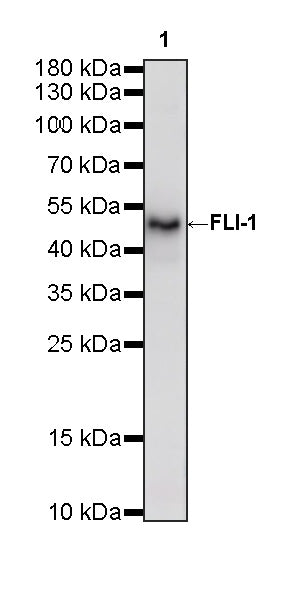
WB result of FLI-1 Rabbit Polyclonal Antibody
Primary antibody: FLI-1 Rabbit Polyclonal Antibody at 1/1000 dilution
Lane 1: mouse thymus lysate 20 μg
Secondary antibody: Goat Anti-Rabbit IgG (H+L), HRP conjugated at 1/10000 dilution
Predicted MW: 51 kDa
Observed MW: 51 kDa