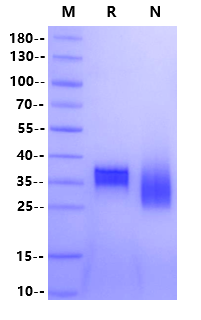
2μg(R: reducing condition, N:non-reducing condition).
DR3/TNFRSF25 His Tag Protein, Human
DR3/TNFRSF25 His Tag Protein, Human
Price:
Regular price
$185 USD
Regular price
Sale price
$185 USD
Unit price
per
For shipping services or bulk orders, you may request a quotation.
Secure checkout with

View full details
Product Details
Product Details
Product Specification
| Species | Human |
| Synonyms | TNFRSF25, APO3, DDR3, DR3, TNFRSF12, WSL, WSL1, Apo-3 |
| Accession | Q93038-1 |
| Amino Acid Sequence | Gln25-Gln199 with His Tag at the C-Terminus |
| Expression System | CHO |
| Molecular Weight | 35-40kDa (Reducing) |
| Purity | >95% by SDS-PAGE&HPLC |
| Conjugation | Unconjugated |
| Tag | His Tag |
| Physical Appearance | Lyophilized powder |
| Storage Buffer | PBS, pH7.4, 5% trehalose |
| Reconstitution | Reconstitute at 0.1-1 mg/ml according to the size in ultrapure water after rapid centrifugation. |
| Stability & Storage |
· 12 months from date of receipt, lyophilized powder stored at -20 to -80℃. · 3 months, -20 to -80℃ under sterile conditions after reconstitution. · 1 week, 2 to 8℃ under sterile conditions after reconstitution. · Please avoid repeated freeze-thaw cycles. |
| Reference | 1.Menghini P, Buttó LF, Gomez-Nguyen A, Aladyshkina N, Buela KA, Osme A, Chan R, Wargo HL, De Santis S, Bamias G, Pizarro TT, Cominelli F. Tumor Necrosis Factor-Like Ligand 1A/Death Receptor 3 Signaling Regulates the Generation of Pathogenic T Helper 9 Cells in Experimental Crohn's Disease. Gastroenterology. 2025 Oct;169(5):892-908. |
Background
DR3 (TNFRSF25), a member of the tumor necrosis factor receptor superfamily, is a type I transmembrane glycoprotein characterized by an extracellular cysteine-rich domain that specifically binds its unique ligand TL1A (TNFSF15) and an intracellular death domain capable of recruiting the adaptor protein TRADD to activate downstream NF-κB and MAPK signaling pathways. Functionally, DR3 exerts bidirectional immunomodulatory effects: it maintains Foxp3⁺ regulatory T cell homeostasis to restrain excessive inflammation, while simultaneously promoting pathogenic Th17 differentiation and inducing fibroblast activation, contributing to intestinal fibrosis; genetic polymorphisms in its ligand-encoding gene TNFSF15 have been strongly associated with susceptibility to Crohn's disease and rheumatoid arthritis. Clinically, DR3 agonists are being developed for the treatment of autoimmune diseases and the prevention of graft-versus-host disease, whereas blocking antibodies show therapeutic promise in inflammatory bowel disease and fibrotic complications; moreover, enrichment of DR3⁺ Tregs in the tumor microenvironment correlates with immune evasion and poor prognosis, positioning DR3 as a multifaceted therapeutic target across autoimmunity, transplantation, oncology, and infectious diseases.
Picture
Picture
SDS-PAGE
SEC-HPLC
The purity of DR3/TNFRSF25 His Tag Protein, Human is more than 95% as determined by SEC-HPLC.
ELISA
Immobilized DR3/TNFRSF25 His Tag Protein, Human (Cat. No. UA016194) at 5μg/mL(100μL/well) can bind Biotinylated Human TL1A/TNFSF15 Protein, His,Avi Tag with EC50 of 3.70-20.00ng/mL.
SPR
DR3/TNFRSF25 His Tag Protein, Human (Cat. No. UA016194) immobilized on CM5 Chip can bind Human TL1A/TNFSF15 Protein, His Tag (Cat. No. S0A4083) with an affinity constant of 51.50nM as determined in a SPR assay.