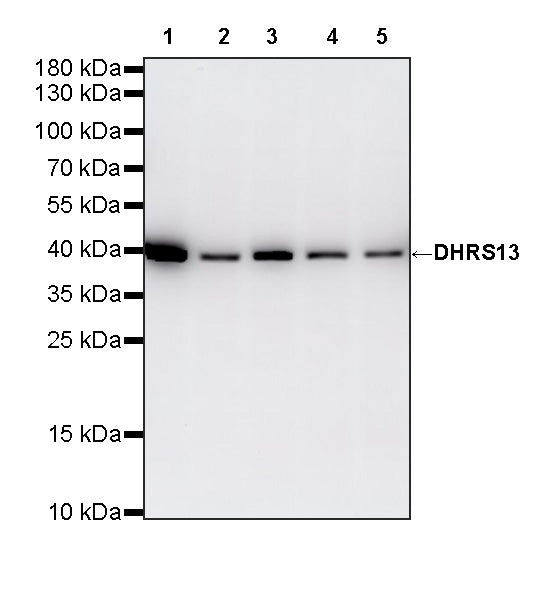
WB result of DHRS13 Recombinant Rabbit mAb
Primary antibody: DHRS13 Recombinant Rabbit mAb at 1/1000 dilution
Lane 1: U-87 MG whole cell lysate 20 μg
Lane 2: SK-BR-3 whole cell lysate 20 μg
Lane 3: Raji whole cell lysate 20 μg
Lane 4: Ramos whole cell lysate 20 μg
Lane 5: SH-SY5Y whole cell lysate 20 μg
Secondary antibody: Goat Anti-Rabbit IgG (H+L), HRP conjugated at 1/10000 dilution
Predicted MW: 41 kDa
Observed MW: 40 kDa
DHRS13 Recombinant Rabbit mAb (S-4011-7)
DHRS13 Recombinant Rabbit mAb (S-4011-7)
Price:
Regular price
$100 USD
Regular price
Sale price
$100 USD
Unit price
per
For shipping services or bulk orders, you may request a quotation.
Secure checkout with

View full details
Product Details
Product Details
Product Specification
| Host | Rabbit |
| Antigen | DHRS13 |
| Synonyms | Dehydrogenase/reductase SDR family member 13; SDR7C5 |
| Immunogen | Synthetic Peptide |
| Location | Secreted |
| Accession | Q6UX07 |
| Clone Number | S-4011-7 |
| Antibody Type | Recombinant mAb |
| Isotype | IgG |
| Application | WB |
| Reactivity | Hu |
| Positive Sample | U-87 MG, SK-BR-3, Raji, Ramos, SH-SY5Y |
| Purification | Protein A |
| Concentration | 2 mg/ml |
| Conjugation | Unconjugated |
| Physical Appearance | Liquid |
| Storage Buffer | PBS, 40% Glycerol, 0.05% BSA, 0.02% sodium azide |
| Stability & Storage | 12 months from date of receipt / reconstitution, -20 °C as supplied |
Dilution
| application | dilution | species |
| WB | 1:2000 | Hu |
Background
DHRS13, namely Dehydrogenase/Reductase SDR Family Member 13, belongs to the short-chain dehydrogenase/reductase (SDR) superfamily. Its gene is located on human chromosome 17q11.2 and encodes a protein consisting of 377 amino acids, featuring a NAD(P)-binding Rossmann-like fold domain. Functionally, DHRS13 is a retinal reductase localized in mitochondria, efficiently utilizing the cofactor NADPH to convert all-trans retinal into all-trans retinol. Studies have found that DHRS13 is highly expressed in undifferentiated glioblastoma cells, where it blocks retinoic acid signaling to prevent the differentiation of glioma stem-like cells, thereby maintaining their undifferentiated state and promoting malignant tumor progression. Conversely, knockdown of DHRS13 induces mitochondrial reactive oxygen species-driven mitophagy and cell death, significantly reducing tumor-initiating capacity and progression. Therefore, DHRS13 is regarded as a potential anti-cancer target, and targeting it may help eliminate undifferentiated tumor cells to improve therapeutic outcomes.
Picture
Picture
Western Blot