WB result of BDNF Recombinant Rabbit mAb
Primary antibody: BDNF Recombinant Rabbit mAb at 1/1000 dilution
Lane 1: SH-SY5Y whole cell lysate 20 μg
Secondary antibody: Goat Anti-Rabbit IgG (H+L), HRP conjugated at 1/10000 dilution
Predicted MW: 28 kDa
Observed MW: 28,16 kDa
BDNF Recombinant Rabbit mAb (S-4118-38)
BDNF Recombinant Rabbit mAb (S-4118-38)
Price:
Regular price
$100 USD
Regular price
Sale price
$100 USD
Unit price
per
For shipping services or bulk orders, you may request a quotation.
Secure checkout with

View full details
Product Details
Product Details
Product Specification
| Host | Rabbit |
| Antigen | BDNF |
| Synonyms | Neurotrophic factor BDNF precursor form; Abrineurin; Brain-derived neurotrophic factor |
| Immunogen | Synthetic Peptide |
| Location | Secreted |
| Accession | P23560 |
| Clone Number | S-4118-38 |
| Antibody Type | Recombinant mAb |
| Isotype | IgG |
| Application | WB, ICC |
| Reactivity | Hu, Ms, Rt |
| Positive Sample | SH-SY5Y, mouse hippocampus, mouse cerebellum, rat hippocampus, rat cerebellum |
| Predicted Reactivity | Pg, Dg, GP, Bv |
| Purification | Protein A |
| Concentration | 0.5 mg/ml |
| Conjugation | Unconjugated |
| Physical Appearance | Liquid |
| Storage Buffer | PBS, 40% Glycerol, 0.05% BSA, 0.02% sodium azide |
| Stability & Storage | 12 months from date of receipt / reconstitution, -20 °C as supplied |
Dilution
| application | dilution | species |
| WB | 1:1000 | Hu, Ms, Rt |
| ICC | 1:100 | Hu |
Background
BDNF (Brain-Derived Neurotrophic Factor) is one of the most important and widely distributed members of the neurotrophin family, belonging to the NGF (nerve growth factor)-related family. It is primarily synthesized and secreted by neurons and astrocytes, with particularly abundant expression in brain regions such as the hippocampus, cerebral cortex, and basal forebrain in mammals. Its precursor, proBDNF, is cleaved by proteases to generate mature mBDNF, which exerts its functions by binding to and activating its high-affinity receptor TrkB (tropomyosin receptor kinase B) as well as the low-affinity receptor p75NTR, thereby initiating multiple intracellular signaling pathways (such as MAPK/ERK, PI3K/AKT, and PLCγ pathways) that play central roles in neuronal survival, differentiation, synaptic plasticity, and axonal and dendritic growth. One of the most renowned functions of BDNF is its regulation of long-term potentiation (LTP), a process considered to be the cellular basis of learning and memory formation, making BDNF critically important in cognitive function, spatial memory, and emotional regulation. Furthermore, BDNF expression levels are highly regulated by environmental factors (such as exercise, enriched environments, and stress) as well as endogenous neural activity, and its functional abnormalities are closely associated with a variety of neuropsychiatric disorders, including depression, Alzheimer's disease, Parkinson's disease, Huntington's disease, and schizophrenia. This makes BDNF not only a hotspot molecule in neuroscience research but also a potential therapeutic target and biomarker for numerous neurological and psychiatric conditions.
Picture
Picture
Western Blot
WB result of BDNF Recombinant Rabbit mAb
Primary antibody: BDNF Recombinant Rabbit mAb at 1/1000 dilution
Lane 1: mouse hippocampus lysate 20 μg
Lane 2: mouse cerebellum lysate 20 μg
Secondary antibody: Goat Anti-Rabbit IgG (H+L), HRP conjugated at 1/10000 dilution
Predicted MW: 28 kDa
Observed MW: 28 kDa
WB result of BDNF Recombinant Rabbit mAb
Primary antibody: BDNF Recombinant Rabbit mAb at 1/1000 dilution
Lane 1: rat hippocampus lysate 20 μg
Lane 2: rat cerebellum lysate 20 μg
Secondary antibody: Goat Anti-Rabbit IgG (H+L), HRP conjugated at 1/10000 dilution
Predicted MW: 28 kDa
Observed MW: 28 kDa
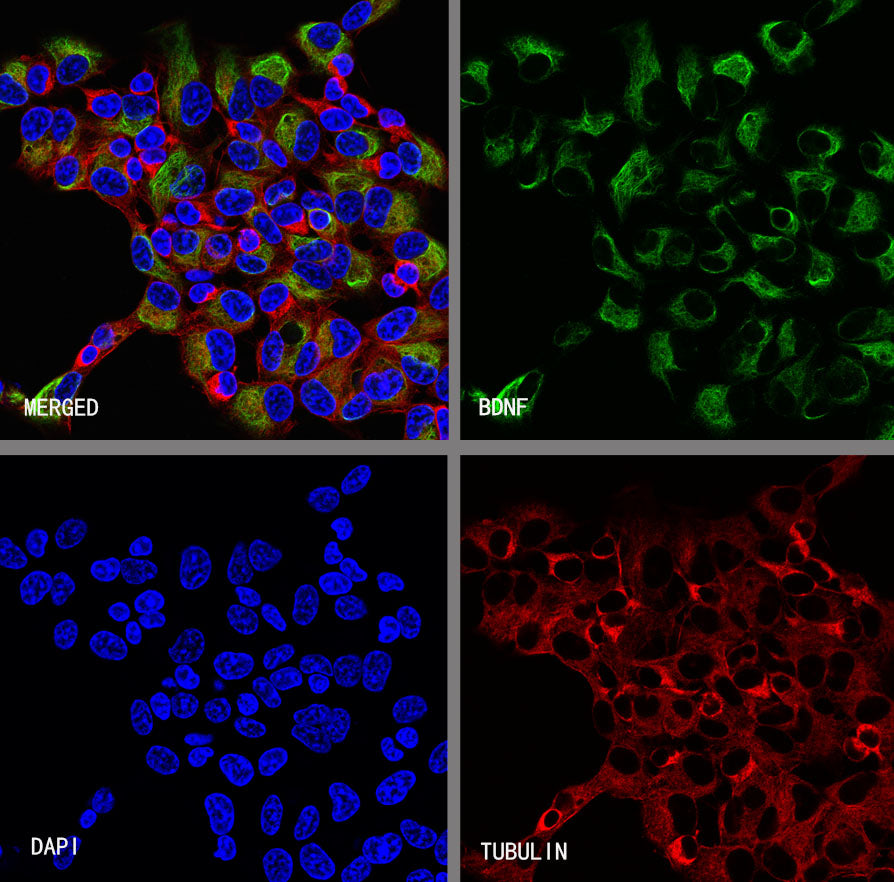
Immunocytochemistry
ICC shows positive staining in SH-SY5Y cells. Anti-BDNF antibody was used at 1/100 dilution (Green) and incubated overnight at 4°C. Goat polyclonal Antibody to Rabbit IgG - H&L (Alexa Fluor® 488) was used as secondary antibody at 1/1000 dilution. The cells were fixed with 100% ice-cold methanol and permeabilized with 0.1% PBS-Triton X-100. Nuclei were counterstained with DAPI (Blue). Counterstain with tubulin (Red).