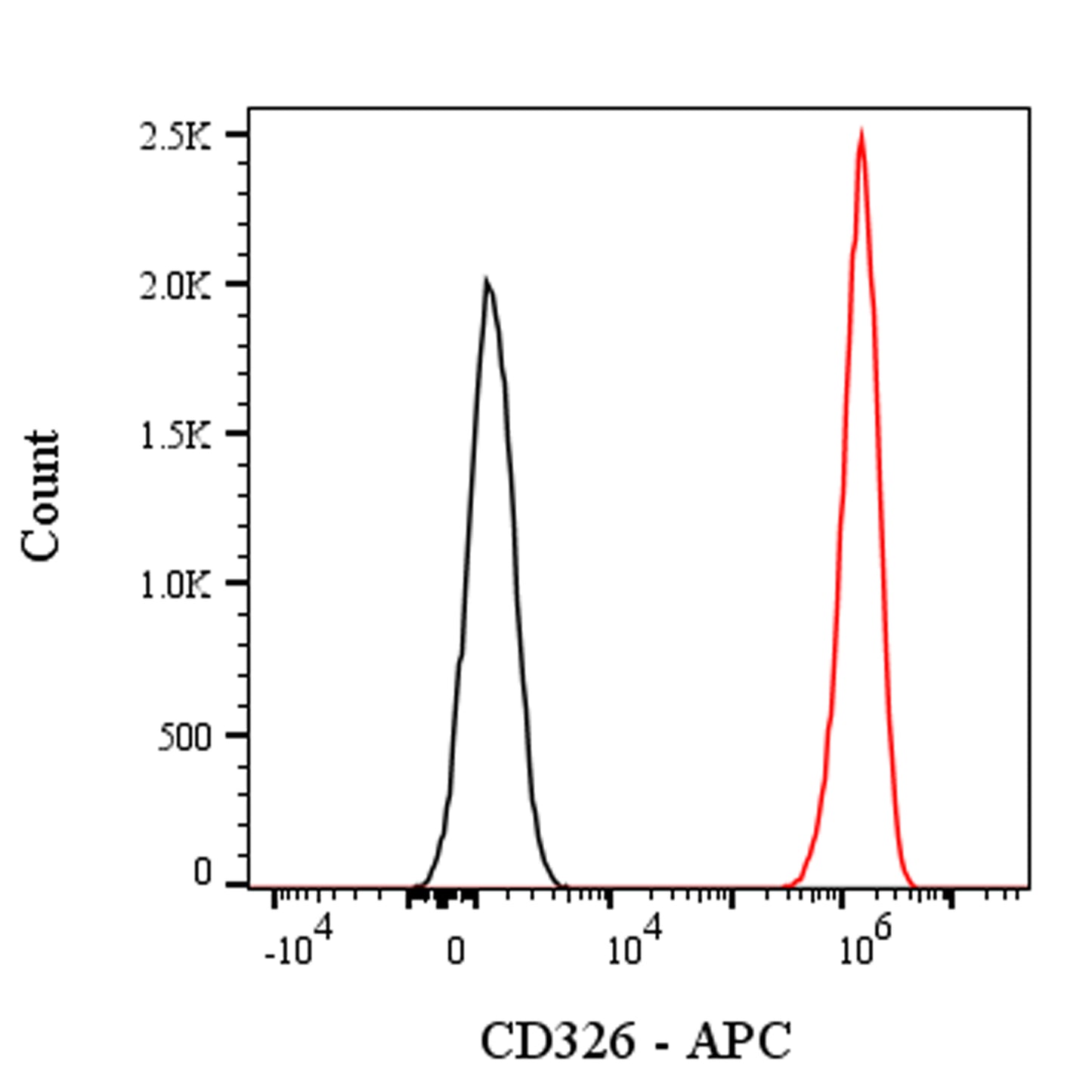
Flow cytometric analysis of human CD326 expression on HT-29 (Human colorectal adenocarcinoma epithelial cell). HT-29 was stained with APC Rabbit IgG Isotype Control (black line histogram) or SDT APC Rabbit Anti-Human CD326 Antibody (red line histogram) at 2 μl/test. Flow cytometry and data analysis were performed using Agilent NovoCyte Quanteon and FlowJo™ software.
APC Rabbit Anti-Human CD326 Antibody (S-1009-76)
APC Rabbit Anti-Human CD326 Antibody (S-1009-76)
Price:
Regular price
$200 USD
Regular price
Sale price
$200 USD
Unit price
per
For shipping services or bulk orders, you may request a quotation.
Secure checkout with

View full details
Product Details
Product Details
Product Specification
| Host | Rabbit |
| Antigen | CD326 |
| Synonyms | Epithelial cell adhesion molecule; Ep-CAM; Adenocarcinoma-associated antigen; Cell surface glycoprotein Trop-1; Epithelial cell surface antigen; Epithelial glycoprotein (EGP); Epithelial glycoprotein 314 (EGP314; hEGP314); CD326; GA733-2; M1S2; M4S1; MIC18; TACSTD1; TROP1; EPCAM |
| Immunogen | Recombinant Protein |
| Location | Cell membrane |
| Accession | P16422 |
| Clone Number | S-1009-76 |
| Antibody Type | Recombinant mAb |
| Isotype | IgG |
| Application | FCM |
| Reactivity | Hu |
| Positive Sample | HT-29 |
| Purification | Protein A |
| Concentration | 0.1 mg/ml |
| Conjugation | APC |
| Physical Appearance | Liquid |
| Storage Buffer | PBS, 1% BSA, 0.09% sodium azide |
| Stability & Storage | 12 months from date of receipt / reconstitution, 2 to 8 °C as supplied |
Dilution
| application | dilution | species |
| FCM | 2μl per million cells in 100μl volume | Hu |
Background
EpCAM (epithelial cell adhesion molecule, CD326) is a 35–40 kDa type-I transmembrane glycoprotein expressed on most epithelia, where it first assembles into cis-dimers that further cluster into tetramers to support homotypic cell–cell contacts, and then—through sequential proteolytic cleavage—releases its intracellular domain (EpICD) that partners with β-catenin, FHL2 and LEF1 to enter the nucleus and drive Wnt-dependent transcription of genes controlling proliferation, stemness and epithelial-to-mesenchymal transition, thereby functioning not merely as an adhesion molecule but as a dynamic signaling hub that is highly up-regulated in most carcinomas, marks circulating tumor and cancer stem cells, and serves as both a prognostic biomarker and a therapeutic target while mutations that truncate or mis-localize the protein underlie the severe congenital diarrhea disorder tufting enteropathy.
Picture
Picture
FC