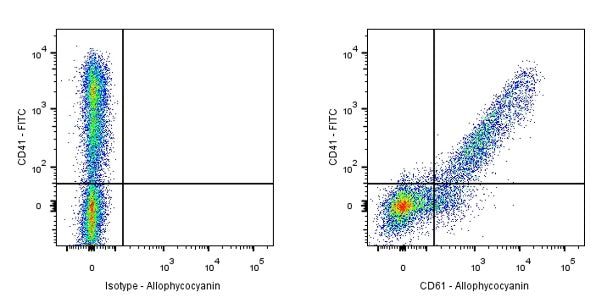
Flow cytometric analysis of Human CD61 expression on Human Peripheral Blood cells. Human Peripheral Blood cells were stained with FITC Mouse Anti-Human CD41a Antibody and either Mouse IgG1, κ Isotype Control (Left panel) or SDT APC Mouse Anti-Human CD61 Antibody (Right panel) at 5μl/test. Flow cytometry and data analysis were performed using BD FACSymphony™ A1 and FlowJo™ software.
APC Mouse Anti-Human CD61 Antibody (S-R618)
APC Mouse Anti-Human CD61 Antibody (S-R618)
Price:
Regular price
$250 USD
Regular price
Sale price
$250 USD
Unit price
per
For shipping services or bulk orders, you may request a quotation.
Secure checkout with

View full details
Product Details
Product Details
Product Specification
| Host | Mouse |
| Antigen | CD61 |
| Synonyms | Integrin beta-3; Platelet membrane glycoprotein IIIa (GPIIIa); ITGB3; GP3A |
| Location | Cell membrane, Cell projection |
| Accession | P05106 |
| Clone Number | S-R618 |
| Antibody Type | Mouse mAb |
| Isotype | IgG1,k |
| Application | FCM |
| Reactivity | Hu |
| Positive Sample | Human Peripheral Blood cells |
| Purification | Protein G |
| Concentration | 50 μg/ml |
| Conjugation | APC |
| Physical Appearance | Liquid |
| Storage Buffer | PBS, 1% BSA, 0.3% Proclin 300 |
| Stability & Storage | 12 months from date of receipt / reconstitution, 2 to 8 °C as supplied |
Dilution
| application | dilution | species |
| FCM | 5μl per million cells in 100μl volume | Hu |
Background
CD61 protein, also known as integrin β3 subunit (ITGB3), is a transmembrane glycoprotein with a molecular weight of approximately 105 kDa and belongs to the β subunit family of integrins. It forms heterodimeric integrin receptors by pairing with different α subunits (e.g., αIIb or αV). The αIIbβ3 complex (GPIIb/IIIa), predominantly expressed on platelet surfaces, mediates platelet binding to fibrinogen during vascular injury, driving platelet aggregation and thrombus formation. In contrast, αVβ3 is widely distributed in endothelial cells, osteoblasts, and tumor cells, participating in cell adhesion, migration, tissue repair, and angiogenesis. The intracellular domain of CD61 connects to the cytoskeleton via adaptor proteins (e.g., talin, kindlin) to regulate intracellular signaling. Dysfunction of CD61 can lead to Glanzmann thrombasthenia (a bleeding disorder caused by αIIbβ3 deficiency), while αIIbβ3 antagonists (e.g., abciximab) are used in antithrombotic therapy. Additionally, altered CD61 expression in tumor metastasis, bone remodeling, and inflammatory responses positions it as a potential biomarker for disease diagnosis and targeted therapies.
Picture
Picture
FC