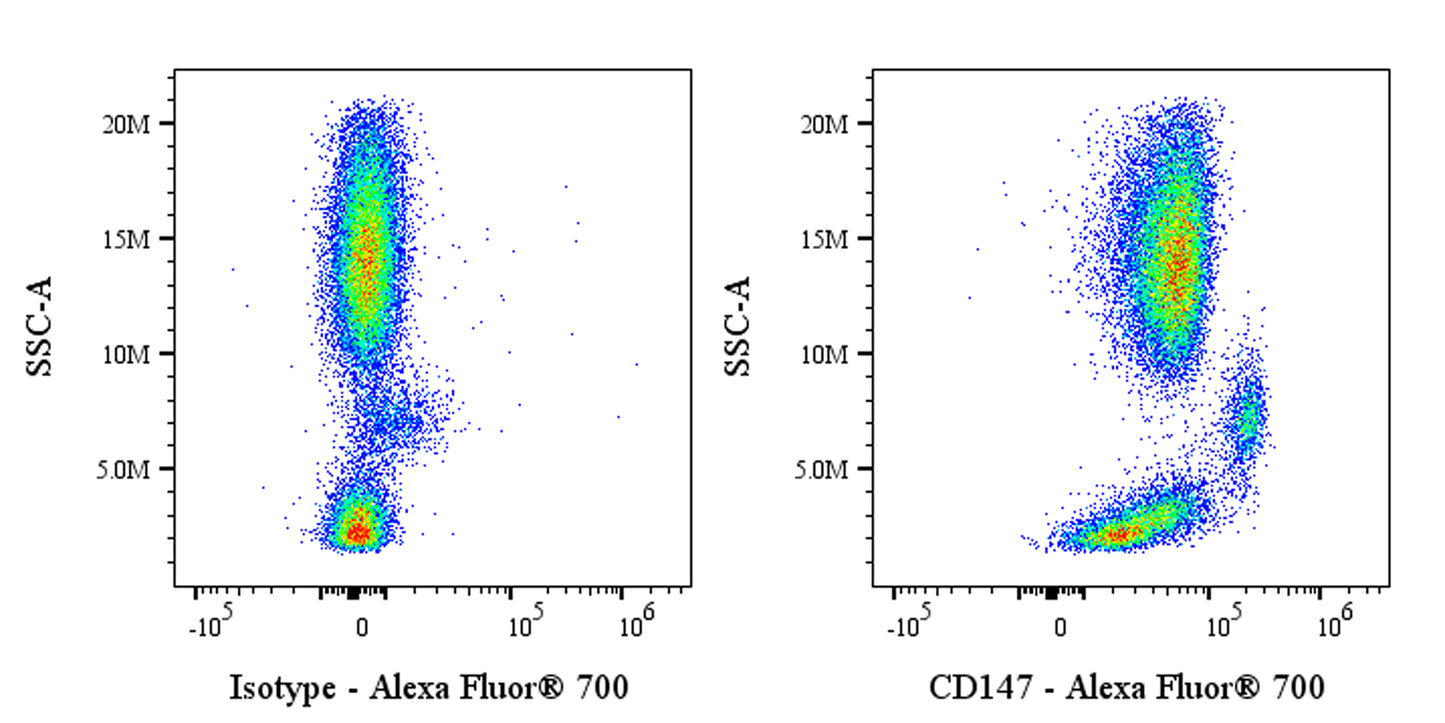
Flow cytometric analysis of human CD147 expression on human peripheral blood cells. Human peripheral blood cells were stained with Alexa Fluor® 700 Mouse IgG1, k Isotype Control (left panel) or SDT Alexa Fluor® 700 Mouse Anti-Human CD147 Antibody (right panel) at 5 μl/test. Flow cytometry and data analysis were performed using Agilent NovoCyte Quanteon and FlowJo™ software.
Alexa Fluor® 700 Mouse Anti-Human CD147 Antibody (S-2803)
Alexa Fluor® 700 Mouse Anti-Human CD147 Antibody (S-2803)
Price:
Regular price
$160 USD
Regular price
Sale price
$160 USD
Unit price
per
For shipping services or bulk orders, you may request a quotation.
Secure checkout with

View full details
Product Details
Product Details
Product Specification
| Host | Mouse |
| Antigen | CD147 |
| Synonyms | Basigin; 5F7; Collagenase stimulatory factor; Extracellular matrix metalloproteinase inducer (EMMPRIN); Hepatoma-associated antigen (HAb18G); Leukocyte activation antigen M6; BSG |
| Location | Endosome, Cell membrane, Endoplasmic reticulum |
| Accession | P35613 |
| Clone Number | S-2803 |
| Antibody Type | Mouse mAb |
| Isotype | IgG1,k |
| Application | FCM |
| Reactivity | Hu |
| Positive Sample | Human peripheral blood cells |
| Purification | Protein G |
| Concentration | 0.2 mg/ml |
| Conjugation | Alexa Fluor® 700 |
| Physical Appearance | Liquid |
| Storage Buffer | PBS, 1% BSA, 0.09% sodium azide |
| Stability & Storage | 12 months from date of receipt / reconstitution, 2 to 8 °C as supplied |
Dilution
| application | dilution | species |
| FCM | 5μl per million cells in 100μl volume | Hu |
Background
CD147, also known as EMMPRIN (extracellular matrix metalloproteinase inducer) or basigin, is a transmembrane glycoprotein and a member of the immunoglobulin superfamily. It is widely expressed in various tissues and cells and plays a crucial role in multiple physiological and pathological processes. CD147 is best known for its ability to induce the expression of matrix metalloproteinases (MMPs), which are involved in extracellular matrix remodeling, tumor invasion, and metastasis. It also regulates glycolysis and is associated with the Warburg effect in cancer cells, promoting tumor growth and resistance to therapy. Additionally, CD147 is involved in inflammation, immune responses, and the pathogenesis of diseases such as asthma, rheumatoid arthritis, and myocardial infarction. In neurological contexts, it contributes to processes ranging from normal retinal function to neuroinflammation in Alzheimer's disease. Its diverse functions and wide expression make it a promising target for therapeutic interventions in various diseases.
Picture
Picture
FC