Alexa Fluor® 488 Mouse Anti-Human CD2 Antibody (S-633-25)
Alexa Fluor® 488 Mouse Anti-Human CD2 Antibody (S-633-25)

Product Details
Product Details
Product Specification
| Host | Mouse |
| Antigen | CD2 |
| Synonyms | T-cell surface antigen CD2, Erythrocyte receptor, LFA-2, LFA-3 receptor, Rosette receptor, T-cell surface antigen T11/Leu-5, SRBC |
| Immunogen | Recombinant Protein |
| Location | Cell membrane |
| Accession | P06729 |
| Clone Number | S-633-25 |
| Antibody Type | Mouse mAb |
| Isotype | IgG1,k |
| Application | FCM |
| Reactivity | Hu |
| Purification | Protein G |
| Concentration | 0.2mg/ml |
| Conjugation | Alexa Fluor® 488 |
| Physical Appearance | Liquid |
| Storage Buffer | PBS, 1% BSA, 0.3% Proclin 300 |
| Stability & Storage | 12 months from date of receipt / reconstitution, -20 °C as supplied |
Dilution
| application | dilution | species |
| FCM | 1μg per million cells in 100μl volume |
Background
CD2 (cluster of differentiation 2) is a cell adhesion molecule found on the surface of T cells and natural killer (NK) cells. It has also been called T-cell surface antigen T11/Leu-5, LFA-2, LFA-3 receptor, erythrocyte receptor and rosette receptor. It interacts with other adhesion molecules, such as lymphocyte function-associated antigen-3 (LFA-3/CD58) in humans, or CD48 in rodents, which are expressed on the surfaces of other cells. CD2 is a specific marker for T cells and NK cells, and can therefore be used in immunohistochemistry to identify the presence of such cells in tissue sections. The great majority of T cell lymphomas and leukaemias also express CD2, making it possible to use the presence of the antigen to distinguish these conditions from B cell neoplasms.
Picture
Picture
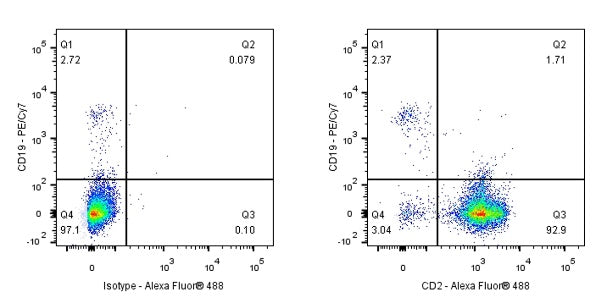
FC