UniOne® TR-FRET Human BCL-XL/CRBN PROTAC Binding Kit
UniOne® TR-FRET Human BCL-XL/CRBN PROTAC Binding Kit

Product Details
Product Details
Product Specification
| Host | Human |
| Stability & Storage | -80℃ |
Background
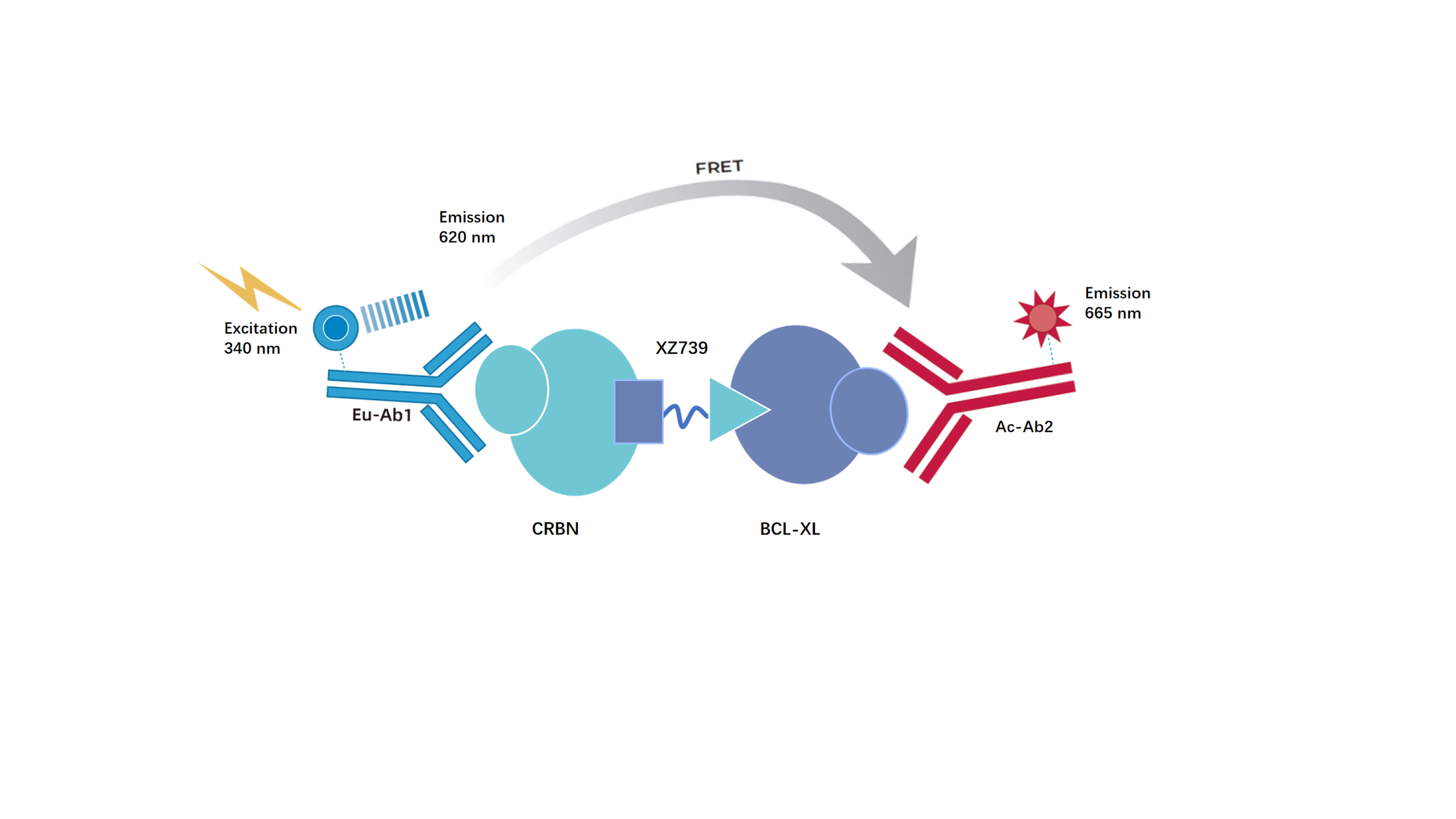
The assay kit employs homogeneous time-resolved fluorescence (TR-FRET) technology to measure the interaction between the DDB1/CRBN complex and BCL-XL mediated by the molecular glue XZ739 and test compounds. This method enables a simple, rapid, and high-throughput screening of small molecules capable of mediating the interaction between the DDB1/CRBN complex and BCL-XL.
As shown in the figure below, the interaction between DDB1/CRBN and BCL-XL is detected using a Eu-labeled anti-Tag1 antibody (TR-FRET donor) and an acceptor-labeled anti-Tag2 antibody (TR-FRET acceptor). The molecular glue XZ739 mediates the interaction between DDB1/CRBN and BCL-XL, bringing the donor and acceptor antibodies into proximity. Excitation of the donor antibody triggers fluorescence resonance energy transfer (FRET) to the acceptor antibody, resulting in a specific emission signal at 665 nm. This signal is proportional to the extent of interaction mediated by XZ739 with DDB1/CRBN and BCL-XL. The homogeneous assay is simple to perform and requires no washing steps.
Components
Here is the translated content in English while preserving the original formatting:```html
Component |
Concentration |
100T |
500T |
2500T |
10000T |
Storage Temperature |
Tag1-CRBN protein |
50× |
8μL |
40μL |
200μL |
800μL |
-80℃ |
Tag2- BCL-XL protein |
100× |
5μL |
20μL |
100μL |
400μL |
-80℃ |
XZ739 |
4mM |
5μL |
5μL |
25μL |
100μL |
-80℃ |
Anti-Tag1 Eu antibody |
100× |
5μL |
25μL |
125μL |
500μL |
-80℃ |
Anti-Tag2 Ac antibody |
25× |
20μL |
100μL |
500μL |
2000μL |
-80℃ |
Detection buffer |
10× |
400μL |
2mL |
10mL |
40mL |
-80℃ |
Note: Aliquot all components immediately after first thawing and store at the recommended temperature. Avoid storage after dilution and repeated freeze-thaw cycles.
```Protocol
1. Reagent Preparation
1.1 Before use, thaw all reagents at room temperature (equilibrate at room temperature for at least 30 min). The reaction volume for a 384-well shallow well plate is 20 μL (reagent volumes for the reaction system are shown in the table). Calculate the required volume before preparation and prepare as needed; the following preparation is for reference only, using 500 tests as an example.
Table 1. Reagent Preparation
Reagent Name |
Preparation |
Volume per Detection Well (μL) |
Detection buffer |
Add 2 mL of 10× Detection buffer 1 to 18 mL of deionized water, dilute to 1×, mix well, and set aside. |
- |
XZ739 |
According to the reaction system, dilute the compound to the desired concentration using 1× Detection buffer. |
2 |
Tag1-CRBN protein |
Take 40 μL of Tag1-CRBN protein stock solution, dilute to 2 mL with 1× Detection buffer, mix well, and set aside. |
4 |
Tag2- BCL-XL protein |
Take 20 μL of Tag2-BCL-XL protein stock solution, dilute to 2 mL with 1× Detection buffer, mix well, and set aside. |
4 |
Antibody Mix |
Take 25 μL of Anti-Tag1 Eu antibody stock solution, add 2.475 mL of 1× Detection buffer, mix well; take 100 μL of Anti-Tag2 Ac antibody stock solution, add 2.4 mL of 1× Detection buffer, mix well; mix both solutions 1:1 to prepare the Antibody Mix. |
10 |
1.2 Gradient Dilution of Test Samples
Using XZ739 as an example, the diluent is 1× Detection buffer. To minimize matrix effect interference, it is recommended to dilute with a solution matching the test sample matrix; adjust the test samples according to actual concentrations.
Table 2. XZ739 Gradient Dilution (Adjust According to Actual Conditions)
|
XZ739 Final Concentration (nM) |
XZ739 Preparation Concentration (nM) |
Preparation Method |
① |
10000 |
100000 |
1μL 4mM XZ739 +39μL 1× Detection buffer |
② |
5000 |
50000 |
20μL ① +20μL 1× Detection buffer |
③ |
2500 |
25000 |
20μL ② +20μL 1× Detection buffer |
④ |
1250 |
12500 |
20μL ③ +20μL 1× Detection buffer |
⑤ |
625 |
6250 |
20μL ④ +20μL 1× Detection buffer |
⑥ |
312.50 |
3125 |
20μL ⑤ +20μL 1× Detection buffer |
⑦ |
156.25 |
1562.50 |
20μL ⑥ +20μL 1× Detection buffer |
⑧ |
78.13 |
781.25 |
20μL ⑦+20μL 1× Detection buffer |
⑨ |
39.06 |
390.63 |
20μL ⑧+20μL 1× Detection buffer |
⑩ |
19.53 |
195.31 |
20μL ⑨+20μL 1× Detection buffer |
⑪ |
9.77 |
97.66 |
20μL ⑩+20μL 1× Detection buffer |
Blank |
0 |
0 |
20μL 1× Detection buffer |
2. Sample Addition and Controls
2.1 Test Samples: Add 4 μL Tag1-CRBN protein working solution, 4 μL Tag2-BCL-XL protein working solution, 2 μL gradient-diluted test samples, and 10 μL mixed Antibody Mix sequentially into the 384-well shallow well plate.
2.2 Positive Control Standard Curve: 4 μL Tag1-CRBN protein working solution, 4 μL Tag2-BCL-XL protein working solution, 2 μL gradient-diluted XZ739, and 10 μL Antibody Mix.
2.3 Blank Control Wells: Replace test samples with 2 μL 1× Detection buffer;
2.4 NC (Negative Control): Add 10 μL 1× Detection buffer and 10 μL Antibody Mix.
After adding all samples, centrifuge, seal with a plate sealing film, and incubate at room temperature for 2 hours.
3. Detection
Positive Control Standard Curve |
Test Samples |
Blank Control Wells |
NC |
|
2 μL Gradient-diluted XZ739 |
2 μL Gradient-diluted test samples |
2 μL 1× Detection buffer |
10 μL 1× Detection buffer Add 10 μL Antibody Mix |
4 μL Tag1-CRBN protein | |||
4 μL Tag2-BCL-XL protein | |||
10 μL Antibody Mix | |||
Seal the plate wells with a sealing film , and incubate at room temperature for 2 hours; | |||
Detect using a microplate reader compatible with TR-FRET. Excitation wavelength is 320/340 nm, and emission wavelengths detected are 620 nm and 665 nm.
[Result Calculation]
1) Calculate signal value (Ratio): Divide the fluorescence signal at 665 nm by the signal at 620 nm, then multiply by 10000.
Ratio = (665/620) ×10000
2) Calculate Net signal based on the signal value:
Net signal = (Std-NC)/NC×100
3) Calculate CV (%):
CV(%)= Standard Deviation/Mean Ratio × 100%
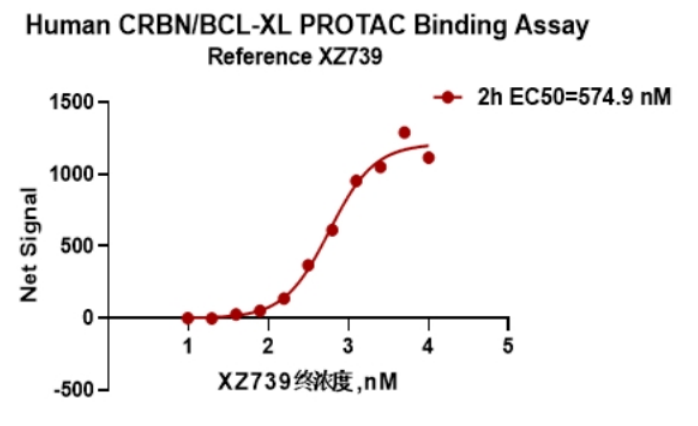
[Data Example]
The following data cannot replace experimental results and is provided only as an example; results may vary depending on the plate reader used.
3 /3Note: Recommended microplates (384-well, white, shallow well);