


Tissue Factor Protein, Human
Tissue Factor Protein, Human

Product Details
Product Details
Product Specification
| Species | Human |
| Synonyms | Coagulation Factor III,Tissue Factor,TF,F3,CD142 |
| Accession | P13726 |
| Amino Acid Sequence | Ser33-Glu251, with C-terminal His Tag |
| Expression System | HEK293 |
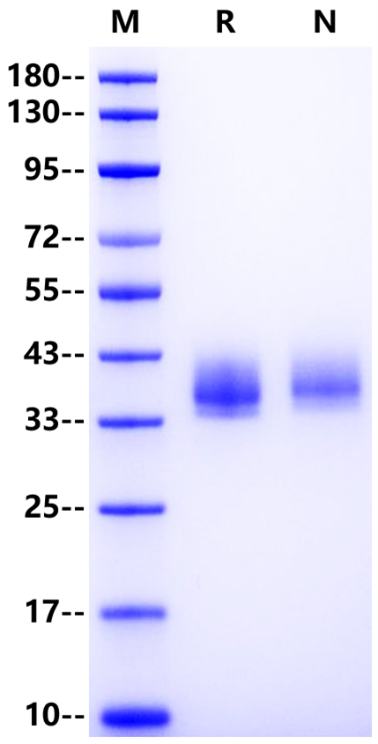
| Molecular Weight | 34-41kDa |
| Purity | >95% by SDS-PAGE |
| Endotoxin | <0.1EU/μg |
| Conjugation | Unconjugated |
| Tag | His Tag |
| Physical Appearance | Lyophilized Powder |
| Storage Buffer | PBS, pH7.4 |
| Reconstitution | Reconstitute at 0.1-1 mg/ml according to the size in ultrapure water after rapid centrifugation. |
| Stability & Storage |
· 12 months from date of receipt, lyophilized powder stored at -20 to -80℃. · 3 months, -20 to -80℃ under sterile conditions after reconstitution. · 1 week, 2 to 8℃ under sterile conditions after reconstitution. · Please avoid repeated freeze-thaw cycles. |
| Reference |
1、Morrissey J H. (2004) Tissue factor: a key molecule in hemostatic and nonhemostatic systems. Int J Hematol. 79(2): 103-108. 2、Milsom C. et al. (2008) Tissue factor and cancer. Pathophysiol Haemost Thromb. 36(3-4): 160-176. 3、Kasthuri R S. et al. (2009) Role of tissue factor in cancer. J Clin Oncol. 27(29): 4834-4838. |
Background
Tissue factor (TF) is an integral membrane protein that is essential to life. It is the high-affinity receptor and cofactor for factor (F)VII/VIIa and plays a primary role in both normal hemostasis and thrombosis. TF is a transmembrane glycoprotein with a 219-amino acid extracellular domain, a 23-residue transmembrane region, and a 21-residue intracellular domain. With a vascular injury, TF becomes exposed to blood and binds plasma factor VIIa, and the resulting complex initiates a series of enzymatic reactions leading to clot formation and vascular sealing. In cancer patients, tumors release TF-positive microvesicles into the circulation that may contribute to venous thrombosis. TF also has nonhemostatic roles. For instance, TF-dependent activation of the coagulation cascade generates coagulation proteases, such as FVIIa, FXa, and thrombin, which induce signaling in a variety of cells by cleavage of protease-activated receptors.
Picture
Picture
SDS-PAGE
ELISA
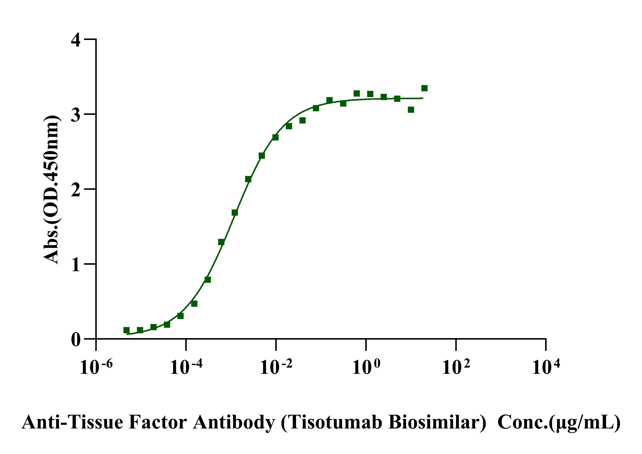
Immobilized Tissue Factor Protein, Human (Cat. No. UA040054) at 1.0μg/mL (100μL/well) can bind Anti-Tissue Factor Antibody (Tisotumab Biosimilar) with EC50 of 0.98-1.3ng/mL.

