

NT-proBNP, Human
NT-proBNP, Human
Price:
Regular price
$370 USD
Regular price
Sale price
$370 USD
Unit price
per
For shipping services or bulk orders, you may request a quotation.
Secure checkout with

View full details
Product Details
Product Details
Product Specification
| Species | Human |
| Synonyms | NT-proBNP;BNF, BNP, brain type natriuretic peptide, Gamma-brain natriuretic peptide, natriuretic peptide B, natriuretic peptide precursor B, natriuretic peptides B, natriuretic protein, NPPB |
| Accession | P16860 |
| Amino Acid Sequence | HHHHHHHPLG SPGSASDLET SGLQEQRNHL QGKLSELQVE QTSLEPLQES PRPTGVWKSR EVATEGIRGH RKMVLYTLRA PR |
| Expression System | E.coli |
| Molecular Weight | 9.2 kDa |
| Purity | >95%, by SDS-PAGE under reducing conditions |
| Endotoxin | <0.2EU/μg |
| Conjugation | Unconjugated |
| Tag | His Tag |
| Physical Appearance | Lyophilized powder |
| Storage Buffer | PBS (pH7.2) |
| Reconstitution | Reconstitute at less than 1 mg/mL according to the size in ultrapure water after rapid centrifugation . |
| Stability & Storage | · 12 months from date of receipt, -20 to -70 °C as supplied. |
Background
N-terminal-prohormone Brain Natriuretic Peptide (NT‑proBNP) has a molecular weight of 8.5 kDa and belongs to the natriuretic peptide family. Also known as B‑type natriuretic peptide, it exerts natriuretic, diuretic, and vasodilatory effects. NT‑proBNP is primarily synthesized and secreted by ventricular cardiomyocytes; cardiac dysfunction characterized by excessive ventricular loading and increased wall tension represents the main stimuli for its secretion, with the intensity of these stimuli directly proportional to NT‑proBNP levels. Consequently, NT‑proBNP can specifically and sensitively reflect changes in ventricular function, making it a clinically important biomarker for heart failure that plays an irreplaceable role in early screening and prognosis assessment. This product consists of human-derived NT‑proBNP protein recombinantly expressed in Escherichia coli BL21(DE3), with an N‑terminal His‑tag composed of six histidine residues. After multistep purification, the solution is filtered for sterilization, aliquoted, and lyophilized. |
Picture
Picture
SDS-PAGE
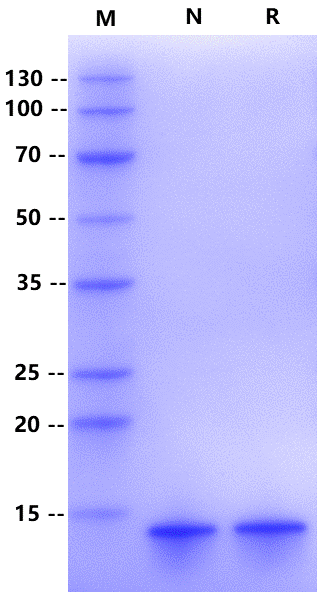
NT-proBNP,Human ,1μg on SDS-PAGE under Non-reducing and reducing condition. The purity is greater than 95%.
