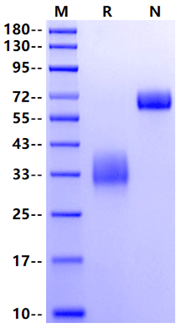
2μg (R: reducing condition, N: non-reducing condition).
LOX-1/OLR1 His Tag Protein, Human
LOX-1/OLR1 His Tag Protein, Human
Price:
Regular price
$604 USD
Regular price
Sale price
$604 USD
Unit price
per
For shipping services or bulk orders, you may request a quotation.
Secure checkout with

View full details
Product Details
Product Details
Product Specification
| Species | Human |
| Accession | P78380 |
| Amino Acid Sequence |
Ser61-Gln273, with N-terminal 9*His HHHHHHHHHSQVSDLLTQEQANLTHQKKKLEGQISARQQAEEASQESENELKEMIETLARKLNEKSKEQMELHHQNLNLQETLKRVANCSAPCPQDWIWHGENCYLFSSGSFNWEKSQEKCLSLDAKLLKINSTADLDFIQQAISYSSFPFWMGLSRRNPSYPWLWEDGSPLMPHLFRVRGAVSQTYPSGTCAYIQRGAVYAENCILAAFSICQKKANLRAQ |
| Expression System | HEK293 |
| Molecular Weight | 30-40kDa (Reducing) |
| Purity | >95% by SDS-PAGE |
| Endotoxin | <0.1EU/μg |
| Conjugation | Unconjugated |
| Tag | His Tag |
| Physical Appearance | Lyophilized Powder |
| Storage Buffer | PBS, pH7.4 |
| Reconstitution | Reconstitute at 0.1-1 mg/ml according to the size in ultrapure water after rapid centrifugation. |
| Stability & Storage | · 12 months from date of receipt, lyophilized powder stored at -20 to -80℃. · 3 months, -20 to -80℃ under sterile conditions after reconstitution. · 1 week, 2 to 8℃ under sterile conditions after reconstitution. · Please avoid repeated freeze-thaw cycles. |
| Reference |
1.Sawamura, T. et al. (1997) Nature 386:73. 2.Daugherty, A. et al. (2000) Curr. Opin. Cardiovasc. Pulm. Ren. Invest.Drugs. 2:223. 3.Platt, N. and S. Gordon (2001) J. Clin. Invest. 108:649. 4. Platt, N. and S. Gordon (1998) Chem. Biol. 5:R193. |
Background
Lectin-like oxidizedlow-density-lipoprotein receptor-1 (LOX-1), also known as oxidizedlow-density-lipoprotein receptor-1 (OLR-1), is a type II transmembrane receptorbelonging to the C-type lectin family. It also belongs to the functionallydefined scavenger receptor (SR) superfamily, whose members share the commonability to bind and internalize modified forms of Low Density Lipoproteins(LDL). LOX-1 is the first member of the class E scavenger receptor subfamily(SR-E). It binds and supports the internalization of multiple structurallyunrelated macromolecules including oxidized LDL, advanced glycation endproducts (AGE), activated platelets, bacteria, apoptotic or aged cells, andheat shock proteins. LOX-1 has also been implicated as an intestinal receptorinvolved in the transcytosis of pancreatic bile salt-dependent lipase. Thehuman LOX-1 gene encodes a 273 amino acid (aa) residue protein with a shortN-terminal intracellular domain, a transmembrane domain, an extracellularstalk/neck region followed by a C-type lectin-like domain (CTLD). The CTLD,which is required for ligand recognition, contains the six conserved cysteineresidues present in all C-type lectins, but lacks the Ca2+-binding residuesfound in classical C-type lectins. LOX-1 can be detected on activatedendothelial cells, vascular smooth muscle cells, macrophages, intestinal cellsand dendritic cells. The expression of LOX-1 is induced by proinflammatory orproatherogenic stimuli, as well as by oxidized LDL itself and hemodynamic or oxidativestress. Human LOX-1 exists on the cell surface as covalent homodimers, whichcan further associate into non-covalent-linked oligomers. Cell surface LOX-1can also be cleaved by yet unidentified proteases to release the soluble LOX-1extracellular domain. Binding and endocytosis of oxidized LDL by LOX-1 inducesoxidative stress, activates NF kappa B, and upregulates the expression of monocyte chemoattractant protein-1 andmatrix metalloproteases. LOX-1-dependent oxidized LDL uptake also inducesapoptosis by inducing the expression of the pro-apoptotic Bax anddownregulation of the anti-apoptotic Bcl-2. Oxidized LDL plays a key role in the pathogenesis of atherosclerosis andendothelial dysfunction. Blockade of LOX-1 functions may turn out to be asuitable target for the therapeutic intervention of atherosclerosis.
Picture
Picture
Bioactivity
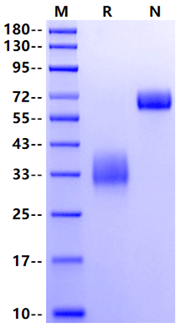
SDS-PAGE
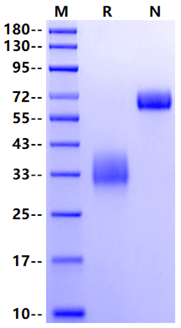
2μg (R: reducing condition, N: non-reducing condition).