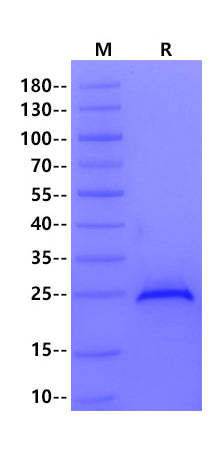
2μg (R: reducing condition).
KRAS(G12C) His Tag Protein, Human (Load GDP/GMPPNP)
KRAS(G12C) His Tag Protein, Human (Load GDP/GMPPNP)
Price:
Regular price
$130 USD
Regular price
Sale price
$130 USD
Unit price
per
For shipping services or bulk orders, you may request a quotation.
Secure checkout with

View full details
Product Details
Product Details
Product Specification
| Species | Human |
| Synonyms | K-Ras 2, Ki-Ras, c-K-ras, c-Ki-ras, GTPase KRas, KRAS2, RASK2 |
| Accession | P01116-2 |
| Amino Acid Sequence | Thr2-Cys185(G12C) with His Tag at the C-Terminus |
| Expression System | E.coli |
| Molecular Weight | 20-25kDa (Reducing) |
| Endotoxin | <1EU/μg |
| Conjugation | Unconjugated |
| Tag | His Tag |
| Physical Appearance | Liquid |
| Storage Buffer | 10mM HEPES pH7.5,150mM NaCl,1mM MgCl2,10%Glycerol |
| Stability & Storage | Stable for 12 months upon stored at -80℃ from the date of receipt. And avoid repeated freeze-thaws cycles. |
| Reference | 1.Kim D, Xue JY, Lito P. Targeting KRAS(G12C): From Inhibitory Mechanism to Modulation of Antitumor Effects in Patients. Cell. 2020 Nov 12;183(4):850-859. |
Background
KRAS(G12C) is an oncogenic mutant of the RAS family member KRAS, in which a glycine at position 12 is mutated to cysteine. This mutation disrupts GTP hydrolysis, causing the protein to remain persistently in the GTP-bound "activated state". The G12C mutation introduces a nucleophilic cysteine into the Switch II pocket, providing a binding site for covalent inhibitors (e.g., Sotorasib, Adagrasib), which lock KRAS in the inactive GDP-bound conformation. This mutation constitutively activates downstream pathways such as RAF-MEK-ERK and PI3K-AKT, driving cell proliferation and survival, making it a key driver in non-small cell lung cancer (NSCLC; ~14%), pancreatic cancer (~2%), and colorectal cancer (~3%). Clinically, KRAS(G12C) was once considered an "undruggable" target until the first covalent inhibitor, AMG 510, emerged in 2019, marking a major breakthrough in precision oncology. To date, the FDA has approved Sotorasib and Adagrasib for second-line treatment of KRAS G12C-mutant NSCLC. Combination therapy with EGFR inhibitors has also shown significant efficacy in colorectal cancer; however, acquired resistance remains a clinical challenge.
Picture
Picture
SDS-PAGE