WB result of Nanog Recombinant Rabbit mAb
Primary antibody incubation conditions: overnight at 4°C
Primary antibody: Nanog Recombinant Rabbit mAb at 1/1000 dilution
Lane 1: NIH/3T3 whole cell lysate 20 µg
Lane 2: F9 whole cell lysate 20 µg
Negative control: NIH/3T3 whole cell lysate
Secondary antibody: Goat Anti-rabbit IgG, (H+L), HRP conjugated at 1/10000 dilution
Predicted MW: 34 kDa
Observed MW: 34-40 kDa
Nanog Recombinant Rabbit mAb (S-3917-57)
Nanog Recombinant Rabbit mAb (S-3917-57)
Price:
Regular price
$100 USD
Regular price
Sale price
$100 USD
Unit price
per
For shipping services or bulk orders, you may request a quotation.
Secure checkout with

View full details
Product Details
Product Details
Product Specification
| Host | Rabbit |
| Antigen | Nanog |
| Immunogen | Synthetic Peptide |
| Location | Nucleus |
| Accession | Q80Z64 |
| Clone Number | S-3917-57 |
| Antibody Type | Recombinant mAb |
| Isotype | IgG |
| Application | WB, ChIP |
| Reactivity | Ms |
| Positive Sample | F9 |
| Purification | Protein A |
| Concentration | 2 mg/ml |
| Conjugation | Unconjugated |
| Physical Appearance | Liquid |
| Storage Buffer | PBS, 40% Glycerol, 0.05% BSA, 0.02% sodium azide |
| Stability & Storage | 12 months from date of receipt / reconstitution, -20 °C as supplied |
Dilution
| application | dilution | species |
| WB | 1:1000 | Ms |
| ChIP | 1:20-1:50 | Ms |
Background
Nanog is a homeobox transcription factor that plays a critical role in embryonic stem (ES) cells, serving as a key node in the core regulatory network that maintains pluripotency and self-renewal. It typically works in concert with Oct4 and Sox2 to lock cells in an undifferentiated pluripotent state by binding to regulatory regions of downstream target genes, activating pluripotency-associated genes (such as Rex1 and Tcl1) while repressing the transcription of differentiation-related genes (such as Gata6 and Hand1). Nanog expression exhibits dynamic heterogeneity, with its protein levels fluctuating within a cell population. This "seesaw" mechanism allows some cells to transiently exit pluripotency in preparation for differentiation, whereas cells with high Nanog expression can maintain self-renewal independently even in the absence of exogenous differentiation inhibitors like LIF. Furthermore, during somatic cell reprogramming into induced pluripotent stem cells (iPSCs), Nanog is not required for initiating reprogramming but significantly improves the quality and efficiency of the resulting fully reprogrammed cells. It also serves as a marker for the establishment of pluripotency in the post-implantation epiblast, but is rapidly silenced during subsequent differentiation, and its aberrant expression has been linked to the development of various germ cell tumors.
Picture
Picture
Western Blot
ChIP
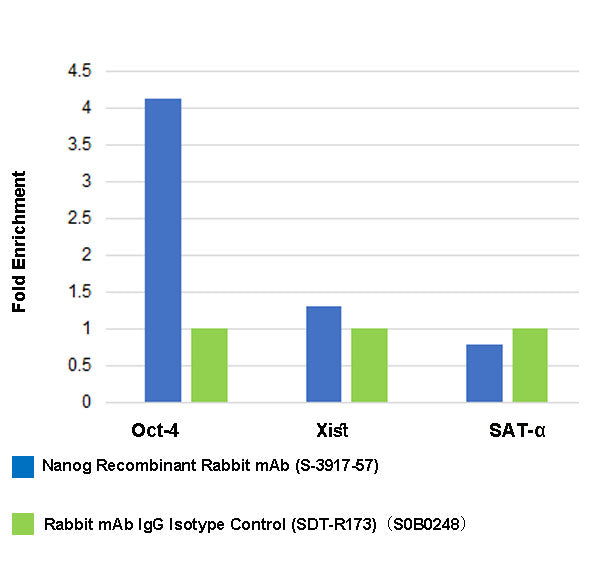
Chromatin immunoprecipitation (ChIP) was performed on F9 cells
cross - linked with 1% formaldehyde for 10 min, then chromatin was fragmented by sonication.
Parallel reactions used Nanog Recombinant Rabbit mAb (S-3917-57) and Rabbit mAb IgG Isotype Control (SDT-R173) at 1:20 for immunoprecipitation. Post - immunoprecipitation, both samples were washed, eluted, and cross-links reversed. Purified DNA was analyzed by qPCR. qPCR showed the enrichment of Oct-4, Xist and SAT-α in Nanog Recombinant Rabbit mAb (S-3917-57)
-immunoprecipitated sample.