庆大霉素残留检测试剂盒

庆大霉素残留检测试剂盒

Catalog Number: abs590011 Brand: Absin
Price:
Regular price $697 USD
Regular price Sale price $697 USD
Size:

For shipping services or bulk orders, you may request a quotation.
Secure checkout with
View full details

Product Details

Product Specification

Usage

1. Preparation
1 Kit preparation
Each component of the kit was left to equilibrate at room temperature 30min After starting the operation.
2 、   Consumables and equipment required to be brought by yourself
( 1 ) Microplate reader, constant temperature oscillator (or constant temperature incubator), plate washing machine, vortex oscillator, Timer;
( 2 ) High-precision pipettes and disposable tips ( 0.5-10µL 、 10-100µL 、 30-300µL 、 100-1000µL );
( 3 ) deionized water (used to prepare lotions ( 1× ));
( 4 ) absorbent paper, EP Tubes, disposable gloves.
3 Reagent preparation
( 1 ) Lotion ( 1× ) formulation of
Take the wash ( 20× ) 1 Portions, add 19 Parts of deionized water are prepared into a working concentration washing solution ( 1× )。 Lotion ( 20× If crystals are formed in), it should be placed at room temperature or 37℃ Shake gently in the water bath and wait until the crystals are completely dissolved before diluting. Unused lotion ( 20× ) should be placed in 2-8℃ Storage.
( 2 ) Preparation of chromogenic solution
The colored solution A Chromogenic Solution B Mix in equal volumes, mix well and place in the dark. (Note: The time cannot be left for too long, before general use 10min Formulation. Do not use if the mixed color solution has turned blue).
( 3 ) Preparation of standards
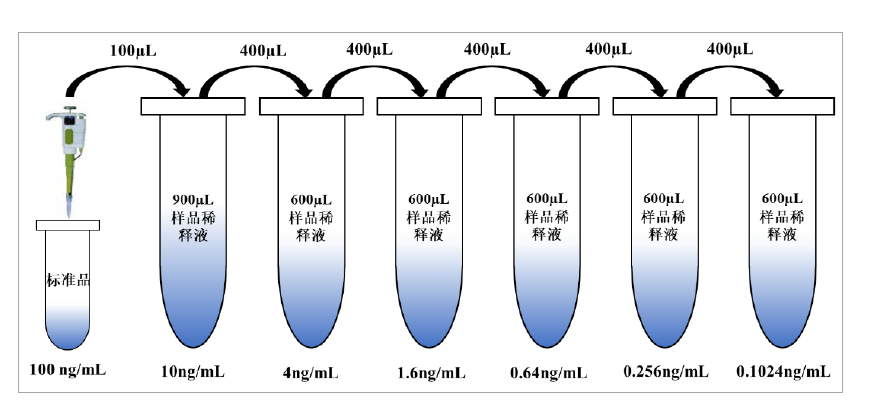
Dilute the standard with sample diluent to 10ng/mL , and then use 2.5 The standard is prepared by double dilution method (freshly prepared standard solution is used for each experiment), as shown in the following figure:

4 Sample preparation
Return the sample to room temperature and mix the sample before loading; If users need to dilute samples or high-concentration standards in the box, they can use the sample diluent in the box for dilution; If it is a cell sample, it is recommended to press before testing 3000rpm/min Rotational speed, centrifugation 5min , take the supernatant for detection.
Two, Operation Process
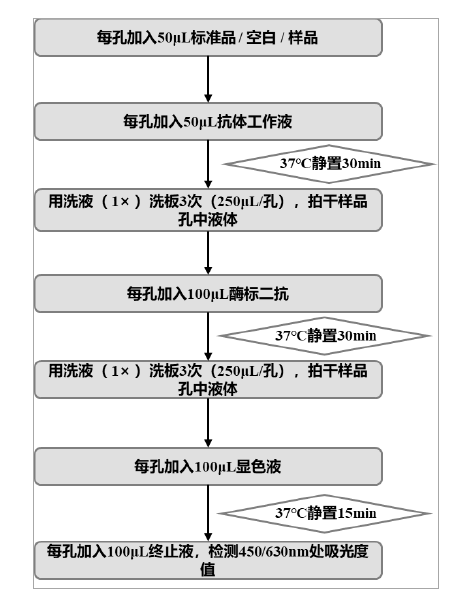
1 Operation diagram

2 Detailed operation steps
( 1 ) Return each component of the kit to room temperature 30min , take out the enzyme-labeled slats required for the test from the aluminum foil bag that has been equilibrated to room temperature, mark the sequence of slats with a marker (it is recommended to perform double-hole determination), seal the remaining slats with a sealing film and put them back into the aluminum foil bag, seal them well, and place them in 2-8℃ Save.
(Note: The slats are easy to fall off during the subsequent clapping process, so be careful to mark them)
( 2 ) Sample incubation: added to each well 50µL Standard / Blank (sample dilution) / Sample, then added 50µL Antibody working solution, sealed with plate sealing membrane, and then placed in 37℃ Static incubation in the dark 30min 。
(Note: The standard product must be added first. If the antibody is added first, it will directly react with the antigen on the plate; if the plate is not sealed or the plate is not sealed completely during the incubation process, the reaction solution will evaporate, resulting in errors in the experiment; Try to avoid light irradiation during all incubation processes)
( 3 ) Plate washing: After incubation, carefully peel off the plate sealing film, discard the liquid in the wells, and use the wash solution ( 1× ) wash plate 3 Times ( 250µL/ Well), pat dry the residual liquid in the sample well.
(Note: If hand washing plate is used, add washing solution ( 1× ), it is necessary to add liquid in the air, and it is best not to touch the inner wall of the hole with the gun tip; Each addition of the lotion ( 1× ) after standing 30s And vibrate slightly; When patting dry, pay attention to changing absorbent paper each time or patting dry on clean areas of the paper)
( 4 ) Enzyme-labeled secondary antibody incubation: adding enzyme-labeled secondary antibody to each well, 100µL/ Hole, seal the plate with a plate sealing film, and then place 37℃ Static incubation 30min 。
( 5 ) Plate washing: the method is the same as the step ( 3 )。
( 6 ) Color development: press the pre-configured color development solution 100µL/ The holes are added into an enzyme label plate, and the plate is sealed with a plate sealing membrane, 37℃ Static incubation in the dark 15min 。
( 7 ) Termination: add termination solution, 100µL/ The hole can be read after the color is evenly developed.
(Note: It is recommended to set in the microplate reader reading program 5-10s Shock)
( 8 ) Reading: Place the microplate in the microplate reader and set the wavelength to dual wavelength 450/630nm , read the absorbance value, and the determination should be terminated after 20min Within completion.
Three, Data processing
1 Calculation of absorbance value
The absorbance value of each standard or sample is OD450nm-OD630nm 。
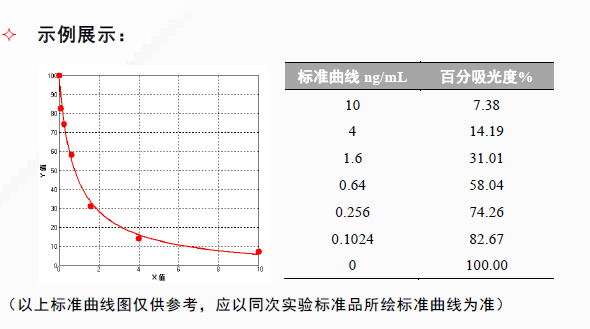
2 Calculation of percent absorbance
The average absorbance value of each standard or sample (double well) divided by 0ng/mL Of the standard The average absorbance value is multiplied by 100% , that is, the percentage absorbance:
Percent absorbance ( % )= B/B0×100%
B : Average absorbance value of standard or sample
B0 : 0ng/mL Average absorbance values of standards
3 Drawing and calculation of standard curve
Take the percent absorbance value of the standard as ordinate Y The standard concentration value is the abscissa X , painted Four parameters are recommended to prepare standard curves Logistic Mathematical model fitting equation:
Y=((A-D)/(1+(X/C)^B))+D
Substitute the percentage absorbance value of the sample into the standard curve, read out the corresponding concentration value of the sample, and multiply it by its corresponding dilution factor to obtain the actual concentration of gentamicin in the sample.
(Note: ① Per Chinese Pharmacopoeia <9012> 4. Relevant requirements in ligand binding analysis, four parameters are recommended for the fitting equation Logistic Mathematical models. ② Try to use the recommended dual-wavelength correction method, using 630nm Wavelength is corrected, OD450-OD630 Is the corrected OD The value can be directly used for calculation, or it can be blank corrected according to the data quality. If there is no dual wavelength microplate reader, read OD450 After the data, the data quality should be judged first, and then blank correction should be performed.)

Theory This kit uses indirect competition ELISA method to determine trace residues of gentamicin in samples. The microwell strip is pre-coated with conjugated antigen, and the residual gentamicin in the sample competes with the conjugated antigen pre-coated on the microwell strip for anti-gentamicin antibody. The enzyme-labeled secondary antibody is added, and then the color is developed by adding TMB substrate. Use a microplate reader to measure the absorbance (OD value) at the wavelength of 450nm/630nm, and the absorbance is negatively correlated with the content of gentamicin in the sample.
Description         Gentamicin is an alkaline compound extracted from the fermentation broth of the genus Monospore of Actinomyceaceae. It is a commonly used aminoglycoside antibiotic and widely used in culture medium preparation. Clinically, it is mainly used to treat bacterial infections. Gentamicin is neurotoxic, nephrotoxic and ototoxic. Its residues in animal food and biological drugs will affect human health and even cause allergic reactions. European and American countries and China all require its limited use.
        Gentamicin quantitative detection kit uses indirect competition ELISA Methods, the pre-coated gentamicin antigen on the microwell strip competed with the residual gentamicin in the sample to bind enzyme-labeled gentamicin monoclonal antibody, then the enzyme-labeled secondary antibody was added, and then by adding TMB The substrate developed color, and the absorbance value was detected by a microplate reader. The absorbance value was negatively correlated with the content of gentamicin in the sample. The operation time of this kit is only about one hour, and the linear range is 0.1ng/mL-10ng/mL 。
        When doing the linearity verification of gentamicin raw materials, it is recommended to dilute gentamicin raw materials within the linear range of the kit before determination, and dilute them according to a certain proportion to at least 5 The detected concentration is linearly correlated with the dilution factor.  
        Specificity should be verified for other substances present in the process. It is recommended to use high-concentration and low-concentration quality control samples, and add increasing concentrations of relevant interfering substances for specific investigation. The matrix to which no analyte is added should also be measured at the same time. The accuracy of the controls should be within a range and the measured values of the matrix without the addition of analyte should be below the lower limit of quantification.  
Product Features:
Strong specificity: no cross-reaction with penicillin, streptomycin sulfate, kanamycin, ampicillin
High sensitivity: the kit sensitivity is 0.1ng/mL
Convenient and efficient: using the two-step method, just 1 The results can be obtained in about hours
Excellent performance: good calibration curve, high accuracy and good repeatability
Product performance indicators:
Limit of detection: < 0.1 ng/mL ;  
Limit of quantification: 0.1 ng/mL 
Linearity Range: 0.1-10 ng/mL 
Accuracy (spiked recovery): 70%-130% 
Accuracy (measurement deviation): ≤15% 
Repeatability (intra-batch difference): ≤15% 
Specificity:
Antibiotics Cross-reactivity rate
Gentamicin 100%
Streptomycin sulfate < 1%
Kanamycin < 1%
Penicillin < 1%
Ampicillin < 1%
Composition
serial number Name Specifications Save
1 Enzyme plate 8×12 Strip 2-8℃ Protect from light
2 Standard ( 100 ng/mL ) 1mL 2-8℃ Protect from light
3 Antibody working solution 7mL 2-8℃
4 Enzyme-labeled secondary antibody 12mL 2-8℃
5 Sample dilution 30mL 2-8℃
6 Lotion ( 20× ) 30mL 2-8℃
7 Chromogenic liquid A 8mL 2-8℃ Protect from light
8 Chromogenic liquid B 8mL 2-8℃ Protect from light
9 Stop liquid 15mL 2-8℃
10 Sealing film 3 Zhang -
General Notes 1. All components in the kit must be restored to room temperature (20-25 ℃) before use.  
2. Mix all components thoroughly before use. The standard product needs to be shortly centrifuged for 5 seconds to concentrate all the liquid on the tube wall and lid at the bottom of the tube; All reagents were returned to 2-8 °C immediately after use.  
3. The kit must be used within the validity period, and the corresponding standard curve must be prepared for each test. It is not recommended to use different batches of related reagents in mixed batches.  
4. When adding liquid to the microplate, be careful not to touch the bottom of the microplate to prevent damage to the coating layer. Replace the sample loading tank and suction tip in time between different samples and steps to avoid cross-contamination.  
5. When patting the slats dry after washing, be careful to prevent the slats from falling off, and be careful not to reuse the sealing film.  
6. High concentration may produce black flocs during color development, which is a normal phenomenon, and the slight degree will not affect the final reading result.  
7. When reading, pay attention to check whether the detection wavelength and fitting equation are correct.  
8. Only by strictly abiding by the operation methods of the instructions and using all the reagents supporting this kit can the best detection effect be guaranteed.  
9. Differences in test results can be caused by a variety of factors, including the operation of the experimenter, the use of the pipette, the plate washing technique, the reaction time or temperature, the storage of the kit, etc.  
10. The company is only responsible for the kit itself, and is not responsible for the sample consumption caused by the use of the kit. Users are requested to fully consider the possible usage of samples and reserve sufficient samples before use.  
11. The termination solution in this kit is acid solution, so special attention should be paid to operation.  
12. Operators should wear personal protective equipment, such as laboratory coats, gloves, masks and goggles.
Storage Temp.

The kit should be stored at 2-8 ℃, protected from light, and the shelf life is 12 months. Note that the unused kit after opening should still be stored at 2-8 ℃ in the dark.