Immobilized CD3 epsilon Fc Chimera Protein, Human (Cat. No. UA010199) at 2 μg/mL (100 μL/well) can bind Human CD3 delta, His tag with EC50 of 3.8-4.6 μg/ ml.
Human CD3 delta Protein, His Tag
Human CD3 delta Protein, His Tag
Price:
Regular price
$45 USD
Regular price
Sale price
$45 USD
Unit price
per
For shipping services or bulk orders, you may request a quotation.
Secure checkout with

View full details
Product Details
Product Details
Product Specification
| Species | Human |
| Synonyms | T-cell surface glycoprotein CD3 delta chain, T-cell receptor T3 delta chain, CD3d |
| Accession | P04234 |
| Amino Acid Sequence | Protein sequence(P04234, Phe22-Ala105, with C-10*His)FKIPIEELEDRVFVNCNTSITWVEGTVGTLLSDITRLDLGKRILDPRGIYRCNGTDIYKDKESTVQVHYRMCQSCVELDPATVAGGGGSHHHHHHHHHH |
| Expression System | HEK293 |
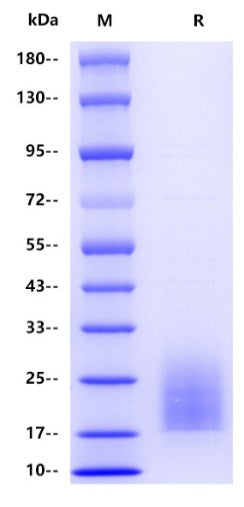
| Molecular Weight | Predicted MW: 11.2 kDaObserved MW: 18-25 kDa |
| Purity | >90% by SDS-PAGE |
| Endotoxin | <1EU/μg |
| Conjugation | Unconjugated |
| Tag | with C-His Tag |
| Physical Appearance | Lyophilized powder |
| Storage Buffer | Lyophilized from a 0.2 μm filtered solution of PBS, pH7.4 with 3% trehalose. |
| Reconstitution | Reconstitute no more than 1 mg/mL according to the size in deionized water after rapid centrifugation. |
| Stability & Storage | 12 months from date of receipt, -20 to -70 °C as supplied. |
Background
CD3 delta is part of the T-cell receptor/CD3 complex (TCR/CD3 complex) and is involved in T-cell development and signal transduction. The encoded membrane protein represents the delta subunit of the CD3 complex, and along with four other CD3 subunits, binds either TCR alpha/beta or TCR gamma/delta to form the TCR/CD3 complex on the surface of T-cells. Defects in this gene are a cause of severe combined immunodeficiency autosomal recessive T-cell-negative/B-cell-positive/NK-cell-positive (SCIDBNK). Two transcript variants encoding different isoforms have been found for this gene.
Picture
Picture
Bioactivity
SDS-PAGE
2μg(R: reducing conditions)