Human IL-13 Kit (HICA)
Human IL-13 Kit (HICA)

Product Details
Product Details
Product Specification
| Stability & Storage | Store at 2–8°C, protected from light, for 6 months. After reconstitution, the calibrator may be aliquoted and stored at −20°C for up to 3 months; avoid repeated freeze-thaw cycles. |
Background
Human interleukin-13 (Human Interleukin 13, IL-13) is a type I cytokine secreted by activated Th2 cells, with a molecular weight of approximately 12 kDa, and is an important member of the Th2 cytokine family. IL-13 exerts multiple biological functions in immune regulation, particularly playing a critical role in B-cell maturation, differentiation, and immunoglobulin class switching. It can upregulate the expression of CD23 and MHC class II molecules on the B-cell surface and promote class switching toward IgE production, thereby serving as a central mediator in allergic immune responses.In addition,IL-13 exerts a significant negative regulatory effect on the monocyte-macrophage system, inhibiting the production of pro-inflammatory cytokines and chemokines, thereby participating in the regulation of inflammatory responses. In the lungs, IL-13 is one of the key mediators that induce allergic airway diseases, capable of inducing airway hyperresponsiveness, goblet cell metaplasia, and excessive mucus secretion. These pathological changes collectively lead to airway obstruction and impaired pulmonary function, forming an important pathophysiological basis for allergic airway diseases such as asthma.Given thatIL-13 plays a crucial role in allergic diseases, fibrotic disorders, and the immune responses associated with certain cancers, making it a focus of research on disease mechanisms, drug efficacy evaluation, and biomarker development. Researchers often assess immune response status, inflammation severity, and the effects of pharmacological interventions by measuring IL-13 expression levels. The Human IL-13 ELISA Kit provides a sensitive, specific, and efficient tool for the quantitative in vitro detection of IL-13 concentrations in samples such as cell culture supernatants, serum, and plasma, and is suitable for basic biomedical research and drug screening applications..
Principle of the test:
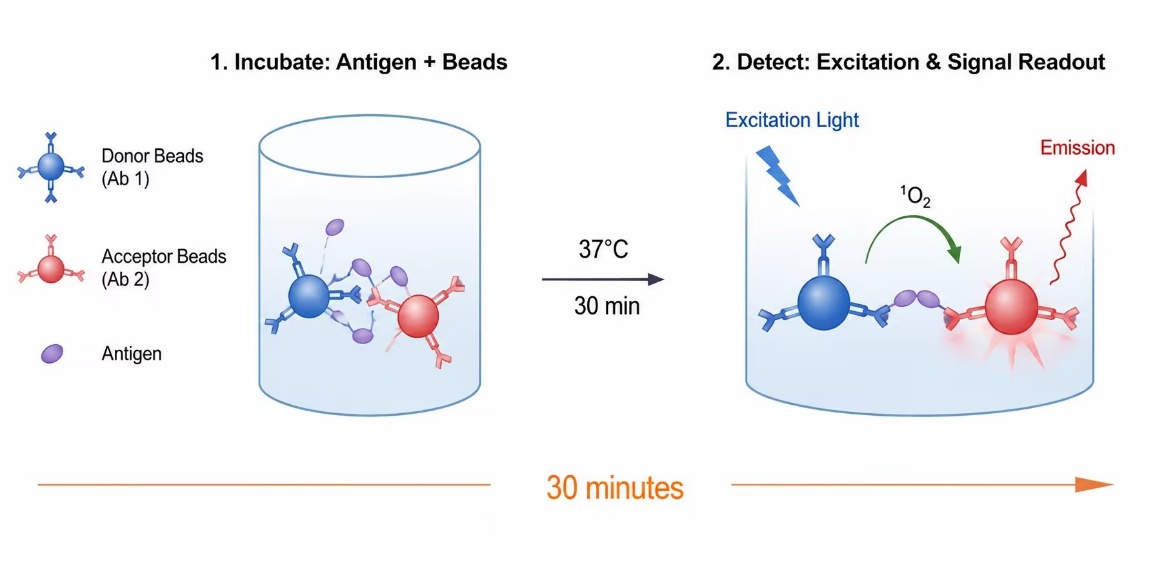
This kit employs a homogeneous chemiluminescence assay based on the sandwich ELISA method.Homogeneous Immuno Chemiluminescence Assay, HICA) to detect cytokine concentrations, with simple operation,No washing required.
The detection system includes two types of microspheres:DonorMicrosphere conjugation targeting the target proteinAntibody 1,ReceptorMicrosphere conjugationAntibody to the target protein 2At the time of the reaction, the target protein binds to the antibody and the microbeads, forming an immune complex that brings the two types of microbeads closer together. When the distance between the donor microbead and the receptor microbead is less than 200 nm, the singlet oxygen generated upon light excitation can be transferred to the receptor microbead, triggering chemiluminescence; conversely, if the target protein is absent and the microbeads are too far apart, no signal is produced.
By detecting the intensity of the chemiluminescence signal, quantitative analysis of the target protein can be achieved. This method is characterized by its simple operation, rapid reaction, and high sensitivity.
Components
Name |
Specifications |
Component specifications |
Testing reagentR1 |
250T |
14mul /Pipe ×1 |
1200T |
seventymul /Pipe ×1 |
|
Testing reagentR2 |
250T |
14mul /Pipe ×1 |
1200T |
seventymul /Pipe ×1 |
|
Calibrator |
250T |
30ngLyophilized product ×1 |
1200T |
30ngLyophilized product ×5 |
|
Reagent diluent |
250T |
5.5 mL/Bottle ×1 |
1200T |
27.5 mL/Bottle ×1 |
|
Calibrator diluent |
250T |
1 ml/Pipe ×1 |
1200T |
1 ml/Pipe ×5 |
Note: It is recommended to use a microplate for the plates used.384Shallow holeor384,96Orifice plate, white or gray)
Guidelines
Reagents R1 and R2 should be used protected from light; sample addition and incubation are recommended to be performed under green light or dim lighting (100 LUX).
Each assay requires recalibration, with each concentration level of the calibrator tested in at least duplicate wells, using four-parameter (weighting 1/Y²) curve fitting for calculation.
During incubation, temperature and time must be strictly controlled; it is recommended to cover microplates with a film, and an ELISA reader equipped with the ALPHA function should be used.
Components from different kit lots must not be mixed.