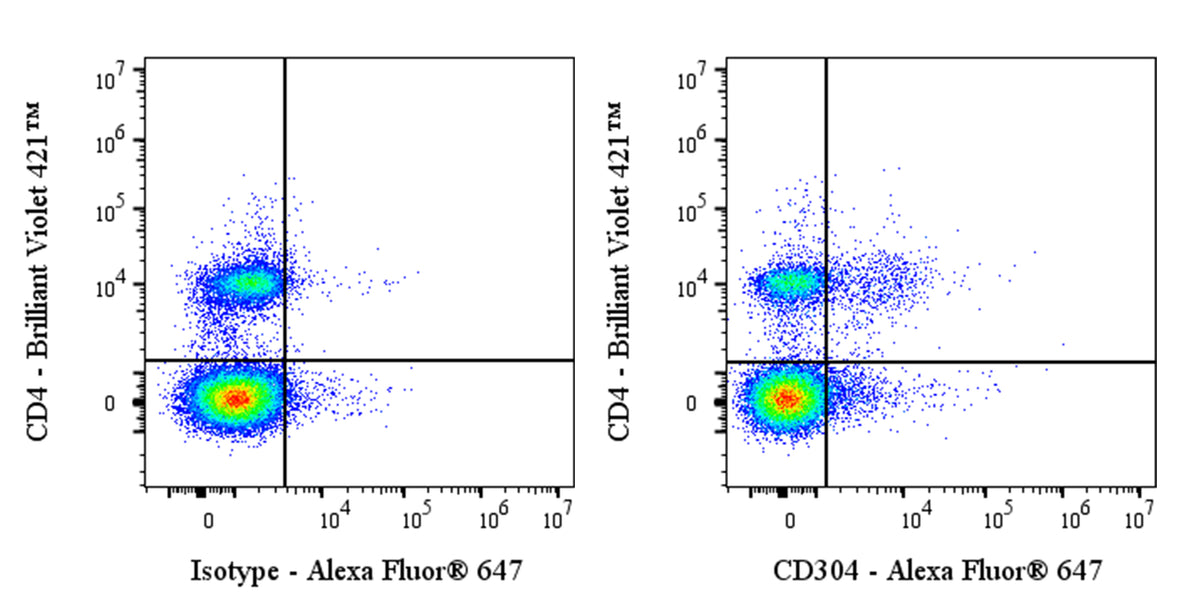
Flow cytometric analysis of C57BL/6 mouse splenocytes labelling mouse CD304 antibody at 1/500 dilution (1 μg) / (right panel) compared with a Rat IgG2a, κ Isotype Control / (left panel). Goat Anti-Rat IgG Alexa Fluor® 647 was used as the secondary antibody. Then cells were stained with CD4 - Brilliant Violet 421™ antibody separately. Total viable cells, as determined by Fixable Viability Dye 515 (S0D0013), were used for analysis. Flow cytometry and data analysis were performed using Agilent NovoCyte Quanteon and FlowJo™ software.
Rat Anti-Mouse CD304 Antibody (S-R693)
Rat Anti-Mouse CD304 Antibody (S-R693)
Price:
Regular price
$100 USD
Regular price
Sale price
$100 USD
Unit price
per
For shipping services or bulk orders, you may request a quotation.
Secure checkout with

View full details
Product Details
Product Details
Product Specification
| Host | Rat |
| Antigen | CD304 |
| Synonyms | Neuropilin-1; A5 protein; Nrp1; Nrp |
| Accession | P97333 |
| Clone Number | S-R693 |
| Antibody Type | Rat mAb |
| Isotype | IgG2a,k |
| Application | FCM |
| Reactivity | Ms |
| Positive Sample | C57BL/6 mouse splenocytes |
| Purification | Protein G |
| Concentration | 2 mg/ml |
| Conjugation | Unconjugated |
| Physical Appearance | Liquid |
| Storage Buffer | PBS pH7.4 |
| Stability & Storage | 12 months from date of receipt / reconstitution, 2 to 8 °C as supplied |
Dilution
| application | dilution | species |
| FCM | 1:500 | Ms |
Background
The CD304 protein, also known as Neuropilin-1, BDCA-4, or VEGF165R, is a type I transmembrane glycoprotein of approximately 130-140 kD encoded by the NRP1 gene. Its extracellular region contains two CUB domains, two coagulation factor V/VIII homology domains, and one MAM domain. As a co-receptor lacking intrinsic enzymatic activity, CD304 forms complexes with transmembrane proteins such as VEGFR and Plexin, playing a key regulatory role in angiogenesis, axon guidance, and tumor metastasis. It binds VEGF165 to promote endothelial cell chemotaxis and Semaphorin 3A to mediate chemorepulsive signals in neuronal development. The protein is expressed on plasmacytoid dendritic cells, neurons, endothelial cells, and certain Tfh subsets, and is highly expressed in various cancers—its elevated levels in prostate cancer are significantly associated with poor prognosis. Notably, CD304 also serves as an auxiliary entry receptor for SARS-CoV-2 by recognizing the CendR motif in the viral spike protein, thereby enhancing viral infectivity.
Picture
Picture
FC