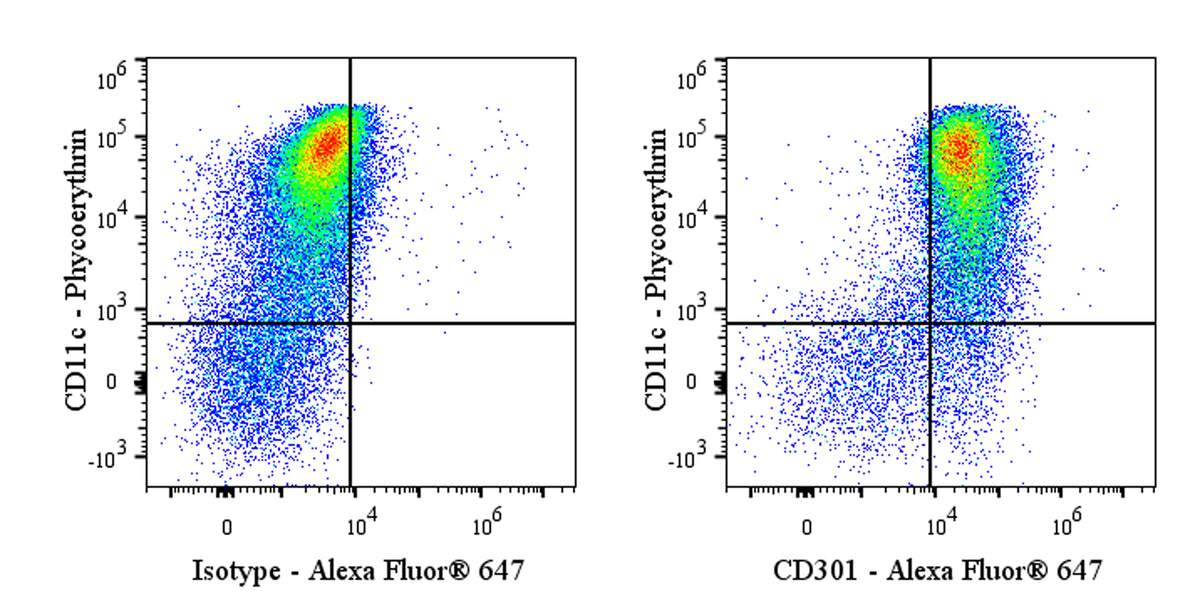
Flow cytometric analysis of BMDC (Bone Marrow-Derived Dendritic Cells) labelling Mouse CD301 antibody at 1/200 dilution (1 μg) / (right panel) compared with a Rat IgG2b, κ Isotype Control / (left panel). Goat Anti-Rat IgG Alexa Fluor® 647 was used as the secondary antibody. Then cells were stained with CD11c - PE antibody separately. Flow cytometry and data analysis were performed using Agilent NovoCyte Quanteon and FlowJo™ software.
Rat Anti-Mouse CD301 Antibody (S-R708)
Rat Anti-Mouse CD301 Antibody (S-R708)
Price:
Regular price
$100 USD
Regular price
Sale price
$100 USD
Unit price
per
For shipping services or bulk orders, you may request a quotation.
Secure checkout with

View full details
Product Details
Product Details
Product Specification
| Host | Rat |
| Antigen | CD301 |
| Synonyms | C-type lectin domain family 10 member A; MMGL; Macrophage asialoglycoprotein-binding protein 1 (M-ASGP-BP-1); Macrophage galactose/N-acetylgalactosamine-specific lectin; Mgl; Mgl1; Clec10a |
| Location | Membrane |
| Accession | P49300 |
| Clone Number | S-R708 |
| Antibody Type | Rat mAb |
| Isotype | IgG2b,k |
| Application | FCM |
| Reactivity | Ms |
| Positive Sample | BMDC |
| Purification | Protein G |
| Concentration | 2 mg/ml |
| Conjugation | Unconjugated |
| Physical Appearance | Liquid |
| Storage Buffer | PBS pH7.4 |
| Stability & Storage | 12 months from date of receipt / reconstitution, 2 to 8 °C as supplied |
Dilution
| application | dilution | species |
| FCM | 1:200 | Ms |
Background
CD301, also known as CLEC10A (C-type lectin domain family 10 member A) or MGL (Macrophage Galactose-type C-type Lectin), is a 30–40 kDa type II transmembrane glycoprotein belonging to the C-type lectin superfamily that functions as a calcium-dependent pattern recognition receptor and endocytic receptor predominantly expressed on macrophages, immature myeloid dendritic cells, Langerhans cells, and alternatively activated (tolerogenic) macrophages. Structurally, it features a short cytoplasmic tail containing an endocytosis motif (YxxΦ), a single transmembrane domain, and an extracellular carbohydrate recognition domain (CRD) that exhibits unique specificity for terminal nonsialylated N-acetylgalactosamine (GalNAc) and galactose residues, including the tumor-associated Tn antigen and Lewis structures, enabling it to distinguish between healthy and malignant tissues while recognizing pathogenic glycans from bacteria, parasites, and viruses such as Ebola and Marburg. Through binding these carbohydrate ligands, CD301 orchestrates diverse immunological functions: it mediates antigen internalization and presentation via MHC molecules to bridge innate and adaptive immunity, modulates immune responses by inducing interleukin-10 production and regulating T cell activation or apoptosis, and plays dual roles in promoting either immune tolerance or anti-tumor immunity depending on context. Additionally, CD301 is implicated in metabolic regulation through its expression on adipose tissue macrophages where it influences monocyte trafficking and phenotypic switching in obesity, and genetic variants have been associated with type 2 diabetes susceptibility, highlighting its significance as a potential therapeutic target for cancer immunotherapy, infectious disease control, and metabolic disorders.
Picture
Picture
FC