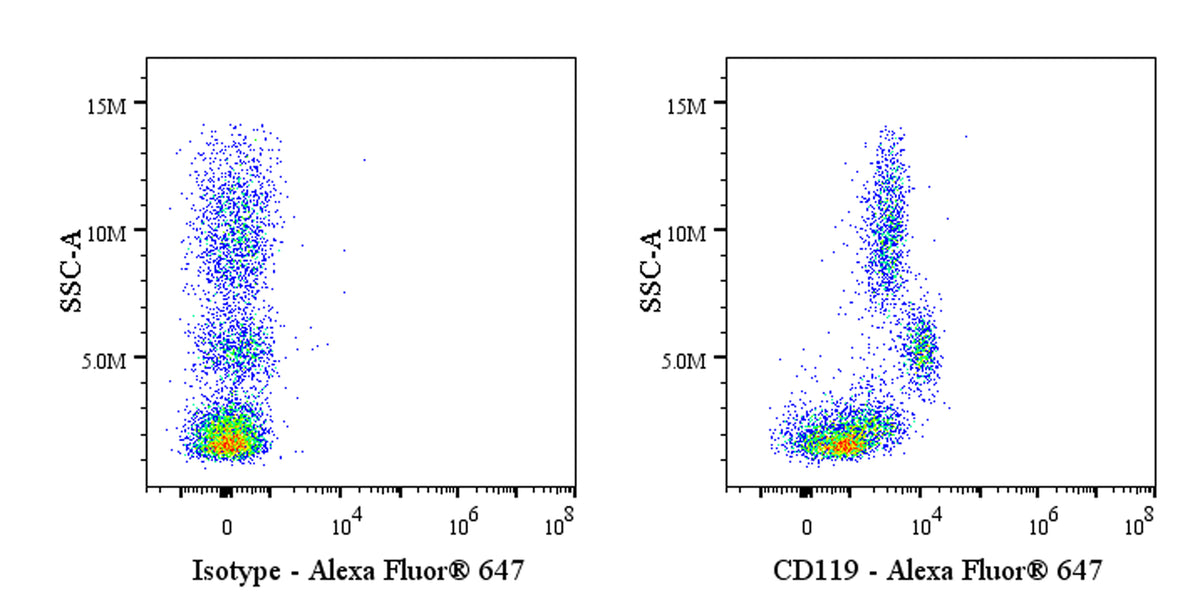
Flow cytometric analysis of human peripheral blood cells labelling CD119 antibody at 1/200 dilution (1 μg) / (right panel) compared with a Mouse IgG2b, κ Isotype Control / (left panel). Goat Anti-Mouse IgG Alexa Fluor® 647 was used as the secondary antibody. Flow cytometry and data analysis were performed using Agilent NovoCyte Quanteon and FlowJo™ software.
Mouse Anti-Human CD119 Antibody (S-3124)
Mouse Anti-Human CD119 Antibody (S-3124)
Price:
Regular price
$100 USD
Regular price
Sale price
$100 USD
Unit price
per
For shipping services or bulk orders, you may request a quotation.
Secure checkout with

View full details
Product Details
Product Details
Product Specification
| Host | Mouse |
| Antigen | CD119 |
| Synonyms | Interferon gamma receptor 1; IFN-gamma receptor 1; IFN-gamma-R1; CDw119; Interferon gamma receptor alpha-chain; IFNGR1 |
| Location | Cell membrane |
| Accession | P15260 |
| Clone Number | S-3124 |
| Antibody Type | Mouse mAb |
| Isotype | IgG2b,k |
| Application | FCM |
| Reactivity | Hu |
| Positive Sample | Human Peripheral Blood cells |
| Purification | Protein A |
| Concentration | 2 mg/ml |
| Conjugation | Unconjugated |
| Physical Appearance | Liquid |
| Storage Buffer | PBS pH7.4 |
| Stability & Storage | 12 months from date of receipt / reconstitution, 2 to 8 °C as supplied |
Dilution
| application | dilution | species |
| FCM | 1:200 | Hu |
Background
CD119 protein, also known as interferon-gamma receptor alpha chain (IFN-γRα), is a critical member of the type II cytokine receptor family on the cell surface. It serves as the high-affinity and specific binding subunit for interferon-gamma (IFN-γ) and, together with the β chain (IFN-γRβ), forms the functional receptor dimer responsible for recognizing and transmitting IFN-γ signals. IFN-γ is primarily produced by activated T cells and natural killer cells and is a central cytokine regulating both innate and adaptive immunity. Upon binding of IFN-γ, CD119 induces receptor subunit aggregation and activates the associated JAK1/JAK2 kinases, leading to phosphorylation of the STAT1 transcription factor. Activated STAT1 forms homodimers and translocates into the nucleus, driving the expression of a wide array of interferon-stimulated genes (ISGs). This process promotes macrophage activation, enhances antigen presentation, facilitates Th1-type immune responses, and exerts potent antiviral and anti-intracellular pathogen effects. CD119 is expressed on various immune cells (such as macrophages, T cells, and NK cells) as well as non-immune cells. Loss-of-function mutations in CD119 can lead to a severe hereditary immunodeficiency known as Mendelian susceptibility to mycobacterial disease (MSMD), rendering patients susceptible to weakly virulent mycobacteria and certain viruses. Therefore, CD119 acts not only as a key sentinel in immune defense but also as an important target for immunomodulation and the treatment of infectious diseases.
Picture
Picture
FC