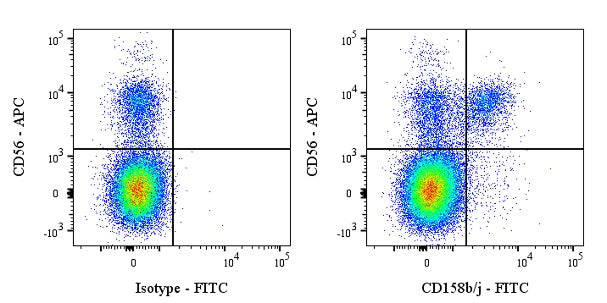
Flow cytometric analysis of human CD158b/j expression on human PBMC. Human PBMC were stained with APC Mouse Anti-Human CD56 Antibody and either FITC Mouse IgG2a, κ Isotype Control (left panel) or SDT FITC Mouse Anti-Human CD158b/j Antibody (right panel) at 5 μl/test. Flow cytometry and data analysis were performed using Agilent NovoCyte Quanteon and FlowJo™ software.
FITC Mouse Anti-Human CD158b/j Antibody (S-2917)
FITC Mouse Anti-Human CD158b/j Antibody (S-2917)
Price:
Regular price
$135 USD
Regular price
Sale price
$135 USD
Unit price
per
For shipping services or bulk orders, you may request a quotation.
Secure checkout with

View full details
Product Details
Product Details
Product Specification
| Host | Mouse |
| Antigen | CD158b/j |
| Synonyms | CD158b1; KIR2DL2; CD158B1; NKAT2a; NKAT2b; CD158b2; KIR2DL3; CD158B2; KIRCL23; NKAT2; CD158j; KIR2DS2; CD158J; NKAT5 |
| Location | Cell membrane |
| Accession | P43627、P43628、P43631 |
| Clone Number | S-2917 |
| Antibody Type | Mouse mAb |
| Isotype | IgG2a,k |
| Application | FCM |
| Reactivity | Hu |
| Positive Sample | Human PBMC |
| Purification | Protein A |
| Concentration | 0.2 mg/ml |
| Conjugation | FITC |
| Physical Appearance | Liquid |
| Storage Buffer | PBS, 1% BSA, 0.3% Proclin 300 |
| Stability & Storage | 12 months from date of receipt / reconstitution, 2 to 8 °C as supplied |
Dilution
| application | dilution | species |
| FCM | 5μl per million cells in 100μl volume | Hu |
Background
CD158b/j, also known as Killer Cell Immunoglobulin-Like Receptor 2DL2/3 (KIR2DL2/3), is a highly polymorphic inhibitory receptor belonging to the KIR family that is primarily expressed on the surface of natural killer (NK) cells and specific T-cell subsets, where it plays a critical role in regulating immune responses by recognizing specific epitopes of Human Leukocyte Antigen (HLA)-C group 1 molecules (characterized by an asparagine at position 80). Structurally, this type I transmembrane glycoprotein features two extracellular immunoglobulin-like domains, a transmembrane region, and a long cytoplasmic tail containing immunoreceptor tyrosine-based inhibitory motifs (ITIMs); upon binding to its HLA-C ligand on healthy self-cells, these ITIMs become phosphorylated and recruit phosphatases such as SHP-1 or SHP-2 to dampen downstream activating signaling cascades, thereby preventing NK cell-mediated cytotoxicity and cytokine release against normal tissues. The "b/j" designation reflects the complex genetic variation and serological cross-reactivity often observed between the KIR2DL2 and KIR2DL3 gene products, which share significant sequence homology but differ in their binding avidity and functional thresholds, making CD158b/j a pivotal checkpoint in maintaining self-tolerance, shaping NK cell education, and influencing clinical outcomes in scenarios such as viral infections, pregnancy complications, and hematopoietic stem cell transplantation where donor-recipient KIR-HLA mismatches can significantly alter graft-versus-leukemia effects or graft rejection risks.
Picture
Picture
FC