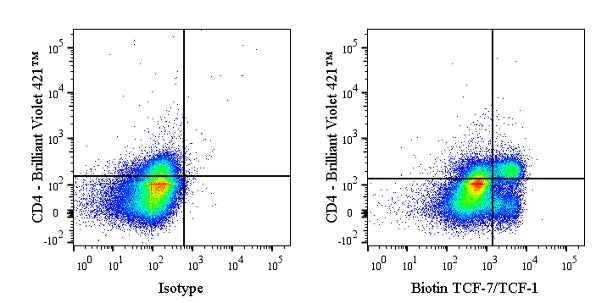
Flow cytometric analysis of TCF-7/TCF-1 expression in PBMC (Human peripheral blood mononuclear cells). Human PBMC were fixed and permeabilized with Foxp3 / Transcription Factor Staining Buffer Set. The cells were then stained with Brilliant Violet 421™ Mouse Anti-Human CD4 Antibody and either Biotin Mouse IgG1, κ Isotype Control (left panel) or SDT Biotin Mouse Anti-Human TCF-7/TCF-1 Antibody at 5 μl/test followed by Sav-PE. Total viable cells, as determined by Fixable Viability Dye 515 (S0D0013), were used for analysis. Flow cytometry and data analysis were performed using BD FACSymphony™ A1 and FlowJo™ software.
Biotin Mouse Anti-Human/Mouse TCF-7/TCF-1 Antibody (S-4484)
Biotin Mouse Anti-Human/Mouse TCF-7/TCF-1 Antibody (S-4484)
Price:
Regular price
$200 USD
Regular price
Sale price
$200 USD
Unit price
per
For shipping services or bulk orders, you may request a quotation.
Secure checkout with

View full details
Product Details
Product Details
Product Specification
| Host | Mouse |
| Antigen | TCF1/TCF7 |
| Synonyms | Transcription factor 7; T-cell-specific transcription factor 1 (T-cell factor 1; TCF-1); TCF1; TCF7 |
| Location | Nucleus |
| Accession | P36402、Q00417 |
| Clone Number | S-4484 |
| Antibody Type | Mouse mAb |
| Isotype | IgG1,k |
| Application | ICFCM |
| Reactivity | Hu, Ms |
| Positive Sample | Human PBMC |
| Purification | Protein G |
| Concentration | 0.2 mg/ml |
| Conjugation | Biotin |
| Physical Appearance | Liquid |
| Storage Buffer | PBS pH7.4, 0.03% Proclin 300 |
| Stability & Storage | 12 months from date of receipt / reconstitution, 2 to 8 °C as supplied |
Dilution
| application | dilution | species |
| ICFCM | 5μl per million cells in 100μl volume | Hu |
Background
TCF1 (T-cell factor 1), encoded by the TCF7 gene, is a 48–58 kDa sequence-specific HMG-box transcription factor and a founding member of the TCF/LEF family that serves as the primary nuclear effector of the canonical Wnt/β-catenin pathway, binding via its N-terminal β-catenin interaction domain and its central DNA-binding HMG motif to the consensus sequence 5’-(A/T)(A/T)CAAAG-3’ in promoters/enhancers of genes such as MYC, CCND1 and LEF1, thereby driving embryonic stem cell pluripotency, thymic T-cell lineage specification, CD8⁺ T-cell memory formation, and adult intestinal epithelial renewal, while its expression is dynamically regulated by alternative promoters and differential splicing to yield long (p45) and short (p33) isoforms with opposing activities; TCF1 also possesses context-dependent repressive functions when β-catenin is absent, interacts with Groucho/TLE co-repressors, and is frequently inactivated by loss-of-function mutations or deletions in colorectal, hematopoietic and other malignancies, making it both a developmental gatekeeper and a tumor suppressor.
Picture
Picture
FC