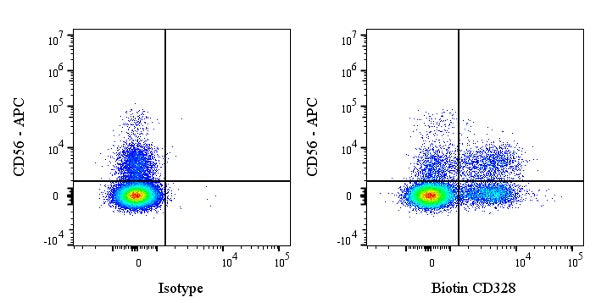
Flow cytometric analysis of human CD328 expression on human PBMC (human peripheral blood mononuclear cell). Human PBMC were stained with APC Mouse Anti-Human CD56 Antibody and either Biotin Mouse IgG1, κ Isotype Control (left panel) or SDT Biotin Mouse Anti-Human CD328 Antibody (right panel) at 5 μl/test followed by Sav-PE. Flow cytometry and data analysis were performed using Agilent NovoCyte Quanteon and FlowJo™ software.
Biotin Mouse Anti-Human CD328 Antibody (S-3029)
Biotin Mouse Anti-Human CD328 Antibody (S-3029)
Price:
Regular price
$200 USD
Regular price
Sale price
$200 USD
Unit price
per
For shipping services or bulk orders, you may request a quotation.
Secure checkout with

View full details
Product Details
Product Details
Product Specification
| Host | Mouse |
| Antigen | CD328 |
| Synonyms | Sialic acid-binding Ig-like lectin 7; Siglec-7; Adhesion inhibitory receptor molecule 1 (AIRM-1); CDw328; D-siglec; QA79 membrane protein; p75; AIRM1; SIGLEC7 |
| Location | Membrane |
| Accession | Q9Y286 |
| Clone Number | S-3029 |
| Antibody Type | Mouse mAb |
| Isotype | IgG1,k |
| Application | FCM |
| Reactivity | Hu |
| Positive Sample | Human PBMC |
| Purification | Protein G |
| Concentration | 0.2 mg/ml |
| Conjugation | Biotin |
| Physical Appearance | Liquid |
| Storage Buffer | PBS pH7.4, 0.03% Proclin 300 |
| Stability & Storage | 12 months from date of receipt / reconstitution, 2 to 8 °C as supplied |
Dilution
| application | dilution | species |
| FCM | 5μl per million cells in 100μl volume | Hu |
Background
CD328, also known as Siglec-7, is a 467-amino-acid inhibitory receptor of the CD33-related Siglec family that displays a single N-terminal V-set immunoglobulin domain for binding α2,3- and α2,6-linked sialic acids, followed by two C2-set Ig domains, a transmembrane segment and a cytoplasmic tail containing two ITIMs; expressed predominantly on NK cells, CD8⁺ T cells and monocytes, it recruits SHP-1/2 phosphatases upon engagement of sialylated glycans, thereby dampening cytotoxicity, cytokine release and cellular activation to help maintain immune tolerance.
Picture
Picture
FC