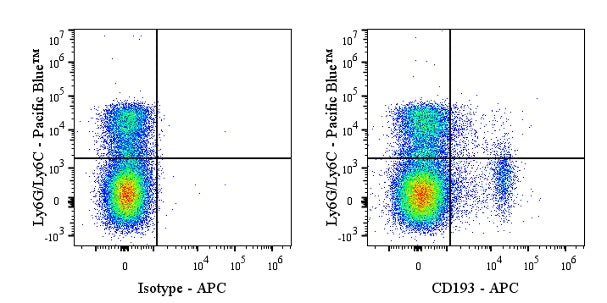
Flow cytometric analysis of mouse CD193 expression on fresh C57BL/6 mouse splenocytes. Fresh C57BL/6 mouse splenocytes were stained with Pacific Blue™ Rat Anti-Mouse Ly6G/Ly6C Antibody and either APC Rat IgG2a, κ Isotype Control (left panel) or SDT APC Rat Anti-Mouse CD193 Antibody (right panel) at 1.25 μl/test. Flow cytometry and data analysis were performed using BD FACSymphony™ A1 and FlowJo™ software.
APC Rat Anti-Mouse CD193 Antibody (S-R699)
APC Rat Anti-Mouse CD193 Antibody (S-R699)
Price:
Regular price
$200 USD
Regular price
Sale price
$200 USD
Unit price
per
For shipping services or bulk orders, you may request a quotation.
Secure checkout with

View full details
Product Details
Product Details
Product Specification
| Host | Rat |
| Antigen | CD193 |
| Synonyms | Probable C-C chemokine receptor type 3; C-C CKR-3; CC-CKR-3; CCR-3; CCR3; CKR3; Macrophage inflammatory protein 1-alpha receptor-like 2 (MIP-1 alpha RL2); Cmkbr1l2; Cmkbr3 |
| Location | Cell membrane |
| Accession | P51678 |
| Clone Number | S-R699 |
| Antibody Type | Rat mAb |
| Isotype | IgG2a,k |
| Application | FCM |
| Reactivity | Ms |
| Positive Sample | Fresh C57BL/6 mouse splenocytes |
| Purification | Protein G |
| Concentration | 0.2 mg/ml |
| Conjugation | APC |
| Physical Appearance | Liquid |
| Storage Buffer | PBS, 1% BSA, 0.3% Proclin 300 |
| Stability & Storage | 12 months from date of receipt / reconstitution, 2 to 8 °C as supplied |
Dilution
| application | dilution | species |
| FCM | 0.25μg per million cells in 100μl volume | Ms |
Background
CD193, also known as C-C motif chemokine receptor 3 (CCR3), is a member of the G protein-coupled receptor (GPCR) family, characterized by its seven-transmembrane structure. It is a high-affinity receptor for various chemokines, including eotaxin-1 (CCL11), eotaxin-2 (CCL24), eotaxin-3 (CCL26), MCP-3 (CCL7), MCP-4 (CCL13), and RANTES (CCL5). CD193 is highly expressed on eosinophils, basophils, and airway epithelial cells, and is also detected in CD4+ T cells, mast cells, monocytes, platelets, and CD34+ hematopoietic progenitor cells. This receptor plays a crucial role in mediating the migration and activation of eosinophils and other inflammatory cells, contributing to allergic responses and inflammatory processes in conditions such as asthma and allergic rhinitis. Additionally, CD193 has been identified as a co-receptor for HIV-1 entry into cells.
Picture
Picture
FC