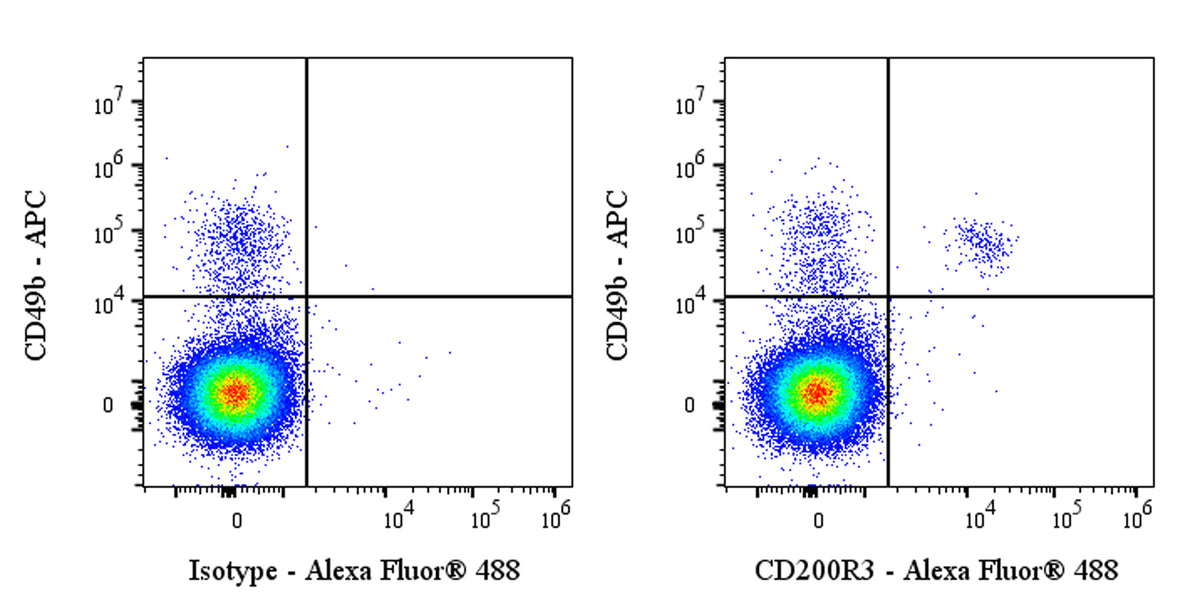
Flow cytometric analysis of mouse CD200R3 expression on C57BL/6 mouse bone marrow. C57BL/6 mouse bone marrow were stained with APC Rat Anti-Mouse CD49b Antibody and either Alexa Fluor® 488 Rat IgG2a, κ Isotype Control (left panel) or SDT Alexa Fluor® 488 Rat Anti- Mouse CD200R3 Antibody (right panel) at 2 μl/test. Flow cytometry and data analysis were performed using Agilent NovoCyte Quanteon and FlowJo™ software.
Alexa Fluor® 488 Rat Anti-Mouse CD200R3 Antibody (Ba13)
Alexa Fluor® 488 Rat Anti-Mouse CD200R3 Antibody (Ba13)
Price:
Regular price
$70 USD
Regular price
Sale price
$70 USD
Unit price
per
For shipping services or bulk orders, you may request a quotation.
Secure checkout with

View full details
Product Details
Product Details
Product Specification
| Host | Rat |
| Antigen | CD200R3 |
| Synonyms | Cell surface glycoprotein CD200 receptor 3; CD200 cell surface glycoprotein receptor-like 3 (CD200 receptor-like 3); CD200 cell surface glycoprotein receptor-like b (CD200RLb); Cell surface glycoprotein OX2 receptor 3; Cd200rlb; Cd200r3 |
| Location | Membrane |
| Accession | Q5UKY4 |
| Clone Number | Ba13 |
| Antibody Type | Rat mAb |
| Isotype | IgG2a,k |
| Isotype Control | S0B5537 |
| Application | FCM |
| Reactivity | Ms |
| Positive Sample | C57BL/6 mouse bone marrow |
| Purification | Protein G |
| Concentration | 0.5 mg/ml |
| Conjugation | Alexa Fluor® 488 |
| Physical Appearance | Liquid |
| Storage Buffer | PBS, 1% BSA, 0.09% sodium azide |
| Stability & Storage | 12 months from date of receipt / reconstitution, 2 to 8 °C as supplied |
Dilution
| application | dilution | species |
| FCM | 1μg per million cells in 100μl volume | Ms |
Background
CD200R3, also known as CD200 receptor 3 or CMRF-35-like molecule 1 (CLM-1), is an inhibitory immunoreceptor belonging to the immunoglobulin superfamily that is primarily expressed on myeloid cells such as macrophages, dendritic cells, and granulocytes. Structurally characterized by two extracellular immunoglobulin-like domains and a cytoplasmic tail containing immunoreceptor tyrosine-based inhibitory motifs (ITIMs), CD200R3 functions as a critical negative regulator of innate immune responses by binding to its ligand, CD200 (OX-2), which is widely expressed on various cell types including neurons and endothelial cells. Upon ligand engagement, the receptor's ITIMs become phosphorylated, recruiting phosphatases like SHP-1 and SHP-2 to dampen downstream signaling cascades, thereby suppressing pro-inflammatory cytokine production, limiting excessive immune activation, and maintaining tissue homeostasis, particularly in contexts such as neuroinflammation, tumor microenvironments, and the prevention of autoimmunity.
Picture
Picture
FC