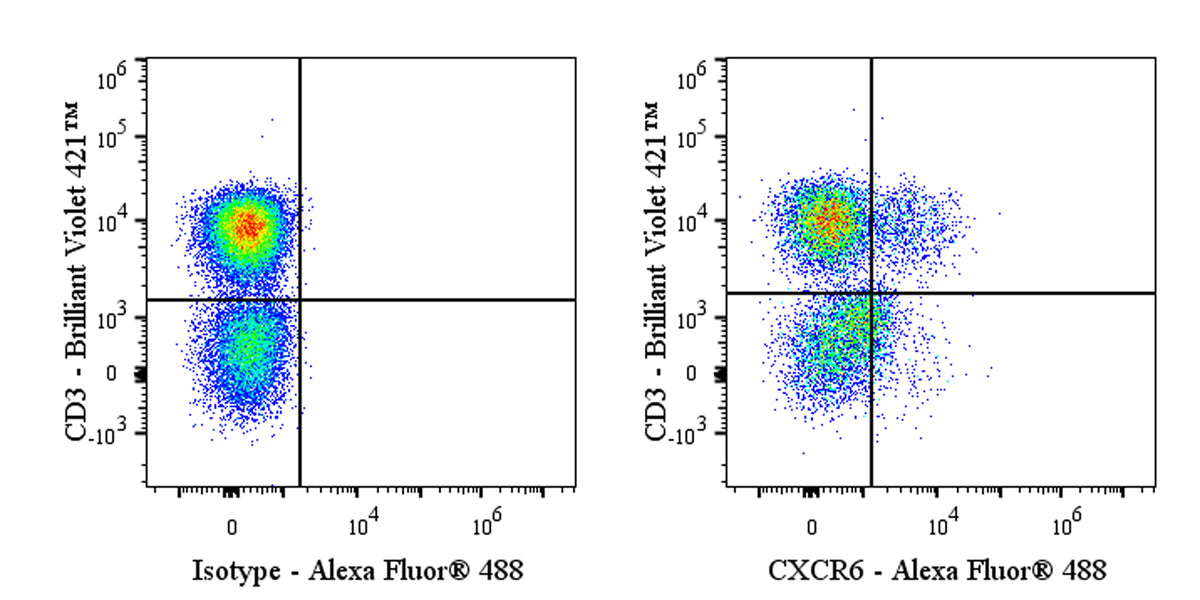
Flow cytometric analysis of human CXCR6 expression on human PBMC (human peripheral blood mononuclear cell). Human PBMC were stained with Brilliant Violet 421™ Mouse Anti-Human CD3 Antibody and either Alexa Fluor® 488 Mouse IgG2a, k Isotype Control (left panel) or Alexa Fluor® 488 Mouse Anti-Human CXCR6 Antibody (right panel) at 5 μl/test. Flow cytometry and data analysis were performed using BD FACSymphony™ A1 and FlowJo™ software.
Alexa Fluor® 488 Mouse Anti-Human CD186 (CXCR6) Antibody (S-3884)
Alexa Fluor® 488 Mouse Anti-Human CD186 (CXCR6) Antibody (S-3884)
Price:
Regular price
$210 USD
Regular price
Sale price
$210 USD
Unit price
per
For shipping services or bulk orders, you may request a quotation.
Secure checkout with

View full details
Product Details
Product Details
Product Specification
| Host | Mouse |
| Antigen | CXCR6 |
| Synonyms | C-X-C chemokine receptor type 6; CXC-R6; CXCR-6; CDw186; G-protein coupled receptor STRL33; G-protein coupled receptor bonzo; CD186; BONZO; STRL33; TYMSTR |
| Location | Cell membrane |
| Accession | O00574 |
| Clone Number | S-3884 |
| Antibody Type | Mouse mAb |
| Isotype | IgG2a,k |
| Application | FCM |
| Reactivity | Hu |
| Positive Sample | Human PBMC |
| Purification | Protein A |
| Concentration | 0.2 mg/ml |
| Conjugation | Alexa Fluor® 488 |
| Physical Appearance | Liquid |
| Storage Buffer | PBS, 1% BSA, 0.3% Proclin 300 |
| Stability & Storage | 12 months from date of receipt / reconstitution, 2 to 8 °C as supplied |
Dilution
| application | dilution | species |
| FCM | 5μl per million cells in 100μl volume | Hu |
Background
CXCR6 (C-X-C motif chemokine receptor 6), also known as STRL33 and T-lymphocyte-expressed seven-transmembrane domain receptor (TYMSTR), is a G protein-coupled receptor (GPCR) that specifically binds to its unique ligand CXCL16, a transmembrane chemokine that can also be cleaved to function as a soluble chemokine. CXCR6 is predominantly expressed on memory/effector T cells, natural killer T (NKT) cells, natural killer (NK) cells, and plasma cells, playing critical roles in immune cell trafficking, adhesion, and activation. The CXCR6-CXCL16 axis is essential for the recruitment and positioning of immune cells in various tissues, particularly in the liver, spleen, and inflamed sites, and has been implicated in numerous pathological conditions including chronic inflammation, autoimmune diseases, infectious diseases, and cancer. In oncology, CXCR6 expression on tumor-infiltrating lymphocytes (TILs) is associated with improved prognosis in certain cancers, while its expression on tumor cells can promote metastasis and disease progression. The receptor signals primarily through Gαi proteins, activating downstream pathways such as PI3K/AKT, MAPK/ERK, and calcium mobilization, thereby regulating cell migration, survival, and proliferation. Given its selective expression on activated immune cells and its involvement in disease pathogenesis, CXCR6 represents an attractive therapeutic target for immunomodulatory strategies and precision medicine approaches.
Picture
Picture
FC