
Human ABHD5 ELISA Kit
Human ABHD5 ELISA Kit
Price:
Regular price
$368 USD
Regular price
Sale price
$368 USD
Unit price
per
For shipping services or bulk orders, you may request a quotation.
Secure checkout with

View full details
Product Details
Product Details
Product Specification
| Usage |
1. Self-provided test equipment required for the experiment: 1. microplate reader ( 450nm ) 2. High-precision sampler and gun head: 0.5-10μL, 2-20μL,20-200μL ,200-1000μL 3. 37℃ incubator 4. Distilled or deionized water II. Sample processing and requirements: 1. Serum: Whole blood samples collected in serum separation tubes were placed at room temperature 2 Hours or 4℃ overnight, and then 1000×g centrifugation 20 Minutes, take the supernatant, or place the supernatant in -20℃ Or -80℃ Preserve, but repeated freezing and thawing should be avoided. 2 . Plasma: use EDTA Or heparin as an anticoagulant to collect specimens, and the specimens after the collection 30 Within minutes at 2-8℃ 1000×g centrifugation 15 Minutes, take the supernatant to detect, or place the supernatant in -20℃ Or -80℃ Preserve, but repeated freezing and thawing should be avoided. 3. Tissue homogenate: With pre-cooled PBS (0.01M , pH=7.4) The tissue was rinsed, residual blood was removed (lysed red blood cells in the homogenate affected the measurements), and the tissue was sheared after weighing. Combine the shredded tissue with the corresponding volume of PBS (generally based on 1:9 The weight-to-volume ratio of, such as 1g The tissue sample corresponds to 9mL of PBS The specific volume can be appropriately adjusted according to the experimental needs and recorded. Recommended in PBS Add protease inhibitor into a glass homogenizer and grind thoroughly on ice. To further lyse tissue cells, the homogenate can be ultrasonically disrupted, or repeatedly freeze-thawed. Finally, the homogenate was added to 5000×g centrifugation 5~10 Minutes, take the supernatant for detection. 4 . Cell culture supernatant or other biological specimen: Please 1000×g centrifugation 20 Minutes, take the supernatant to detect, or place the supernatant in -20℃ Or -80℃ Preserve, but repeated freezing and thawing should be avoided. Note: Hemolysis of specimens will affect the final test results, so hemolysed specimens are not suitable for this test. III. Preparation before testing: 1. The kit should be taken out of the refrigerated environment and equilibrated at room temperature before use. 2.20× Dilution of wash buffer: Distilled water 1 : 20 Dilution, i.e. 1 portions 20× Wash buffer plus 19 Parts of distilled water. IV. Operation steps: 1. Equilibration from room temperature 20min Take out the required slats from the aluminum foil bag, seal the remaining slats with a ziplock bag and put them back 4℃ 。 2. Set up standard wells and sample wells, and add standards of different concentrations to each standard well 50μL 。 3. Adding the sample to be tested into the sample well 50μL ; Blank holes are not added. 4. Except for blank wells, horseradish peroxidase was added to each well of standard and sample wells ( HRP ) Labeled detection antibody 100μL Sealing the reaction hole with a sealing film, 37℃ Water bath or incubator incubation 60min 。 5. Discard the liquid, pat dry on absorbent paper, and fill each well with washing liquid ( 350μL ), stand 1min Throw off the washing liquid, pat dry on the absorbent paper, and repeat washing the plate 5 Time (plate washer can also be used to wash the plate). 6. Add substrate per well A 、 B Each 50μL , 37℃ Incubation dark from light 15min 。 7. Adding stop solution per well 50μL , 15min Inside, in 450nm The wavelength of each well was measured OD Value. V. Calculation of experimental results: Based on the tested standard OD The value is the abscissa, and the concentration value of the standard is the ordinate. Draw the standard curve on the coordinate paper or using relevant software, and obtain the linear regression equation. OD Values were substituted into the equation to calculate the concentration of the sample. 1. Specificity: does not cross-react with other soluble structural analogs. 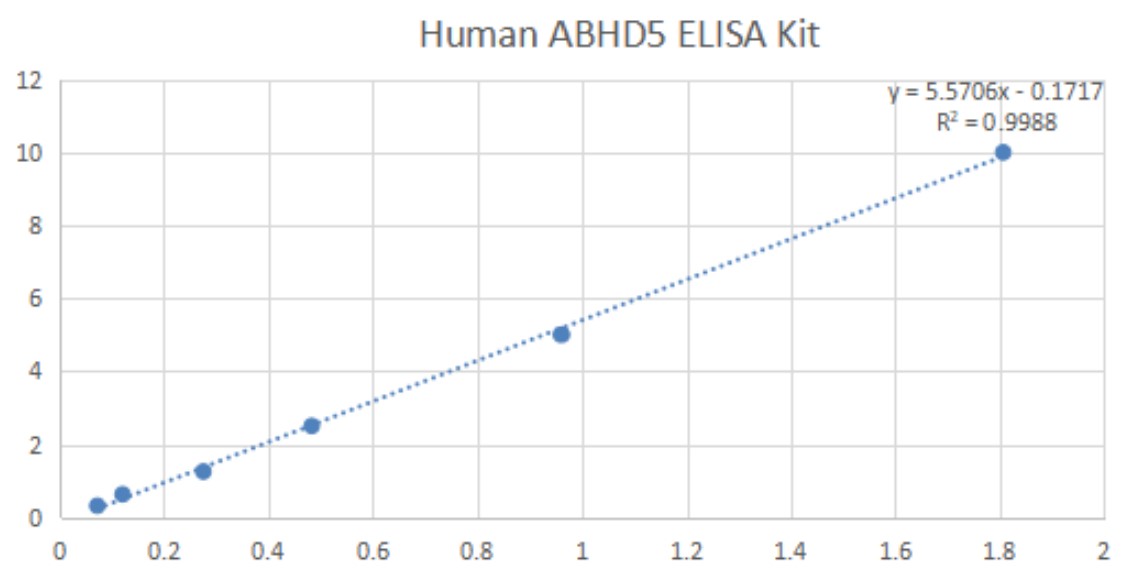 VI. Kit performance: 2. Repeatability: Intraplate coefficient of variation is less than 10% The inter-plate coefficient of variation is less than 15% 。 |
|||||||||||||||||||||||||||||||||
| Sensitivity | Minimum detection concentration less than 0.1 ng/mL | |||||||||||||||||||||||||||||||||
| Theory | The kit uses double antibody one-step sandwich enzyme-linked immunosorbent assay (ELISA). Specimens, standards, and HRP-labeled detection antibodies were sequentially added to coated microwells previously coated with human α β hydrolase domain protein 5 (ABHD5) capture antibodies, incubated and washed thoroughly. Color was developed with the substrate TMB, which was converted to blue under the catalysis of peroxidase and to final yellow under the action of acid. The shade of color was positively correlated with the human αβ hydrolase domain protein 5 (ABHD5) in the sample. The absorbance (OD value) was measured with a microplate reader at a wavelength of 450 nm and the sample concentration was calculated. | |||||||||||||||||||||||||||||||||
| Synonym | Human Alpha beta hydrolase domain protein 5 ELISA Kit | |||||||||||||||||||||||||||||||||
| Detection Type | Double antibody sandwich method | |||||||||||||||||||||||||||||||||
| Composition |
1 The concentration of the standard is: 10 、 5 、 2.5 、 1.25 、 0.625 、 0.3125 ng/mL 。 2 After a large number of normal specimens are tested, the normal concentration values of the specimens are within the detection range provided by the kit, and they are taken directly during the experiment 50μL Just load the sample. When some sample values exceed the maximum standard concentration, the sample may be appropriately diluted with the sample diluent before performing the experiment. |
|||||||||||||||||||||||||||||||||
| General Notes | 1. Incubate strictly according to the specified time and temperature to ensure accurate results. All reagents must reach room temperature 20-25°C prior to use. Preserve reagents in refrigeration immediately after use. 2. Incorrect washing can lead to inaccurate results. Be sure to absorb as much liquid as possible from the wells before adding the substrate. Do not allow microwells to dry out during incubation. 3. Eliminate the residual liquid and finger prints at the bottom of the board, otherwise it will affect the OD value. 4. The substrate chromogenic solution should be colorless or very light in color, and the substrate solution that has turned blue cannot be used. 5. Avoid cross-contamination of reagents and specimens to avoid wrong results. 6. Avoid direct exposure to strong light during storage and incubation. 7. After balancing to room temperature, open the sealed bag to prevent water droplets from condensing on the cold slats. 8. Any reaction reagent cannot contact the bleaching solvent or the strong gas emitted by the bleaching solvent. Any bleaching ingredient will destroy the biological activity of the reaction reagents in the kit. 9. Can't use expired products. 10. If it is possible to spread diseases, all samples should be managed well, and the samples and detection devices should be processed according to the prescribed procedures. 11. The final experimental results are closely related to the effectiveness of the reagents, the relevant operations of the experimenters and the experimental environment at that time. Please be sure to prepare sufficient specimen backup. 12. Different batches of the same product may have slight differences. 13. Only by using all the supporting reagents of this kit can the detection effect be guaranteed, and products from other manufacturers cannot be mixed. The best test results will be obtained only if the experimental instructions of this kit are strictly followed. 14. Our company is only responsible for the kit itself, not for the sample consumption caused by the use of the kit. Users are requested to fully consider the possible usage of samples before use and reserve sufficient samples. 15. Tissue homogenate or cell extract prepared by chemical lysis solution may cause deviation in ELISA experimental results due to the introduction of certain chemicals. 16. If the sample is a cell culture supernatant, it may not be detected because there are many interfering factors in this type of sample, such as cell status, cell number, sampling time, etc. 17. Certain natural proteins or recombinant proteins, including prokaryotic and eukaryotic recombinant proteins, may not be detected because they do not match the detection antibodies and capture antibodies used in this product. 18. This kit is only for scientific research and may not be used for clinical diagnosis. |
|||||||||||||||||||||||||||||||||
| Storage Temp. | Storage condition: 2-8℃, shelf life: 6 months | |||||||||||||||||||||||||||||||||
| Test Range | 0.3125 ng/mL – 10 ng/mL | |||||||||||||||||||||||||||||||||
| Applications | Serum, plasma, tissue homogenates and related fluid samples |