
HA-tag ELISA Kit
HA-tag ELISA Kit
Price:
Regular price
$368 USD
Regular price
Sale price
$368 USD
Unit price
per
For shipping services or bulk orders, you may request a quotation.
Secure checkout with

View full details
Product Details
Product Details
Product Specification
| Usage |
I. Self-provided test equipment required for the experiment: 1. microplate reader ( 450nm ) 2. High-precision sampler and gun head: 0.5-10μL 、 5-50μL 、 20-200μL 、 200-1000μL 3. 37℃ incubator 4. Distilled or deionized water II. Sample processing and requirements: Recombinant protein III. Preparation before testing: 1. Please advance 10 Minutes Remove the kit from the refrigerator and equilibrate to room temperature. 2. Preparation of standard gradient working solution: Add 1mL Universal diluent into lyophilized standard , stand 15 Minutes until it is completely dissolved and then gently mix (concentration of 3000ng/mL ), followed by the following concentrations: 3000ng/mL ,1500ng/mL,750ng/mL,375ng/mL,187.5ng/mL,93.75ng/mL, 46.875ng/mL, 0ng/mL Dilution was performed. Double ratio dilution method: take 7 branch EP Tubes, each tube added 500μL Universal diluent, 3000ng/mL Pipette from the standard working fluid 500μL To the first branch EP Mix well in tube to prepare 1500ng/mL Follow this procedure to suck and mix the standard working solution. The last tube is directly used as a blank hole, and there is no need to draw liquid from the penultimate tube, as shown in the following figure. 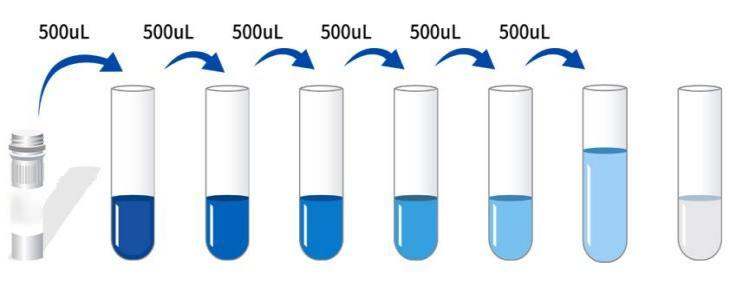 4.Preparation of working solution of enzyme conjugate : Before use 15 Minutes will 100x The enzyme conjugate was concentrated in 1000×g centrifugation 1 minute In a general diluent, 100× concentrate HRP The enzyme conjugate is diluted to 1× Working concentration (Example: 10μL Concentrate +990μL Universal diluent) for same-day use. 5. 1× Washing liquid preparation: Take 10mL 20× Washing liquid to 190mL In distilled water (the concentrated washing liquid taken out of the refrigerator may have crystals, which is a normal phenomenon. It can be left at room temperature and prepared after the crystals are completely dissolved). IV. Operation steps: 1. Equilibration from room temperature 10 After a minute, take out the required slats from the aluminum foil bag, and seal the remaining slats with a ziplock bag and put them back 4℃ 。 2. Adding samples: the samples or standards of different concentrations are separately adjusted according to 50μL Each well was added to the corresponding well, blank wells were added 50μL Universal dilution, followed by each well 50μL Biotin- Antibody working fluid. After covering the sealing plate film 37℃ Incubation 1 Hours. (Recommendation: Minimum dilution of sample to be tested with universal diluent 1 Then add the enzyme label plate for testing, thereby reducing the error of the matrix effect on the test result Influence, and finally, the sample concentration needs to be multiplied by the corresponding dilution factor. All samples to be tested and standards are recommended to set up double wells in the test). 3. Wash the plate: discard the liquid and add each well 300μL 1x Washing liquid, stand 1 Minutes, throw off the washing liquid, pat dry on absorbent paper, and repeat washing the plate 3 Time (plate washer can also be used to wash the plate). 4. Enzyme-adding conjugate working solution : Add enzyme conjugate working solution per well 100μL After covering the sealing plate film 37℃ Incubation 30 Minutes. 5. washing plates : Discard the liquid according to the procedure 3 Washing Method , washing the plate 5 Twice. 6. Add substrate: add substrate per well ( TMB ) 90μL Covered with a sealing film, 37℃ Incubation in the dark 15 Minutes. 7. Adding stop solution: Take out the enzyme label plate and directly add stop solution to each well 50μL , immediately at 450nm The wavelength of each well was measured OD Value. V. Calculation of experimental results: Result Judgment: 1. Calculate the average of standard and sample double wells OD Value and subtract the blank well's OD Value as a correction value. Taking the concentration as the abscissa, OD The value is the ordinate , draw a standard curve of a four-parameter logistic function on double logarithmic paper. 2. If the sample OD If the value is above the upper limit of the standard curve, the test should be retested after appropriate dilution and multiplied by the corresponding dilution factor when calculating the sample concentration. 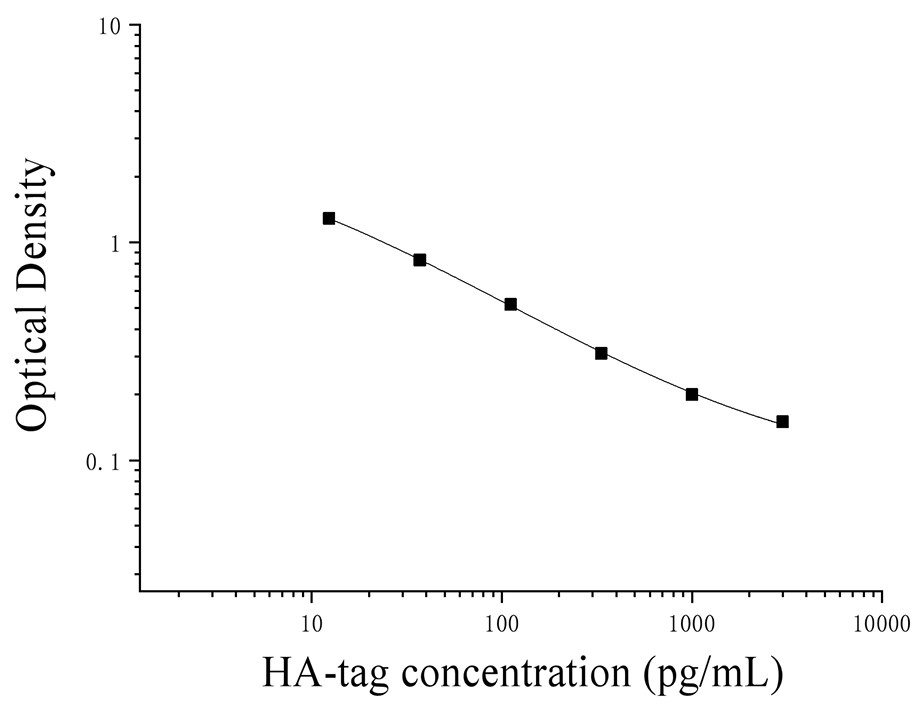 |
|||||||||||||||||||||||||||||||||
| Sensitivity | 6.17ng/mL | |||||||||||||||||||||||||||||||||
| Theory | This kit uses competitive enzyme-linked immunosorbent assay (ELISA). Sample, standard, Biotin-labeled antibody, HRP enzyme conjugate were sequentially added to microwells pre-coated with hemagglutinin-tag (HA-tag) antigen, incubated and washed in between, and developed color with substrate TMB, which was converted to blue under the catalysis of peroxidase (HRP) and to final yellow under the action of acid. The shade of color was inversely correlated with the hemagglutinin tag (HA-tag) in the sample. The absorbance (OD value) was measured with a microplate reader at a wavelength of 450 nm and the sample concentration was calculated. | |||||||||||||||||||||||||||||||||
| Source | Universal | |||||||||||||||||||||||||||||||||
| Synonym | Generl Hemagglutinin tag(HA-tag)ELISA Kit | |||||||||||||||||||||||||||||||||
| Detection Type | Competition law | |||||||||||||||||||||||||||||||||
| Composition |
|
|||||||||||||||||||||||||||||||||
| Background | Hemagglutinin tag (HA-tag) is a 9-amino acid polypeptide derived from residues 90-106 of HA molecule of human influenza virus. It is a surface glycoprotein with a molecular weight of about 63 kDa associated with human virus infection cells. It is widely used as an epitope tag in expression vectors, which facilitates the detection, isolation and purification of proteins. Many recombinant proteins can express the HA tag because it does not interfere with the biological activity or biodistribution of the protein. | |||||||||||||||||||||||||||||||||
| General Notes | 1. Incubate strictly according to the specified time and temperature to ensure accurate results. All reagents must reach room temperature 20-25°C prior to use. Preserve reagents in refrigeration immediately after use. 2. Incorrect washing may lead to inaccurate results. Be sure to absorb as much liquid as possible from the wells before adding the substrate. Do not allow microwells to dry out during incubation. 3. Eliminate the residual liquid and finger prints at the bottom of the board, otherwise it will affect the OD value. 4. The substrate chromogenic solution should be colorless or very light in color, and the substrate solution that has turned blue cannot be used. 5. Avoid cross-contamination of reagents and specimens to avoid wrong results. 6. Avoid direct exposure to strong light during storage and incubation. 7. Any reaction reagent cannot contact the bleaching solvent or the strong gas emitted by the bleaching solvent. Any bleaching ingredient will destroy the biological activity of the reaction reagents in the kit. 8. Expired products cannot be used, and components with different item numbers and batch numbers should not be mixed. 9. Recombinant proteins from sources other than the kit may not match the antibodies of this kit and not be recognized. 10. If it is possible to spread diseases, all samples should be managed well, and the samples and detection devices should be processed according to the prescribed procedures. |
|||||||||||||||||||||||||||||||||
| Storage Temp. | Unopened kit, stored at 4°C, shelf life 6 months. | |||||||||||||||||||||||||||||||||
| Test Range | 12.34-3000ng/mL | |||||||||||||||||||||||||||||||||
| Applications | Recombinant protein |