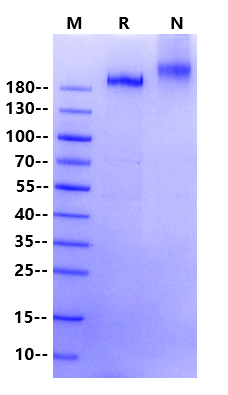
2μg (R: reducing condition, N:non-reducing condition).
PAPP-A2 His Tag Protein, Human
PAPP-A2 His Tag Protein, Human
Price:
Regular price
$320 USD
Regular price
Sale price
$320 USD
Unit price
per
For shipping services or bulk orders, you may request a quotation.
Secure checkout with

View full details
Product Details
Product Details
Product Specification
| Species | Human |
| Synonyms | Pappalysin-2, PAPPA2, PLAC3 |
| Accession | Q9BXP8 |
| Amino Acid Sequence | Ser234-Cys1396 with His Tag at the C-Terminus |
| Expression System | HEK293 |
| Molecular Weight | >180kDa (Reducing) |
| Purity | >95% by SDS-PAGE |
| Conjugation | Unconjugated |
| Tag | His Tag |
| Physical Appearance | Lyophilized powder |
| Storage Buffer | PBS, pH7.4, 5% trehalose |
| Reconstitution | Reconstitute at 0.1-1 mg/ml according to the size in ultrapure water after rapid centrifugation. |
| Stability & Storage | · 12 months from date of receipt, lyophilized powder stored at -20 to -80℃. |
| Reference | 1.Christians JK, de Zwaan DR, Fung SH. Pregnancy associated plasma protein A2 (PAPP-A2) affects bone size and shape and contributes to natural variation in postnatal growth in mice. PLoS One. 2013;8(2):e56260. |
Background
PAPP-A2 (Pregnancy-associated plasma protein-A2) is a secreted metalloproteinase belonging to the pappalysin family, whose structure comprises multiple functional domains that specifically hydrolyze insulin-like growth factor binding proteins 3 and 5 (IGFBP-3/5). By cleaving IGFBPs, PAPP-A2 releases free IGF-1, thereby precisely regulating IGF-1 bioavailability and playing a central role in fetal-placental development, postnatal linear growth, and bone metabolism. Clinical studies have demonstrated that PAPP-A2 gene mutations cause PAPP-A2 deficiency syndrome, characterized by idiopathic short stature, delayed bone age, and a distinctive biochemical phenotype of decreased free IGF-1 with elevated total IGF-1, while recombinant human IGF-1 replacement therapy can significantly improve patient growth; furthermore, abnormal placental PAPP-A2 expression is closely associated with preeclampsia, indicating that it serves not only as a critical regulator of growth and development but also as a potential biomarker for pregnancy complications.
Protocol
Assay protocol
Principle: As an active protease, recombinant human PAPP-A2 cleaves IGFBP-5 under the conditions described in Activity Assay Protocol.
Materials
1.Assay Buffer: 50 mM Tris, pH 8.0
2.PAPP-A2 His Tag Protein, Human
3.Human IGFBP5 Protein, His Tag (S0A0185)
4.4-20% SDS-PAGE gel
5.5×reducing SDS-PAGE gel buffer
6.SDS-PAGE
Produce
1. Dilute rhPappalysin-2 to 40 µg/mL in Assay Buffer.
2. Dilute rhIGFBP-5 to 200 µg/mL in Assay Buffer (Note: Acetonitrile interferes with assay, dry down rhIGFBP-5 and reconstitute at
200 µg/mL with Assay Buffer if necessary).
3. Combine equal volumes of 40 µg/mL rhPappalysin-2 and 200 µg/mL rhIGFBP-5. Include two blank controls containing Assay Buffer in place of rhPappalysin-2.
4. Incubate reaction vials and one control at 37 °C overnight. Keep the other control at -20 °C during the overnight incubation period.
5. Combine 20 µL from each reaction vial with 5µL 5×reducing SDS-PAGE gel buffer.
6. Analyze the cleavage by SDS PAGE (load 20 µL/lane) followed by protein staining.
Picture
Picture
SDS-PAGE